

The hospitality industry depends on people. Friendly front desk teams, quick support staff, and helpful service teams shape every guest’s stay. But many hotels and resorts are facing a real challenge today: there are not enough staff members to handle the growing number of guest questions and service requests.
This shortage does not only affect daily operations. It also affects guest satisfaction, response times, and overall service quality. Long waits for simple answers, missed booking chances, and tired teams are becoming more common.
Here is where AI chatbots are quietly changing the way hotels work. Without replacing human teams, these digital assistants take care of many routine tasks and help hotels keep service running smoothly. Below are five practical ways AI chatbots are helping hotels manage labor shortages, based only on how this technology works in real hospitality settings.
Why Labor Shortages Are Hitting Hotels So Hard
Hotels deal with guest requests all day and night. These requests are often simple but frequent:
- Check-in and check-out times
- Room details and amenities
- Booking questions
- General hotel policies
When staff numbers are low, these repeated questions can overload front desks and call centers. This creates a cycle:
- Staff become stressed
- Guests wait longer
- Service quality drops
AI chatbots step in to manage these high-volume, low-complexity tasks, allowing teams to focus on guests who need real human attention.
1. 24/7 Support Without Extra Staff Shifts
One of the biggest pressures on hotel teams is late-night and early-morning questions. Guests may arrive late, plan trips at odd hours, or need quick information before check-in.
AI chatbots provide round-the-clock guest support. This means:
- Guests get instant replies at any time
- Hotels do not need to schedule extra night staff for basic questions
- Common questions are handled without delay
Key impact on labor shortages:
- Fewer after-hours calls for staff
- Reduced pressure on night shifts
- Continuous service without hiring more people
This simple change removes a large workload from human teams, especially during quiet hours.
Hotels exploring digital support tools often start by learning how an AI Agent for hotels can support daily guest communication and reduce pressure on limited staff. Xovient ai is one example of how these tools are being used in real hospitality settings. To understand how such systems can fit into your hotel’s service flow, Contact them and explore how automated guest support can work alongside your team.
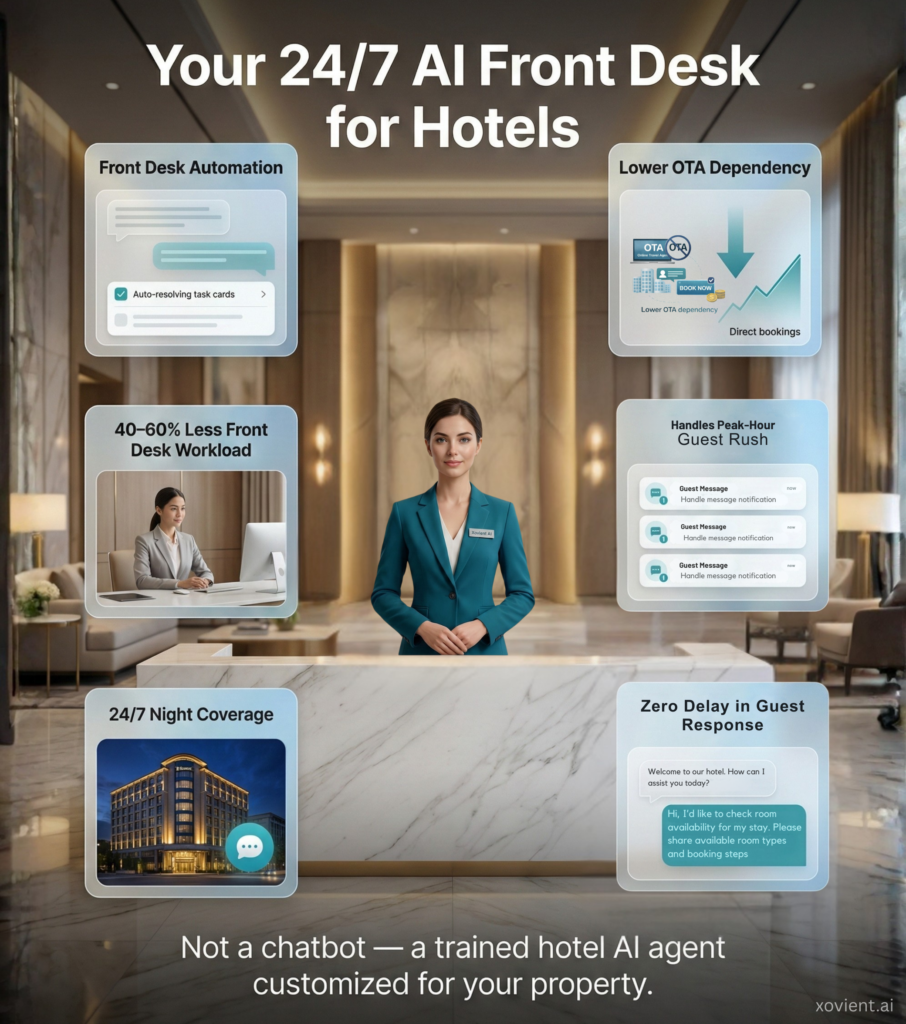
2. Handling Multiple Guest Conversations at Once
A human staff member can usually help one guest at a time. During peak seasons or busy hours, this becomes a bottleneck. Phones ring, chat windows pile up, and response times slow down.
AI chatbots can manage many conversations at the same time across website chat and messaging platforms. This changes the game for hotels with limited staff.
What this means for hotels:
- No waiting line for basic questions
- Faster replies even during busy hours
- Better first response time without adding staff
Below is a simple view of how guest load is managed with and without AI support:
| Situation | Without AI Support | With AI Support |
|---|---|---|
| Peak check-in hours | Long wait times | Instant replies |
| High message volume | Staff overwhelmed | Messages handled in parallel |
| Service consistency | Varies by staff availability | Consistent responses |
This ability to scale support instantly helps hotels survive high-demand periods with fewer people.
3. Reducing Repetitive Work for Front Desk Teams
Front desk teams often answer the same questions again and again. While these questions are important for guests, they take time and energy away from more meaningful tasks.
AI chatbots handle:
- FAQs about hotel services
- Room details
- Basic policy questions
- Reservation-related inquiries
How this helps during labor shortages:
- Staff spend less time repeating the same answers
- Teams can focus on complex guest needs
- Less burnout from routine tasks
This shift does not remove the human touch. Instead, it protects it by allowing staff to give better attention to guests who truly need personal help.
4. Supporting Guests in Multiple Languages
Hotels welcome travelers from many countries. Language barriers can slow down service and create confusion. Training staff in many languages is difficult, especially when staff numbers are already low.
AI chatbots support multilingual conversations, allowing guests to communicate in their preferred language.
Benefits for hotels facing staff shortages:
- No need to hire multilingual staff for every shift
- Fewer misunderstandings in guest communication
- Smoother service for international travelers
Here is a simple comparison of how language support changes service delivery:
| Guest Need | Human-Only Support | AI-Supported Service |
|---|---|---|
| Language variety | Limited by staff skills | Multiple languages supported |
| Response speed | Slower if translation is needed | Instant replies |
| Guest comfort | Depends on staff availability | More consistent experience |
This removes one more pressure point from hotel teams that are already stretched thin.
5. Centralizing Guest Communication for Better Team Focus
When guest messages come from many places—website chat, social apps, and messaging platforms—staff often struggle to keep track. Important requests may be delayed or missed.
AI chatbots bring all guest conversations into a single, easy-to-use system. This helps teams:
- View all guest messages in one place
- Track follow-ups more easily
- Maintain consistent communication
Why this matters during labor shortages:
- Staff waste less time switching between tools
- Fewer missed messages
- Better organization with smaller teams
Centralized chat management helps small teams work like larger ones, simply by staying organized.
How AI Chatbots Help Hotels Stay Operational During Short Staff Periods
AI chatbots do not replace hotel teams. Instead, they support them by taking care of routine communication tasks. This balance is especially important when hiring is slow or staff turnover is high.
Here is a clear view of how workload shifts when chatbots are in place:
| Task Type | Handled by Staff | Handled by AI |
|---|---|---|
| Simple guest questions | Reduced | Primary support |
| Booking guidance | Shared | Initial guidance |
| Personalized replies | Supported by data | Automated first responses |
| Complex guest needs | Main focus | Escalated to humans |
This structure helps hotels continue delivering good service even when they do not have enough people on the floor.
A Quiet Shift That Guests Are Already Feeling
Many guests may not even realize they are speaking with AI at first. They simply notice that:
- Replies are faster
- Information is clear
- Support is always available
This creates a smooth guest journey, even when behind the scenes, hotel teams are working with fewer hands.
The real story here is not about technology replacing people. It is about protecting service quality when people are hard to find. AI chatbots are becoming a safety net for hospitality teams trying to do more with less.
FAQs on AI Chat Support for Hotels
1. What is an AI assistant in a hotel?
An AI assistant is a digital tool that helps answer common guest questions, guide booking inquiries, and support hotel teams by handling routine chats across different channels.
2. Can AI assistants reply to guests at any time?
Yes, AI assistants can respond to guest questions day and night, so guests receive quick replies even outside normal front desk hours.
3. Do AI assistants replace front desk staff?
No. AI assistants handle repetitive and simple questions, while hotel staff focus on complex guest needs and personal service.
4. Can guests chat in different languages?
Yes, AI chat tools support multiple languages, which helps hotels communicate clearly with international guests.
5. Where can guests interact with hotel AI assistants?
Guests can chat with AI assistants on hotel websites, messaging apps, and social platforms, making it easy to reach the hotel from different channels.
Explore more insightful articles on gettonews
