

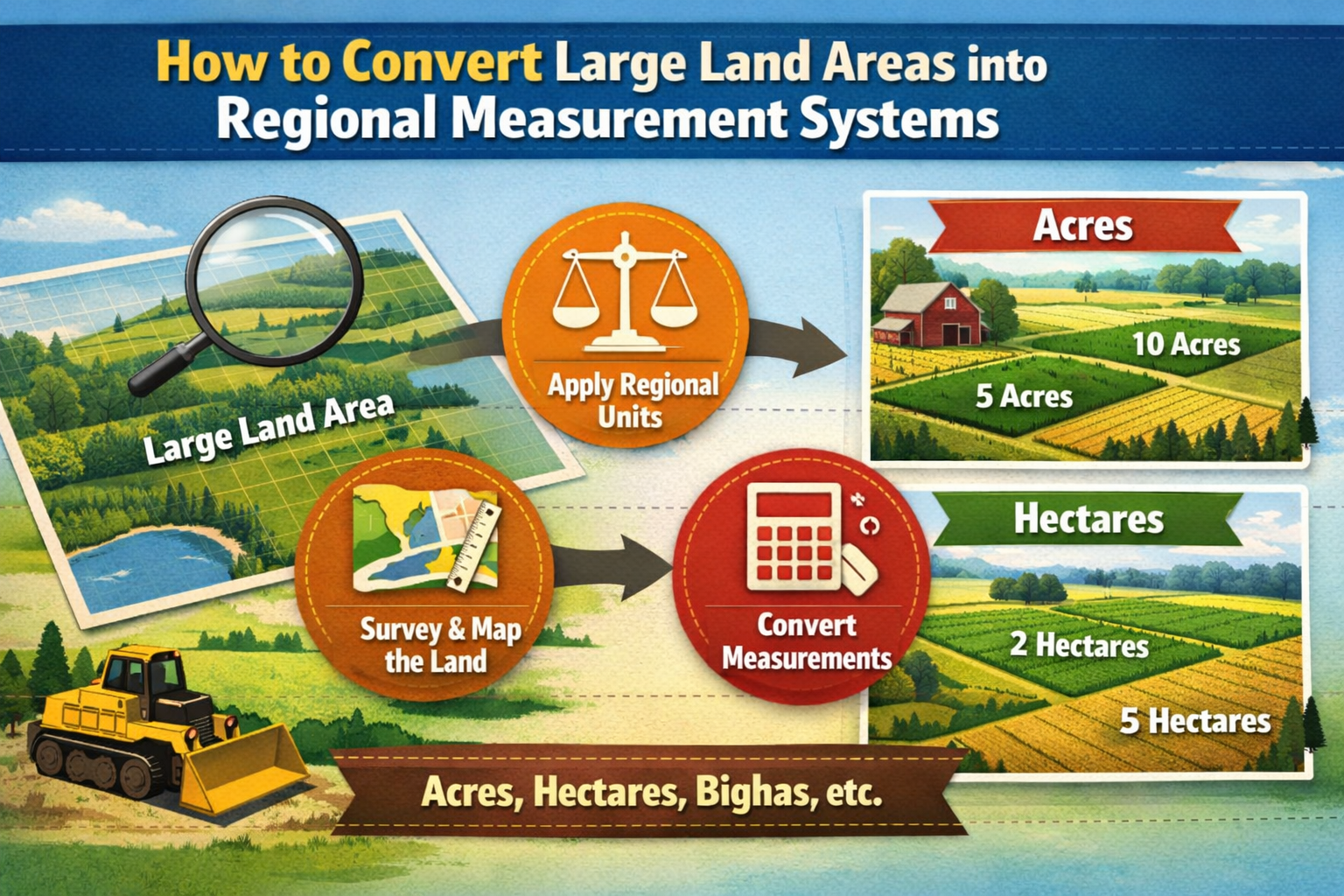
Land measurement plays a critical role in agriculture, real estate, infrastructure planning, and government documentation. However, one of the most common challenges faced by landowners, buyers, surveyors, and developers is converting large land areas into regional measurement systems. While standardized units like hectares and areas are widely used in official records, regional units such as bigha continue to dominate local transactions in many parts of India and South Asia.
Understanding how to accurately convert land measurements is not just a technical requirement—it directly affects land valuation, legal clarity, and financial decision-making. This guide explains how hectares, areas, and bigha work, why conversions are necessary, and how to perform them accurately using modern tools and best practices.
Understanding Large Land Measurement Units
Before diving into conversions, it’s important to understand the primary land measurement units commonly used for large land areas. Conversions like Hectare to Bigha are now faster and more reliable than ever, helping users bridge the gap between traditional and modern systems.
What Is a Hectare?
A hectare is a metric unit of area measurement commonly used worldwide for measuring land. It is especially popular in agriculture, forestry, and land planning.
- 1 hectare = 10,000 square meters
- 1 hectare = 2.471 acres
Hectares are widely used in official land records, government surveys, and international documentation because of their standardization and ease of calculation.
What Is an Area?
An area is another metric unit, though it is smaller than a hectare and less commonly used in everyday conversations today.
- 1 area = 100 square meters
- 100 areas = 1 hectare
Areas are often used in land surveying and urban planning, particularly when dealing with plots that are smaller than a hectare but still require metric precision.
What Is Bigha?
Bigha is a traditional land measurement unit that varies significantly from region to region. Unlike hectares and areas, bigha does not have a uniform value across India.
For example:
- In Uttar Pradesh, 1 bigha is approximately 2,500 square meters
- In Rajasthan, it may range between 1,600 to 2,500 square meters
- In West Bengal, 1 bigha is about 1,338 square meters
This regional variation is the main reason conversions involving bigha require special attention.
Why Land Conversion Is Necessary
Land conversions are essential for multiple reasons:
- Legal documentation: Government records often use hectares, while sale deeds may reference bigha
- Property transactions: Buyers and sellers need clarity to avoid disputes
- Agricultural planning: Crop yield calculations depend on accurate land size
- Infrastructure projects: Engineers and planners work with standardized units
Without accurate conversion, even small miscalculations can result in significant financial and legal consequences.
Challenges in Converting Regional Land Measurements
The biggest challenge in converting land units lies in the regional variability of traditional measurements. While hectares and areas are fixed metric units, bigha changes based on state, district, and sometimes even local customs.
This makes manual conversion risky, especially for large land parcels. A small error in conversion can multiply when dealing with tens or hundreds of hectares, leading to incorrect valuations and documentation errors.
How to Convert Hectare and Area into Bigha
Step 1: Identify the Regional Standard
Before converting, determine which regional definition of bigha applies to your land. This information can usually be obtained from:
- Local revenue offices
- Land survey records
- State land registration authorities
Step 2: Convert Area to Hectare (If Required)
If your land measurement is in areas, convert it into hectares first.
- Total areas ÷ 100 = hectares
This step simplifies further calculations.
Step 3: Convert Hectare into Regional Bigha
Once you have the hectare value, apply the regional conversion rate. Since the value of bigha differs by region, this is where most mistakes happen.
This is why many professionals rely on digital tools instead of manual formulas, especially when accuracy is critical.
Importance of Using Digital Conversion Tools
With increasing digitization of land records, online conversion tools have become essential. A reliable tool automatically factors in regional differences, reducing the risk of human error.
Using the Best Hectare to Bigha Convertor ensures:
- Accurate regional calculations
- Faster results for large land areas
- Reduced dependency on manual formulas
- Consistency across legal and financial documents
Such tools are especially useful for real estate professionals, farmers managing multiple plots, and developers working across different states.
Real-World Applications of Land Conversion
Agriculture and Farming
Farmers often receive government subsidies or agricultural loans based on hectare measurements, while local land discussions still use bigha. Accurate conversion helps farmers understand their landholdings better and make informed decisions.
Real Estate and Property Development
Property prices are often quoted per bigha in rural and semi-urban markets, while official approvals use hectares. Proper conversion avoids undervaluation or overpricing of land.
Infrastructure and Urban Planning
Large infrastructure projects such as highways, industrial zones, and smart cities require precise land measurement conversions to ensure fair compensation and efficient planning.
Best Practices for Accurate Land Conversion
To avoid costly errors, follow these best practices:
- Always confirm the regional definition of bigha
- Use standardized metric units as the base calculation
- Rely on trusted digital conversion tools
- Cross-check values with local authorities for legal documents
- Avoid assumptions when dealing with large land parcels
Using the Best Hectare to Bigha Convertor can significantly reduce confusion and ensure compliance with regional standards.
Common Mistakes to Avoid
Many people make avoidable mistakes during land conversion, such as:
- Assuming bigha has a uniform value nationwide
- Relying solely on verbal estimates
- Ignoring regional land record standards
- Using outdated conversion charts
Avoiding these errors helps protect your investment and ensures transparency in land dealings.
The Role of Technology in Modern Land Measurement
Technology has transformed how land is measured and documented. Online tools, GIS mapping, and digital land records now work together to provide accurate, real-time data.
Conclusion
Converting large land areas into regional measurement systems is no longer optional—it is a necessity in today’s interconnected real estate and agricultural landscape. Understanding the relationship between hectares, areas, and bigha empowers landowners, buyers, and professionals to make informed, confident decisions.
By recognizing regional differences, following structured conversion steps, and using reliable tools like the Best Hectare to Bigha Convertor, you can ensure accuracy, transparency, and peace of mind in every land transaction. Whether you are managing farmland, purchasing property, or planning large-scale development, accurate land conversion is the foundation of success.
