

Application development in the United States is undergoing a quiet but meaningful shift. Businesses are no longer viewing software purely as a technical asset built by engineering teams over long cycles. Instead, applications are increasingly seen as operational tools that must adapt quickly to changing workflows, compliance needs, and customer expectations. Artificial intelligence platforms are playing a central role in this transition by altering how logic, data, and automation come together inside modern systems.
As organizations look for faster ways to design internal tools and operational applications, attention has turned toward platforms that abstract complexity without reducing control. In this environment, the concept of an AI application builder without coding has emerged as a practical response to rising development costs, talent shortages, and the growing need for business-led innovation rather than purely IT-driven delivery.
The Shift From Code-Centric to Logic-Centric Development
Traditional application development has long revolved around writing and maintaining code. While this approach offers flexibility, it also introduces friction through extended timelines, dependency on specialized developers, and challenges in adapting applications once they are deployed. Artificial intelligence platforms are shifting the focus from syntax-heavy programming to logic-centric design, where workflows and decisions define how applications function.
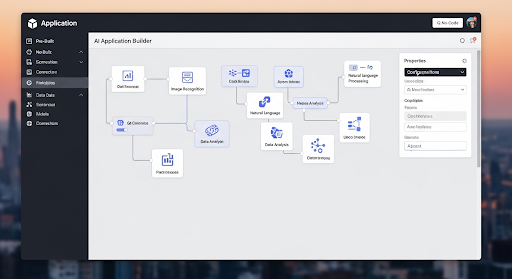
By allowing users to map processes, define rules, and connect data sources visually, these platforms reduce the distance between business intent and technical execution. AI enhances this model by interpreting patterns, optimizing workflows, and reducing the need for manual configuration. The result is a development process that feels more aligned with how organizations actually operate, rather than how software has traditionally been engineered.
Why US Organizations Are Rethinking Application Development Models
In the US market, operational agility has become a competitive requirement rather than a strategic advantage. Regulatory changes, distributed teams, and evolving customer demands mean that applications must be modified frequently and reliably. Relying solely on traditional development pipelines often slows this responsiveness.
AI-driven platforms appeal to US organizations because they support faster iteration without compromising structure. Business teams can participate directly in shaping applications, while IT retains oversight of governance and scalability. This balance is particularly valuable in enterprises where multiple departments require tailored tools that still operate within a unified system architecture.
Business-Led Application Design
One of the most notable changes introduced by AI platforms is the elevation of business users in the development process. Rather than submitting requirements and waiting for delivery, teams can now participate in building and refining applications themselves. This shortens feedback loops and ensures that the final product reflects real operational needs.
AI assists by translating high-level intent into executable logic. It can suggest workflows, flag inefficiencies, and ensure consistency across applications. This collaborative model reduces misunderstandings between business and technical teams, which have historically been a major source of project delays.
Embedded Intelligence in Workflows
Artificial intelligence platforms do more than simplify development. They embed intelligence directly into workflows, enabling applications to make contextual decisions rather than follow static rules. This capability allows systems to respond dynamically to data changes, user behavior, and operational conditions.
For organizations, this means applications that improve over time rather than degrade. Intelligent workflows can adapt to new inputs, optimize task routing, and highlight anomalies without constant manual updates. This makes applications more resilient and aligned with real-world complexity.
Reducing Dependency on Specialized Development Talent
The US technology market continues to face competition for skilled developers. AI platforms help mitigate this challenge by reducing the volume of custom code required for many applications. While expert engineers remain essential for complex integrations and architecture, everyday application development no longer needs to be bottlenecked by limited technical resources.
This shift allows organizations to allocate talent more strategically. Developers can focus on high-impact engineering challenges, while business teams handle process-oriented application creation within governed environments.
Platform Capabilities That Matter in AI-Driven Development
Not all AI platforms deliver the same value. The most effective solutions focus on operational depth rather than surface-level automation. They combine workflow orchestration, data management, and decision logic into a cohesive environment that supports real business use cases.
These platforms emphasize clarity over abstraction. Users can see how processes flow, how decisions are made, and how data moves through the system. AI enhances these capabilities by learning from usage patterns and suggesting improvements without obscuring underlying logic.
Workflow Orchestration at Scale
Scalable workflow orchestration is a foundational capability of serious AI platforms. Applications must handle variations in process paths, approvals, and exceptions without becoming brittle. AI supports this by identifying bottlenecks and optimizing task distribution based on real-time conditions. This approach is particularly relevant for US enterprises operating across regions or departments. A single platform can support diverse workflows while maintaining consistency and governance, reducing fragmentation across the organization.
Data-Driven Decision Models
Modern applications increasingly rely on data-driven decisions rather than static configurations. AI platforms enable this by integrating data sources and applying logic that adapts as conditions change. This supports more accurate and timely outcomes without requiring constant redevelopment. For organizations, this means applications that reflect current realities rather than outdated assumptions. Decisions can be refined continuously, improving reliability and trust in automated systems.
Governance Without Rigidity
One concern often raised about low-code and AI platforms is loss of control. Advanced platforms address this by embedding governance directly into the design environment. Permissions, audit trails, and version control ensure that flexibility does not compromise security or compliance. This balance is critical in regulated US industries where accountability is as important as speed. AI platforms that respect governance constraints are more likely to be adopted at scale.
Final Thoughts on Intelligent Application Platforms
Artificial intelligence platforms are reshaping application development by redefining who builds software and how systems evolve over time. By combining workflow logic, embedded intelligence, and governed flexibility, these platforms address the growing need for speed, adaptability, and operational alignment across US organizations. Applications are no longer static tools but living systems that reflect real business conditions.
In this landscape, platforms such as Workmaster illustrate how an AI no-code app builder in usa can support structured workflows, decision-driven logic, and enterprise-grade governance without sacrificing usability. As organizations continue to modernize their digital operations, intelligent application platforms are likely to become a foundational layer for building scalable, responsive, and future-ready systems.
