

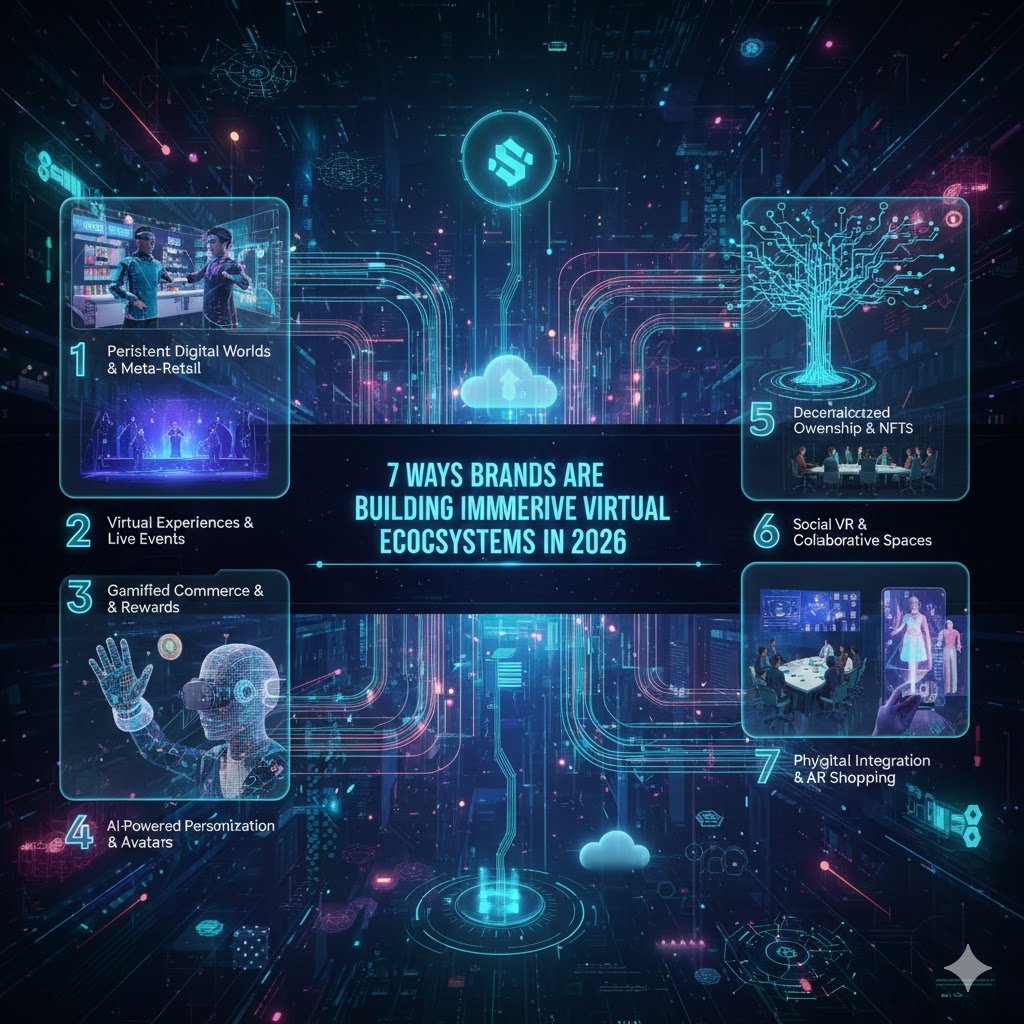
The digital world now goes beyond websites, mobile apps, and social media. In 2026, brands are investing heavily in immersive virtual ecosystems. These ecosystems mix 3D environments with real-time interaction. They also use blockchain, AI personalization, and lasting digital experiences. What began as experimental innovation has matured into a structured business strategy.
Retail, healthcare, real estate, education, entertainment, and tech companies are using immersive ecosystems. They want to boost engagement. They aim to improve retention. They seek new revenue streams and aim to build enduring digital assets.
Here are seven key strategies brands will use to create immersive virtual worlds in 2026. Solid technical and business frameworks back these strategies.
1. Creating Persistent 3D Brand Environments
The first major shift is from static digital presence to persistent virtual environments. Immersive ecosystems are different from traditional websites. They are always-on digital spaces. Users can interact, explore, and come back again and again.
These environments function:
- Virtual flagship stores
- 3D product showrooms
- Interactive training centers
- Digital campuses
- Community hubs
Persistence is the key differentiator. The system saves user data, customization, progress, and digital assets between sessions. This creates a feeling of ownership and continuity.
From a technical standpoint, this involves:
- Real-time rendering engines (Unity, Unreal Engine)
- Cloud infrastructure for scalability
- Spatial design architecture
- Cross-device compatibility (VR, AR, desktop, mobile)
Brands are no longer building pages — they are building destinations.
2. Integrating Commerce Directly Into Virtual Spaces
In 2026, immersive ecosystems have a direct connection to revenue generation. Virtual commerce has evolved from novelty to scalable infrastructure.
Brands are implementing:
- 3D product interaction before buying
- Virtual try-on technology
- Digital twins of physical products
- Tokenized assets and NFTs
- Integrated payment gateways within 3D spaces
Instead of redirecting users to checkout pages, transactions happen inside the immersive environment. This reduces friction and increases engagement time.
The strategic advantage is higher purchase confidence. When customers engage with products in person, conversion rates often rise. This happens because the experience lowers uncertainty.
For B2B companies, immersive commerce means virtual trade shows. It also includes product demos. Investor presentations happen, too. All takes place in unique digital spaces.
3. Leveraging AI for Personalized Virtual Experiences
Personalization now extends beyond recommendation engines, with AI shaping entire immersive journeys. A leading metaverse development service integrates intelligent automation, real-time analytics, and adaptive environments to deliver hyper-personalized virtual experiences that boost engagement, retention, and measurable business growth.
Brands are using artificial intelligence to:
- Adapt environments based on user behavior
- Offer intelligent virtual assistants
- Deliver contextual product suggestions
- Change digital environments in response to changing conditions
- Automate onboarding and guidance
A returning user might see a personalized showroom layout. Their past interactions form the basis for this. AI-driven avatars can guide customers through product exploration or training modules.
This level of personalization increases retention and builds emotional connection. Users explore adaptive digital worlds that fit their behavior patterns, not generic environments.
AI integration requires:
- Behavioral analytics systems
- Machine learning models
- Real-time data processing
- Secure identity management
Immersive ecosystems are no longer static; they are intelligent.
4. Building Community-Driven Virtual Spaces
In 2026, brands recognize that ecosystems thrive on community participation. The focus has shifted from audience consumption to collaborative interaction.
Successful immersive ecosystems incorporate:
- Live events and product launches
- Multiplayer interaction
- Virtual networking spaces
- User-generated content capabilities
- Digital loyalty programs
Community mechanics increase engagement depth. Users interact not only with the brand but also with each other, creating network effects.
For example:
- Educational platforms host live 3D seminars
- Retail brands organize virtual fashion shows
- Real estate developers provide collaborative property walkthroughs
- Healthcare companies create patient engagement hubs
The long-term value lies in ecosystem stickiness. When users connect socially online, churn rates experience a large decline.
5. Implementing Blockchain for Digital Ownership
Ownership and authenticity are major drivers of immersive ecosystem growth. Blockchain technology enables secure digital asset management within virtual spaces.
Brands are implementing:
- NFT-based product ownership
- Tokenized access passes
- Secure digital identities
- Smart contract-enabled transactions
- Virtual asset marketplaces
Digital ownership increases perceived value. When users have assets in an ecosystem, they engage more. This includes digital fashion, event passes, and exclusive experiences.
For brands, blockchain provides:
- Transparent transaction history
- Fraud prevention
- Royalty automation
- Decentralized authentication
This creates new monetization models beyond traditional e-commerce. Virtual goods, digital memberships, and exclusive access rights become long-term revenue streams.
6. Developing Cross-Platform and Device Compatibility
An immersive ecosystem cannot restrict itself to a single device. In 2026, accessibility defines scalability.
Brands are ensuring compatibility across:
- VR headsets
- AR-enabled mobile devices
- Desktop browsers
- Gaming consoles
- Tablets and smartphones
Developers achieve this cross-platform functionality through modular development architecture and cloud-based infrastructure.
The goal is seamless experience continuity. A user can check out a 3D showroom on desktop, switch to mobile, and join a live VR event—all in one place.
From a development perspective, this requires:
- Optimized rendering pipelines
- Low-latency server systems
- Responsive 3D frameworks
- Edge computing integration
Scalability and accessibility are now competitive advantages.
7. Aligning Immersive Infrastructure With Long-Term Business Strategy
Forward-thinking brands see immersive ecosystems as essential infrastructure, not experiments.
In 2026, we align immersive development with:
- Digital transformation strategies
- Customer lifecycle optimization
- Brand positioning
- Data acquisition and analytics
- Omnichannel integration
Immersive ecosystems connect to CRM systems. They also link to marketing automation platforms, ERP software, and analytics dashboards.
The result is measurable ROI.
Brands track:
- Engagement duration
- Conversion metrics
- Virtual asset sales
- User retention rates
- Behavioral heatmaps
Immersive environments are no longer creative experiments; they are performance-driven digital assets.
Why Immersive Ecosystems Matter in 2026
Three macro trends drive the shift toward immersive digital infrastructure:
- Increasing demand for experiential interaction
- Advancements in real-time rendering and AI technologies
- Growth in digital asset economies
Consumers expect interactive, engaging experiences rather than passive browsing. Enterprises seek new revenue channels and competitive differentiation.
Immersive ecosystems offer both.
They combine:
- Engagement
- Ownership
- Commerce
- Community
- Data intelligence
into one unified digital framework.
Industries Leading the Adoption Curve
Several industries are accelerating adoption in 2026:
Retail and Fashion
Virtual storefronts, digital wearables, immersive product showcases.
Real Estate
Interactive 3D property tours and investment visualization platforms.
Education
Virtual campuses, simulation-based learning, interactive classrooms.
Healthcare
Patient engagement hubs, medical training simulations, wellness communities.
Enterprise and B2B
Virtual conferences, product demonstrations, and remote collaboration spaces.
These industries recognize immersive ecosystems as scalable growth infrastructure.
Key Considerations Before Building an Immersive Ecosystem
While the opportunity is significant, successful implementation requires strategic planning.
Brands must check:
- Clear business objectives
- Target audience behavior
- Technical infrastructure readiness
- Data security compliance
- Long-term scalability
Immersive ecosystems need collaboration between designers, developers, strategists, and data analysts.
Badly designed virtual environments lead to low adoption and high abandonment rates. Thus, strategic development and structured execution are critical.
The Role of Professional Development Expertise
Building immersive ecosystems involves:
- 3D environment design
- Blockchain integration
- AI personalization systems
- Backend architecture
- Real-time synchronization
- UI/UX optimization
- Security frameworks
Partnering with experienced development teams ensures technical reliability and performance optimization.
An effective immersive infrastructure balances creativity with scalability, innovation with measurable ROI.
The Future Outlook
In 2026 and beyond, immersive ecosystems will continue evolving toward:
- Hyper-realistic rendering
- Advanced haptic interaction
- Decentralized identity systems
- AI-generated dynamic worlds
- Spatial commerce optimization
The brands investing today are positioning themselves for long-term digital leadership.
Immersive ecosystems aren’t replacing traditional digital channels. Instead, they’re expanding them through advanced technology. These new environments are interactive, persistent, and designed to generate sustainable revenue streams.
Final Thoughts
The evolution of digital interaction is accelerating. Brands that once relied on websites and apps are now building immersive ecosystems. These combine commerce, community, personalization, and ownership in unified 3D spaces.
The seven strategies reveal a clear pattern. In 2026, developers will structure immersive ecosystems to be scalable and performance-focused.
They are not speculative experiments. They are strategic digital infrastructure.
Organizations that emphasize immersive development and set clear goals will have an edge. Strong tech skills will boost their advantage in the future.
The future of brand engagement is no longer two-dimensional.
It is immersive, intelligent, persistent, and built for scale.
