

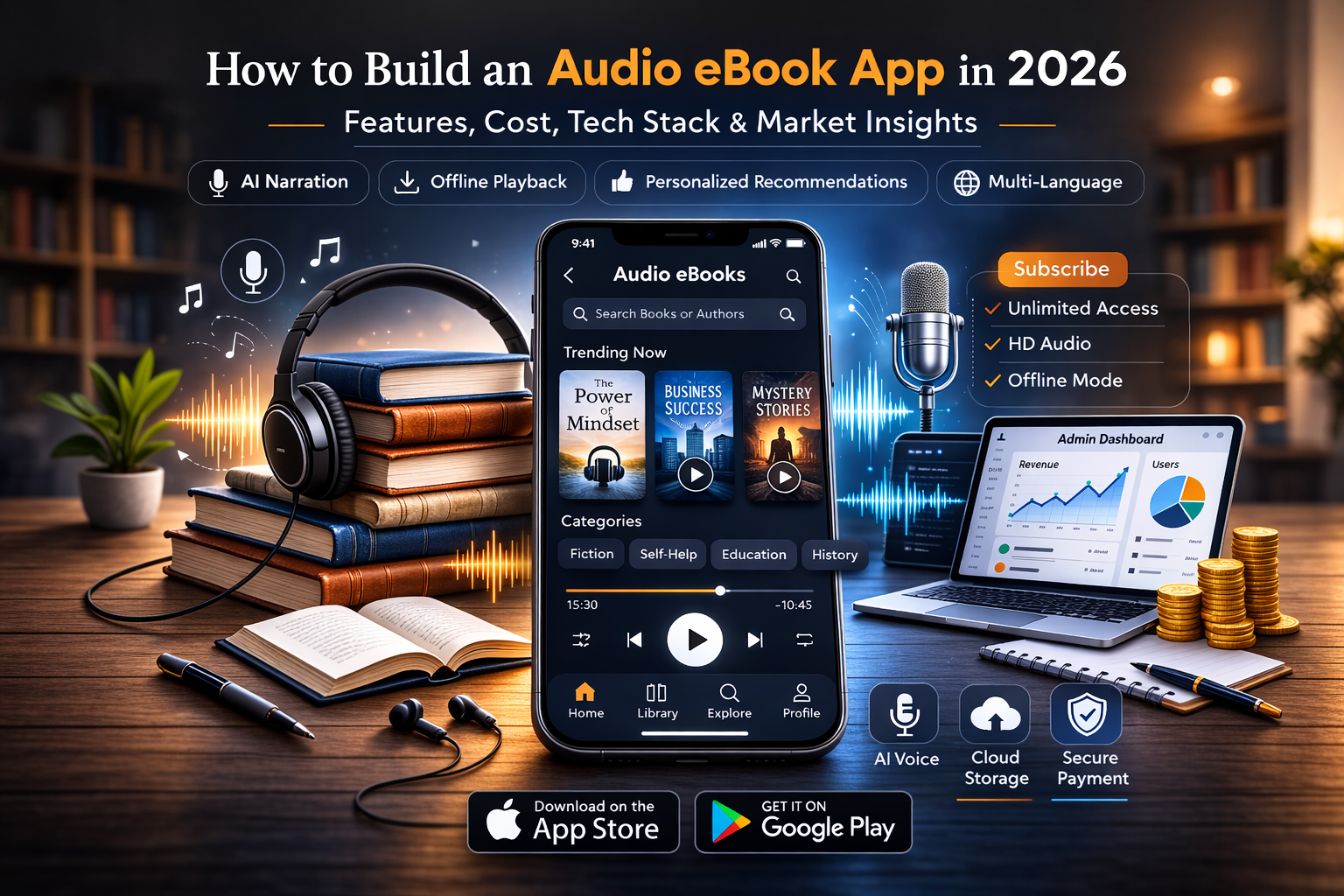
The global digital publishing ecosystem is rapidly evolving, and audio consumption has become a dominant content format. With the rise of multitasking lifestyles, smart devices, and AI-powered personalization, audio eBooks are no longer a niche product. They are a mainstream digital service competing alongside video streaming and music platforms.
In 2026, launching an audio platform is not just about uploading narrated books. It requires advanced personalization, seamless cross-device streaming, offline capabilities, AI narration support, subscription models, and intelligent analytics. Businesses looking to enter this market must understand the strategic, technical, and financial aspects of Audio eBook App Development to ensure scalability and profitability.
This guide explains everything you need to know, including features, tech stack, development stages, cost breakdown, and emerging market insights.
Why Building an Audio eBook App Is a Smart Business Move in 2026
Audio consumption has increased due to remote work culture, long commutes, fitness trends, and smart assistant adoption. Consumers prefer listening to books while driving, exercising, or performing daily tasks.
Key growth drivers include:
- Increased smartphone penetration worldwide
- Faster internet speeds and affordable data
- Integration with wearables and smart speakers
- Rising demand for educational and self-improvement content
- AI-based voice narration reducing production costs
Additionally, subscription-based content models offer recurring revenue opportunities. A properly structured monetization strategy can include monthly subscriptions, pay-per-title access, freemium tiers, ads, and enterprise licensing.
Businesses can either build a platform from scratch or launch faster using a White Label Audio eBook App, which significantly reduces time-to-market while allowing branding customization.
Understanding the Core Business Models of Audio eBook Platforms
Before starting development, defining the right business model is critical.
Subscription-Based Model
Users pay monthly or annually for unlimited or limited listening. This ensures predictable recurring revenue.
Credit-Based Model
Users receive credits to redeem specific titles each month.
Pay-Per-Download Model
Users purchase individual titles permanently.
Ad-Supported Freemium Model
Basic access is free with advertisements, while premium removes ads and unlocks features.
Hybrid Model
Combines subscription and individual purchases for higher revenue flexibility.
Selecting the right monetization strategy impacts feature design, payment integration, and backend architecture.
Essential Features Required for a Competitive Audio eBook App in 2026
Modern users expect intuitive design, seamless playback, and personalization. Below are must-have features.
User Panel Features
- Simple onboarding with email, social login, or OTP
- AI-based content recommendations
- Advanced search with filters (genre, author, language, rating)
- Bookmarking and playback resume
- Adjustable playback speed
- Offline download support
- Sleep timer functionality
- Multi-device synchronization
- In-app purchases and subscriptions
- Reviews and ratings
Admin Panel Features
- Content management system
- Author and publisher management
- User subscription management
- Revenue analytics dashboard
- DRM control and content protection
- Ad management (if freemium model used)
- AI voice narration management
Advanced Features for 2026
- AI narration and voice cloning
- Smart summaries using generative AI
- Voice-command navigation
- Personalized playlists
- Social sharing and listening communities
- Integration with wearables and smart speakers
A scalable architecture ensures these features function smoothly even with millions of active users.
Step-by-Step Audio eBook App Development Process
Developing a scalable platform requires structured execution.
Market Research and Competitor Analysis
Identify gaps in existing platforms, define target audience segments, and determine pricing strategy.
Requirement Finalization and Wireframing
Create user journeys, UI wireframes, and feature mapping to ensure clear development goals.
UI/UX Design
Focus on minimal navigation, intuitive controls, dark/light themes, and accessibility compliance.
Backend Architecture Development
Build a scalable server infrastructure to handle streaming, user authentication, content delivery, and analytics.
Audio Streaming Integration
Use optimized streaming protocols to reduce buffering and ensure high-quality playback.
Payment Gateway Integration
Integrate global payment providers supporting subscriptions and in-app purchases.
Testing and Quality Assurance
Perform functional, usability, performance, and security testing before launch.
Deployment and Maintenance
Launch on Android, iOS, and web platforms, followed by continuous updates and monitoring.
Businesses opting for a White Label Audio eBook App can skip several foundational steps and focus primarily on branding and customization.
Recommended Tech Stack for Audio eBook App Development in 2026
Choosing the right technology ensures performance and scalability.
Frontend Development
- Flutter or React Native for cross-platform apps
- Swift for iOS
- Kotlin for Android
Backend Development
- Node.js or Django
- Microservices architecture
- RESTful APIs
Database
- PostgreSQL or MongoDB
- Redis for caching
Cloud Infrastructure
- AWS, Google Cloud, or Azure
- CDN integration for faster audio delivery
Audio Streaming Technologies
- HLS (HTTP Live Streaming)
- Adaptive bitrate streaming
AI Integration
- Natural Language Processing APIs
- AI-based recommendation engines
- Text-to-speech engines for AI narration
This tech stack ensures high scalability, global content distribution, and seamless playback performance.
Cost Breakdown of Audio eBook App Development in 2026
The cost depends on complexity, platform coverage, feature depth, and development location.
Basic App (MVP Version)
Estimated cost: $15,000 – $30,000
Includes core streaming, search, user registration, and admin panel.
Mid-Level App with Advanced Features
Estimated cost: $30,000 – $70,000
Includes AI recommendations, offline downloads, payment systems, and analytics dashboard.
Enterprise-Grade Platform
Estimated cost: $70,000 – $150,000+
Includes AI narration, large-scale streaming architecture, smart integrations, and advanced security features.
Using a White Label Audio eBook App can reduce initial investment by 40–60%, depending on customization needs.
Ongoing costs include cloud hosting, CDN bandwidth, content licensing, marketing, and maintenance.
Key Market Insights and Industry Trends in 2026
The audio content industry is shaped by technological innovation and changing user habits.
AI-Generated Narration Is Reducing Production Costs
Publishers are increasingly using AI narration tools to convert written books into audio formats faster.
Regional and Multilingual Content Is Growing
Localization strategies help platforms expand into emerging markets.
EdTech and Corporate Learning Integration
Audio eBooks are widely used for microlearning and professional development.
Smart Device Integration
Users expect compatibility with smart speakers, car infotainment systems, and wearables.
Data-Driven Personalization
Advanced analytics and AI algorithms enhance retention by delivering hyper-personalized content recommendations.
Companies entering this market must combine strong content partnerships with robust Audio eBook App Development strategies to remain competitive.
Challenges in Building an Audio eBook App and How to Overcome Them
Licensing and Copyright Issues
Secure legal agreements with authors and publishers before distributing content.
High Bandwidth Costs
Use CDN and optimized streaming protocols to reduce expenses.
User Retention
Implement gamification, loyalty programs, and personalized recommendations.
Security Concerns
Use DRM, encryption, and secure authentication systems to protect content.
Strategies to Monetize and Scale Your Audio eBook Platform
- Launch with niche genres before expanding
- Partner with publishers and independent authors
- Introduce exclusive original content
- Offer student and corporate subscription packages
- Use data analytics to improve recommendations
Scaling requires performance optimization, global cloud distribution, and continuous feature upgrades.
Conclusion
Building an audio eBook app in 2026 requires more than a simple streaming solution. It demands advanced personalization, scalable cloud infrastructure, AI integration, and strong content licensing strategies. From feature planning to tech stack selection and cost estimation, each step must align with long-term scalability goals.
Businesses can choose between building from scratch or accelerating launch with a White Label Audio eBook App, depending on budget and time constraints. With strategic planning and strong Audio eBook App Development execution, companies can successfully tap into the rapidly growing audio content market and build a sustainable recurring revenue model.
Frequently Asked Questions
What is the average cost of Audio eBook App Development in 2026?
The cost typically ranges between $15,000 and $150,000 depending on features, scalability, AI integration, and platform coverage.
How long does it take to build an audio eBook app?
An MVP may take 3 to 4 months, while a fully featured enterprise-level platform may require 6 to 9 months.
Is a White Label Audio eBook App better than custom development?
A white label solution is faster and more cost-effective for startups, while custom development offers greater flexibility and control for large enterprises.
What monetization models work best for audio eBook apps?
Subscription-based and hybrid models are the most successful due to recurring revenue potential.
What technologies are best for scalable audio streaming apps?
Cloud platforms like AWS or Google Cloud combined with microservices architecture, HLS streaming, and AI recommendation engines are ideal for scalability and performance.
