

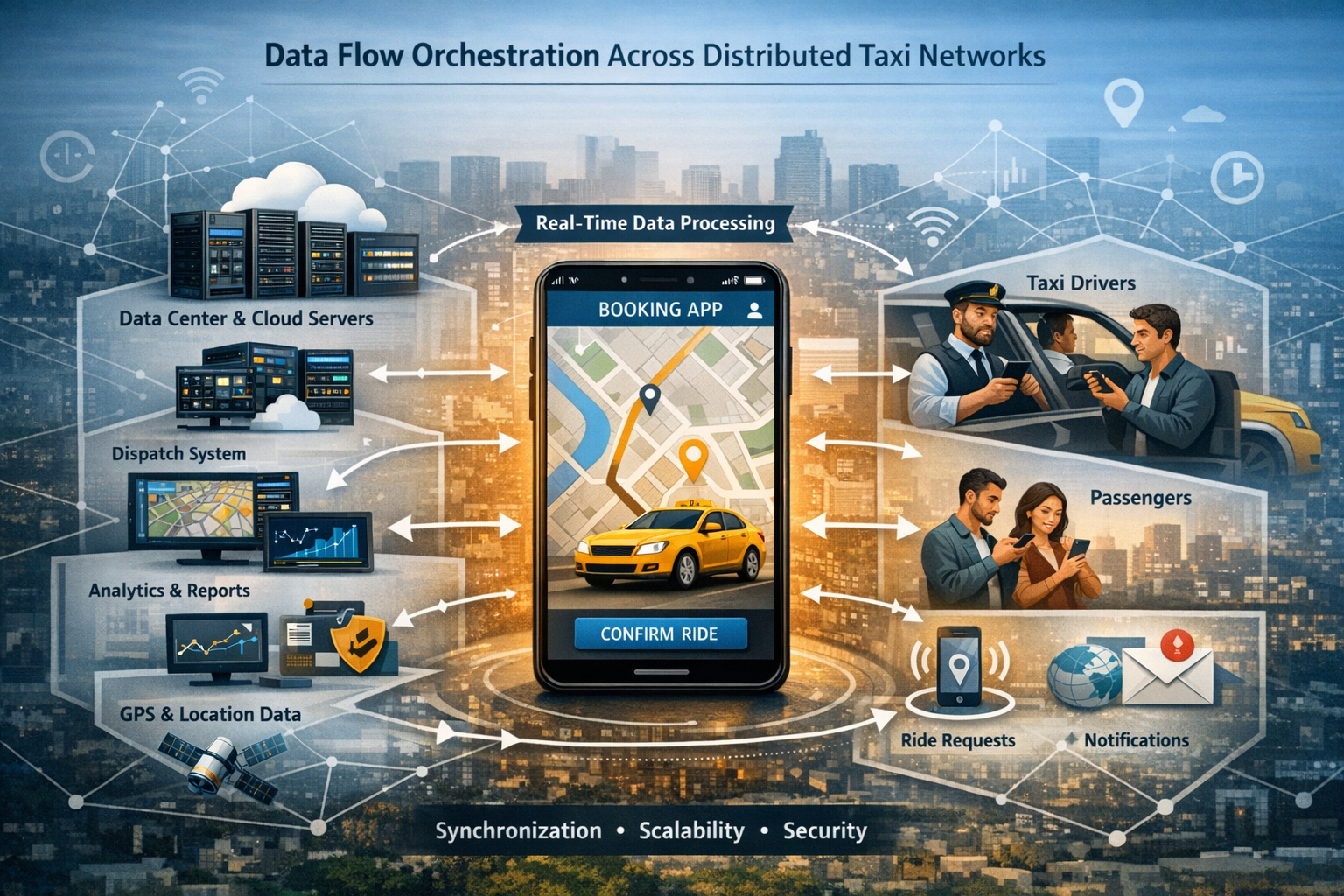
Urban mobility ecosystems increasingly rely on intelligent platforms that coordinate thousands of moving vehicles, drivers, and passengers in real time. At the core of these ecosystems lies data flow orchestration, the structured movement and synchronization of information across distributed taxi networks. From ride requests and driver availability to geolocation feeds and payment confirmations, each data stream must be processed with precision. For any taxi booking app development company, designing resilient data pipelines is fundamental to ensuring scalability, reliability, and consistent rider experiences across regions and service tiers.
Foundations of Distributed Taxi Data Systems
Distributed taxi networks consist of multiple interconnected components operating across various geographies and infrastructure layers. These include rider applications, driver interfaces, dispatch engines, payment gateways, analytics modules, and administrative dashboards. Each component continuously generates and consumes data.
The foundational elements of distributed taxi data systems typically include:
- Real-time event streams from rider and driver devices
- Centralized or hybrid dispatch engines
- Location tracking services powered by GPS and mapping APIs
- Payment authorization and settlement services
- Notification systems for alerts and updates
In such an environment, orchestration refers to the coordinated management of these components to ensure that information flows seamlessly. Instead of isolated data silos, the system must function as an integrated network where each event triggers predictable downstream processes.
Data consistency models are critical. Strong consistency ensures synchronized updates but may introduce latency. Eventual consistency allows faster scaling but requires conflict resolution mechanisms. Choosing the appropriate model depends on network size, regulatory requirements, and operational complexity.
Real-Time Event Streaming and Synchronization
Real-time event streaming forms the backbone of modern taxi platforms. Every ride request initiates a sequence of micro-events: geolocation validation, driver matching, fare estimation, route optimization, and payment pre-authorization. These events must be processed within milliseconds.
Event-driven architectures often leverage message brokers or streaming frameworks to decouple services. This decoupling enables:
- Independent scaling of microservices
- Reduced system downtime during upgrades
- Improved fault isolation
- Faster feature deployment cycles
Synchronization challenges arise when networks operate across multiple cities or countries. Latency, packet loss, and network congestion can impact ride allocation accuracy. Edge computing solutions help mitigate such issues by processing critical decisions closer to the data source.
Moreover, time synchronization protocols ensure accurate timestamping of events. Accurate timestamps are essential for fare calculations, compliance auditing, and dispute resolution. Without consistent temporal alignment, even small discrepancies can escalate into operational inefficiencies.
Microservices Architecture in Taxi Platforms
Traditional monolithic architectures struggle to handle dynamic ride demand fluctuations. Microservices architecture addresses this by decomposing the system into independently deployable services such as:
- User authentication service
- Ride matching service
- Pricing engine
- Driver earnings module
- Notification gateway
Each service communicates via APIs or event streams. This modular approach enhances scalability and reduces systemic risk. If the pricing engine experiences overload, it does not necessarily compromise authentication or location tracking.
However, microservices introduce orchestration complexity. Service discovery, API gateway management, and container orchestration platforms become essential. Kubernetes-based containerization allows automated scaling and rolling updates without downtime.
Data orchestration within microservices requires schema versioning, backward compatibility strategies, and centralized logging. Observability frameworks monitor service health, latency metrics, and throughput. These measures ensure that distributed systems remain predictable under high demand conditions.
Data Security and Compliance Across Regions
Taxi networks operate within strict regulatory environments. Data privacy laws vary across jurisdictions, requiring adaptable compliance frameworks. Sensitive data elements include:
- Passenger contact information
- Driver identification documents
- Payment credentials
- Location histories
Encryption at rest and in transit is mandatory. Secure tokenization protects payment information, while anonymization techniques reduce exposure risks in analytics environments.
Access control mechanisms must follow the principle of least privilege. Role-based access control ensures that administrative users only access necessary data subsets. Audit trails track every modification or retrieval event.
Cross-border operations introduce additional challenges. Data residency requirements may restrict where certain information can be stored or processed. Distributed storage clusters must therefore incorporate geographic partitioning strategies.
Effective orchestration also includes automated compliance monitoring. Systems should detect anomalies, flag unauthorized access attempts, and generate compliance reports. Robust governance frameworks reduce operational and reputational risks.
Scalability Models for Growing Fleet Networks
Demand patterns in taxi networks fluctuate dramatically based on time, weather, and local events. Scalability is therefore not optional but foundational.
Two primary scalability models dominate:
- Vertical scaling, increasing server capacity
- Horizontal scaling, adding more nodes to distribute load
Horizontal scaling is generally preferred for distributed networks due to its resilience and flexibility. Load balancers distribute incoming ride requests across multiple servers to prevent bottlenecks.
Auto-scaling policies rely on real-time metrics such as CPU utilization, memory usage, and request volume. When thresholds are exceeded, additional instances are automatically deployed.
Data replication strategies further enhance availability. Multi-region replication ensures service continuity even if a data center fails. However, replication must balance consistency and latency trade-offs.
A taxi booking app development company must anticipate peak concurrency scenarios such as festivals or severe weather disruptions. Predictive analytics models can forecast demand surges and allocate infrastructure proactively.
Integrating White Label and Custom Solutions
Many operators adopt a white label taxi app to accelerate deployment. These pre-built platforms provide standardized features such as ride booking, payment processing, and driver management. However, distributed networks often require customization to support regional pricing rules, fleet partnerships, or corporate mobility programs.
Integration considerations include:
- API compatibility with existing dispatch systems
- Custom reporting modules
- Localization of currency and language
- Regional tax configuration
Data orchestration must accommodate both standardized modules and bespoke components. Modular integration layers enable operators to extend functionality without destabilizing core services.
For organizations pursuing MVP app development solutions, incremental architecture design is crucial. Instead of building a fully scaled system initially, teams can deploy a minimal viable version focused on essential ride flows. As user adoption grows, additional microservices and data layers can be introduced without disrupting core operations.
Strategic integration planning prevents technical debt accumulation and ensures long-term scalability.
Cost Drivers and Infrastructure Optimization
Understanding the cost to build taxi app platforms requires examining infrastructure complexity, feature depth, and scalability requirements. Distributed data orchestration significantly influences total development and maintenance expenses.
Key cost drivers include:
- Cloud infrastructure and storage
- Real-time analytics engines
- Security and compliance tooling
- Third-party API integrations
- Ongoing monitoring and DevOps support
Efficient orchestration can reduce redundant data transfers and optimize compute resource allocation. Serverless architectures may lower operational overhead for certain workloads, particularly notification or reporting services.
Caching mechanisms decrease database load by storing frequently accessed data temporarily. This approach enhances response times while minimizing infrastructure strain.
Cost optimization should never compromise reliability. Instead, architectural design should align performance benchmarks with budget constraints. Elastic resource allocation ensures that infrastructure spending corresponds directly with demand levels.
Future Trends in Intelligent Mobility Systems
The evolution of distributed taxi networks is closely tied to emerging technologies. Artificial intelligence increasingly informs dispatch algorithms, route optimization, and surge pricing models. Machine learning pipelines require structured data ingestion and model retraining cycles.
Edge computing is gaining traction to minimize latency in high-density urban areas. Processing ride matching decisions at local nodes enhances responsiveness during peak traffic.
Blockchain-based identity management systems are being explored to strengthen driver verification and payment transparency. While still experimental, decentralized ledgers could improve trust mechanisms in multi-operator networks.
Sustainability analytics are also shaping orchestration strategies. Platforms now track carbon emissions per trip and optimize routes to reduce environmental impact.
Organizations that hire taxi app developers with expertise in distributed systems and cloud-native technologies are better positioned to implement these advanced capabilities responsibly and efficiently.
Observability, Monitoring, and Reliability Engineering
Operational reliability depends on continuous monitoring and proactive incident management. Distributed taxi networks must implement comprehensive observability frameworks.
Core observability pillars include:
- Metrics collection for system performance
- Distributed tracing for request lifecycle visibility
- Centralized logging for debugging
- Alerting mechanisms for anomaly detection
Site reliability engineering practices define service level objectives and error budgets. These benchmarks guide capacity planning and maintenance prioritization.
Chaos engineering experiments simulate infrastructure failures to validate system resilience. By intentionally introducing controlled disruptions, teams can identify weak points before real-world incidents occur.
Redundancy planning ensures that critical services such as dispatch and payments remain functional even during partial outages. Multi-layer failover mechanisms and disaster recovery protocols protect business continuity.
Continuous integration and deployment pipelines enable rapid yet controlled updates. Automated testing ensures that new features do not disrupt existing ride flows or compromise data integrity.
Conclusion
Data flow orchestration serves as the operational backbone of distributed taxi networks. Coordinating real-time events, securing sensitive information, managing scalability, and maintaining reliability require a sophisticated architectural approach. As urban mobility ecosystems expand and integrate advanced technologies, structured data management becomes increasingly critical. Well-designed systems not only ensure efficient ride allocation but also support compliance, sustainability, and long-term adaptability. A comprehensive orchestration strategy ultimately determines whether a distributed taxi network can thrive in an increasingly complex digital transportation landscape.
