

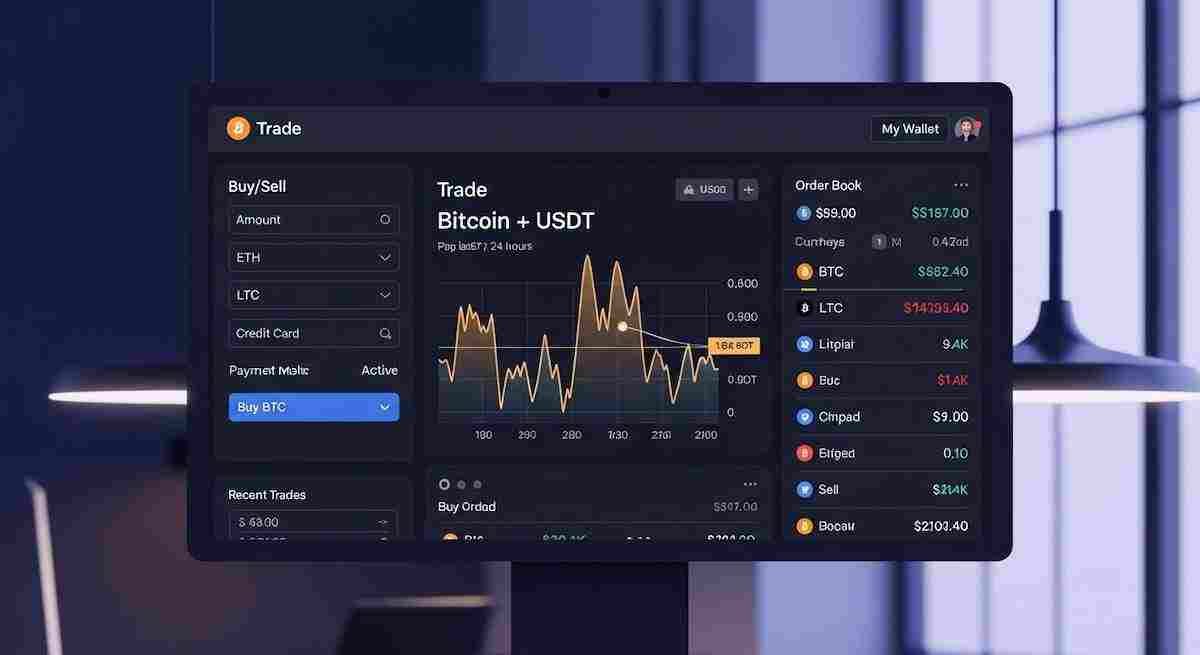
A White Label Perpetual DEX Platform represents a transformative shift in how digital asset trading infrastructures are built, deployed, and scaled, enabling businesses to launch fully functional perpetual futures exchanges without developing complex underlying systems from scratch; as decentralized finance continues to mature, demand for customizable, high-performance trading environments is accelerating, particularly among startups, fintech companies, and institutional players seeking rapid market entry with reduced technical overhead and enhanced flexibility. The convergence of decentralized liquidity protocols, advanced risk engines, and modular smart contract architectures has positioned white-label solutions as a strategic foundation for next-generation trading ecosystems, where speed-to-market, security, and scalability determine long-term competitiveness in the evolving derivatives landscape.
Evolution of Perpetual Trading Ecosystems in Decentralized Finance
The evolution of decentralized derivatives trading has been shaped by rapid innovation in blockchain infrastructure, shifting user expectations, and the increasing demand for capital-efficient financial instruments. Perpetual futures, in particular, have emerged as a dominant product due to their flexibility and ability to replicate traditional futures without expiration constraints. Over time, decentralized exchanges have transitioned from basic automated market makers to sophisticated trading ecosystems capable of handling institutional-grade volume. This progression has created a strong foundation for modern platform builders focusing on scalable and customizable solutions, where white-label perpetual dex platform development plays a key role in accelerating market entry and reducing engineering complexity.
- Perpetual futures have become a dominant instrument in decentralized markets
due to their ability to offer leveraged exposure without expiry constraints.
Their rising adoption reflects trader preference for flexibility and capital efficiency. - Early decentralized exchanges struggled with liquidity fragmentation and slippage
but modern designs integrate automated market-making and oracle-driven pricing.
These improvements have significantly narrowed the gap with centralized platforms. - Institutional participation has increased due to improved infrastructure maturity
including robust matching engines and real-time settlement mechanisms.
This shift signals a broader acceptance of decentralized derivatives trading. - The expansion of modular frameworks has supported rapid ecosystem diversification
enabling platforms to experiment with new incentive models and trading pairs.
This evolution sets the stage for scalable white label deployments.
Core Architecture and Engineering Foundations of Modern White Label Systems
A modern decentralized trading platform relies heavily on a modular and layered architecture that separates execution, liquidity, and risk management into independent but interconnected systems. This structure allows developers to optimize each component without affecting overall platform stability. The integration of blockchain smart contracts with off-chain performance engines ensures both transparency and scalability. Within this ecosystem, white-label perpetual dex platform development enables enterprises to deploy advanced trading infrastructure efficiently while maintaining flexibility for customization and integration with external services such as wallets, analytics dashboards, and liquidity aggregators.
- A white-label perpetual dex platform development framework typically relies on modular microservices separating order matching, risk management, and liquidity aggregation layers.
This architecture ensures high throughput and independent system scalability. - Smart contract design remains central to execution integrity and settlement automation
with on-chain logic governing margin requirements, liquidation thresholds, and funding rates.
Proper structuring reduces counterparty risk while improving transparency. - Off-chain components handle performance-intensive tasks such as order routing,
enabling faster execution speeds without compromising decentralized verification principles.
This hybrid structure balances efficiency with blockchain security guarantees. - API-first infrastructure enables seamless integration with wallets, dashboards, and analytics tools, allowing businesses to extend functionality without modifying core protocol logic.
This flexibility is essential for enterprise-grade deployments.
Liquidity Engineering and Risk Management in Perpetual DEX Platforms
Liquidity engineering forms the backbone of any successful decentralized derivatives platform, ensuring that traders can execute large orders with minimal slippage and consistent pricing. Modern systems combine automated market makers with traditional order book mechanics to create deeper and more resilient markets. At the same time, risk management frameworks continuously monitor leverage exposure and collateral health to prevent systemic instability. The integration of advanced oracle networks and dynamic funding models further enhances pricing accuracy, making decentralized perpetual trading more efficient and reliable under varying market conditions.
- Liquidity provisioning models now combine automated market makers with order book systems
ensuring deeper markets and reduced price impact during high volatility conditions.
This hybrid approach strengthens overall trading stability. - Dynamic funding rate mechanisms help align perpetual contract prices with spot markets,
reducing arbitrage inefficiencies and maintaining pricing equilibrium across venues.
These mechanisms are critical for long-term market reliability. - Risk engines continuously monitor margin ratios and exposure levels across positions,
triggering automated liquidation or deleveraging processes when thresholds are breached.
This reduces systemic risk during extreme market movements. - Advanced Oracle systems supply real-time price feeds from multiple sources,
minimizing manipulation risks and improving the accuracy of valuation models.
Reliable data input is essential for maintaining protocol integrity.
Branding, Customization, and Competitive Positioning for Enterprises
Enterprise adoption of decentralized trading infrastructure increasingly depends on the ability to customize user experience, branding, and functional modules without rebuilding core systems. White-label solutions provide a strategic advantage by enabling companies to launch fully branded exchanges tailored to specific market segments. This flexibility allows operators to define fee structures, leverage limits, and trading interfaces that align with their business goals. In this context, white-label perpetual dex platform development becomes a critical enabler for rapid product differentiation and long-term competitive positioning in the evolving digital asset landscape.
- Businesses adopting white-label solutions benefit from full interface customization,
enabling tailored trading dashboards, UX flows, and feature sets aligned with target users.
This flexibility enhances brand identity in competitive markets. - White-label perpetual dex platform development allows rapid product differentiation
through configurable leverage settings, fee structures, and asset listings.
Operators can adapt quickly to evolving market demands. - White-labeled systems reduce development cycles significantly compared to in-house builds,
allowing firms to focus on marketing, liquidity acquisition, and community growth.
This accelerates revenue generation timelines. - Enterprise operators can integrate loyalty programs and referral incentives directly
improving user retention and driving organic platform expansion.
These mechanisms strengthen long-term ecosystem engagement.
Security Frameworks, Auditing Standards, and Regulatory Considerations
Security remains a foundational pillar in decentralized trading systems, where even minor vulnerabilities can lead to significant financial exposure. Platforms must implement rigorous smart contract auditing, continuous monitoring, and layered defense mechanisms to mitigate risks from exploits and malicious activity. At the same time, regulatory compliance has become increasingly important as decentralized platforms interact with fiat gateways and institutional users. Balancing decentralization with compliance requirements is essential for sustainable growth and global market adoption.
- Smart contract audits are essential to ensure protocol resilience against exploits
involving reentrancy attacks, oracle manipulation, and flash loan vulnerabilities.
Independent audits increase trust among institutional participants. - Multi-layer security systems incorporate encryption, rate limiting, and anomaly detection,
protecting both user funds and platform infrastructure from external threats.
These safeguards are critical for maintaining operational continuity. - Regulatory alignment strategies vary across jurisdictions but often require KYC/AML integration,
particularly when bridging decentralized systems with fiat on-ramps.
Compliance readiness expands market accessibility. - Continuous monitoring tools provide real-time insights into transaction behavior,
allowing rapid response to suspicious activity or systemic anomalies.
This proactive approach reduces exposure to operational risks.
Revenue Models and Economic Sustainability of Perpetual DEX Platforms
Sustainable revenue generation in decentralized trading ecosystems depends on diversified income streams that extend beyond basic transaction fees. Platforms must design economic models that balance user incentives with long-term protocol profitability. Fee structures, liquidation mechanisms, staking models, and governance tokens collectively contribute to financial sustainability. By aligning participant incentives with platform growth, decentralized exchanges can maintain liquidity depth while ensuring stable operational funding across market cycles.
- Transaction fee structures remain the primary revenue source for most platforms
Typically involving maker-taker models that incentivize liquidity provision.
Sustainable fee design ensures long-term platform viability. - White-label perpetual dex platform development enables additional monetization channels,
including subscription licensing, infrastructure fees, and premium feature access.
These diversified models enhance financial stability. - Liquidation fees contribute to protocol revenue during high-volatility events
while also reinforcing risk management discipline across leveraged positions.
This dual function supports ecosystem balance. - Token-based economies further expand revenue opportunities through governance participation
staking incentives, and ecosystem reward distributions.
These mechanisms align user incentives with platform growth.
Strategic Implementation Roadmap for Launch and Scaling
Building and scaling a decentralized perpetual trading platform requires a structured roadmap that prioritizes system stability, liquidity acquisition, and user engagement. Initial phases focus on establishing a secure core trading engine, while subsequent stages emphasize ecosystem expansion through integrations and partnerships. Growth strategies rely heavily on liquidity incentives and community-building mechanisms. As the platform matures, continuous optimization and data-driven enhancements ensure long-term competitiveness in a rapidly evolving financial environment.
- Initial deployment focuses on building a secure and scalable core trading engine
ensuring that order execution, margin logic, and liquidation systems function reliably.
Early-stage stability is critical for user adoption. - White label perpetual dex platform development during launch phases emphasizes modular integration
allowing rapid onboarding of liquidity providers, brokers, and institutional partners.
This accelerates ecosystem formation. - Marketing and liquidity bootstrapping strategies play a central role in early traction
involving incentives such as reduced fees and reward programs for early users.
These initiatives drive initial trading volume. - Post-launch scaling requires continuous optimization of performance, security, and UX
supported by analytics-driven decision-making and iterative upgrades.
This ensures long-term competitiveness in evolving markets.
Conclusion
The rise of white label decentralized derivatives infrastructure signals a structural transformation in how financial trading platforms are conceived, deployed, and scaled, offering a powerful combination of modular engineering, institutional-grade performance, and rapid customization capabilities that significantly reduce time-to-market barriers while enhancing operational efficiency; as adoption of decentralized perpetual markets continues to expand across retail and institutional segments, organizations that invest in scalable architecture, robust liquidity systems, and adaptive risk frameworks are better positioned to capture long-term value, strengthen user engagement, and establish leadership in the evolving digital asset ecosystem.
