

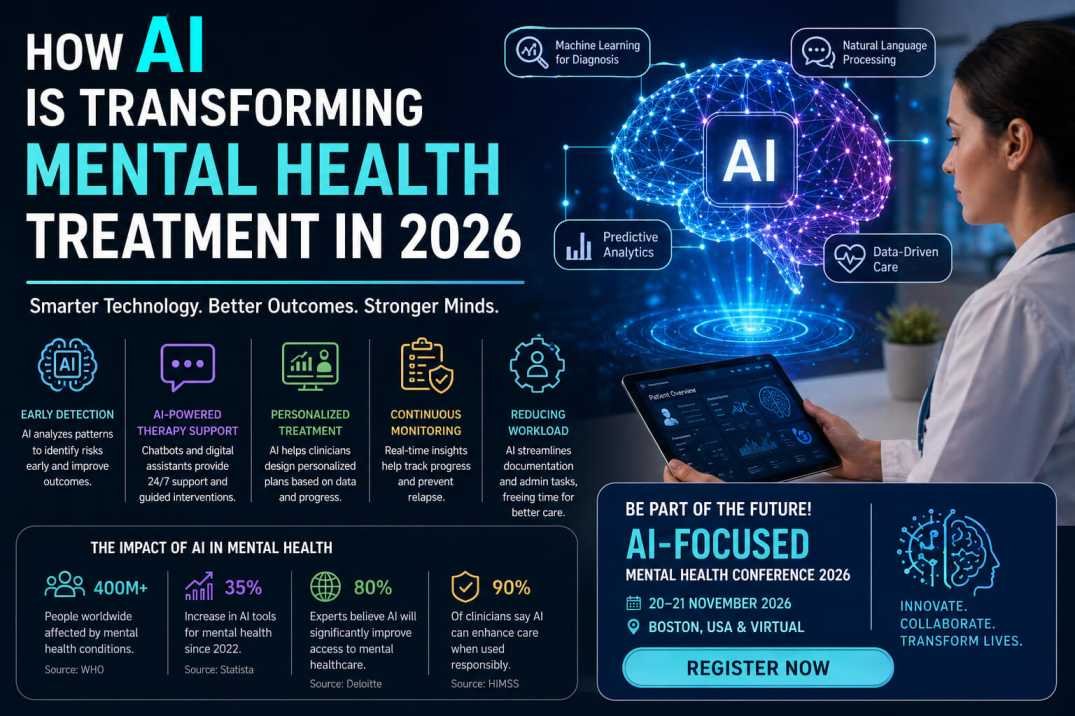
Artificial intelligence has moved from a promising concept to a practical force in mental healthcare. In 2026, it is being used to support screening, monitoring, treatment planning, administrative workflow, and research, while major institutions such as NIMH and WHO continue to emphasize that these tools must be used with strong evidence, human oversight, and ethical safeguards. NIMH describes technology as opening “a new frontier” in mental health care and notes that its research portfolio includes AI tools and technologies, while WHO says AI can improve diagnosis, treatment, and health research only if ethics and human rights remain central to design and deployment.
The shift from experimental tech to real-world care
The most important change in 2026 is that AI is no longer confined to pilot projects. It is increasingly embedded in digital health platforms, mental health research, and clinical workflows. NIMH’s Digital Global Mental Health Program explicitly supports technologies for prevention, diagnosis, treatment, and adherence, including machine learning and AI-based systems. That means the field is not only asking whether AI can be used in mental health, but how it should be validated, integrated, and monitored in live care settings.
A 2025 systematic review in PubMed describes AI applications in mental health across diagnosis, monitoring, and intervention, while a 2025 scoping review maps AI-driven digital interventions across screening, treatment, and maintenance phases. Taken together, these reviews suggest a field that is maturing quickly, but still depends on careful evaluation rather than blind adoption.
Earlier screening is one of AI’s biggest advantages
One of the clearest use cases for AI in mental health is early detection. AI systems can analyze patterns in language, behavior, interaction logs, and other digital signals to flag people who may need closer assessment. NIMH notes that technology now gives providers and researchers new ways to access help, monitor progress, and understand mental well-being, while current reviews show AI being used specifically in diagnostic and screening contexts.
This matters because many mental health conditions are easier to manage when they are identified early. In practice, AI-supported screening can help large systems such as schools, workplaces, and primary care settings identify risk earlier and connect people to human support sooner. That is an inference from the evidence base: the sources do not claim AI should diagnose independently, but they do show that AI can help surface patterns that merit professional attention.
Monitoring is becoming more continuous and more personalized
Mental healthcare has traditionally relied on occasional appointments and self-reported progress. AI is helping make monitoring more continuous. NIMH describes mobile devices as tools for helping people access care, monitor progress, and increase understanding of mental well-being, and its research programs specifically include active and passive mobile assessment, monitoring, and AI tools. This is a major change because it allows clinicians to track fluctuations between visits rather than waiting for a patient to deteriorate before noticing a problem.
That said, monitoring data must be interpreted carefully. NIMH also highlights that AI tools built on smartphone data may struggle to predict depression risk reliably in large and diverse groups, which is a useful reminder that more data does not automatically mean better prediction. The practical lesson is that monitoring tools can support care, but they need validation, calibration, and clinical judgment.
AI chatbots are useful, but they are not a replacement for care
Generative AI chatbots and conversational agents are among the most visible mental health technologies in 2026. A 2025 systematic review on generative AI mental health chatbots and a separate review on generative AI in mental health both show that these tools can be used for support, guidance, and structured interaction, with interest across clinical and subclinical populations. Another 2025 review found that AI-driven tools are being studied across screening, therapeutic support, and maintenance.
The strongest interpretation of this evidence is not that chatbots can replace therapists, but that they may extend access, reinforce coping strategies, and provide low-friction support between sessions. That interpretation is consistent with WHO’s caution that generative AI tools are often neither designed nor tested for mental health, particularly when used for emotional support. In other words, the promise is real, but so are the limits.
Clinicians are also benefiting from AI behind the scenes
AI’s impact is not limited to patient-facing tools. It is also changing how clinicians and care teams work. The NIMH technology page notes that digital tools can make therapy delivery more accessible and engaging, incorporate remote counseling or peer support, and support active and passive mobile assessment and monitoring. In parallel, FDA’s 2025 Digital Health Advisory Committee materials show active regulatory attention to generative AI-enabled digital mental health medical devices, reflecting how seriously the system is taking this category.
Operationally, this means AI can help reduce repetitive tasks such as intake summarization, appointment routing, message triage, and documentation support. That is a reasonable inference from the direction of the evidence and the way digital health systems are being developed: the sources show AI being used across the care continuum, even if they do not list every administrative function individually.
The research pipeline is moving faster than before
AI is also accelerating mental health research. NIMH states that its digital mental health programs support development, testing, implementation, and cost-effectiveness studies for technologies that improve prevention, diagnosis, treatment, and adherence. Reviews in 2025 and 2026 show a rapidly expanding literature on AI-powered mental healthcare, including diagnosis, monitoring, intervention, and network-based care models.
That matters because mental health research has traditionally been slowed by data fragmentation and the difficulty of capturing behavior in real time. AI does not remove those challenges, but it does make it easier to work with large, multidimensional datasets and to test hypotheses at greater speed. The result is a more dynamic research environment where discoveries can move into practice faster than before.
Ethics, privacy, and safety are now central, not optional
The most important theme across official guidance is caution. WHO’s 2021 guidance says AI can improve diagnosis, treatment, and research, but it must place ethics and human rights at the heart of design and deployment. WHO’s 2026 update goes further, warning that generative AI tools are increasingly being used for emotional support even though they were not designed or tested for mental health, and it recommends that mental health be integrated into AI impact assessments and that tools be co-designed with experts and people with lived experience.
FDA’s 2025 advisory committee materials show the regulatory system actively grappling with generative AI-enabled digital mental health devices, including products intended to diagnose, treat, mitigate, or prevent psychiatric conditions. That tells us two things: first, the category is no longer theoretical; second, regulators are concerned about scope, safety, and appropriate use.
A reasonable inference from these sources is that the best AI tools in mental health will be the ones that are evidence-based, transparent, clinically supervised, privacy-preserving, and culturally contextual. Tools that lack those qualities may still be popular, but they will be much harder to trust in serious care settings.
What this means for professionals in 2026
For psychiatrists, psychologists, counselors, researchers, and healthcare leaders, the practical takeaway is straightforward: AI literacy is becoming a career skill. Professionals do not need to become engineers, but they do need to understand what AI tools can do, where they fail, how they are evaluated, and when human judgment must remain in control. NIMH’s research agenda and WHO’s governance framework both point toward a future in which AI is useful only when it is responsibly embedded in care.
That is why attending an AI-focused international mental health conference 2026 can be strategically valuable. A conference is one of the best places to hear how researchers are evaluating these systems, how clinicians are using them, what regulators are concerned about, and which innovations are likely to matter in real practice. In a fast-moving field, that kind of exposure can shape how you work, what you study, and where your career goes next.
Conclusion
AI is transforming mental health treatment in 2026 by improving early screening, continuous monitoring, digital support, clinical workflow, and research capacity. At the same time, official guidance from WHO and NIMH makes clear that the future must be built on ethical design, human oversight, and rigorous evaluation. The field is moving quickly, but the central principle remains unchanged: technology should strengthen care, not replace it.
For professionals who want to stay ahead of that change, the best next step is to keep learning, keep evaluating tools critically, and keep engaging with the scientific community. That is what makes the conversation around AI in mental health so important in 2026—and why events like an AI-focused global mental health conference 2026 matter.
