

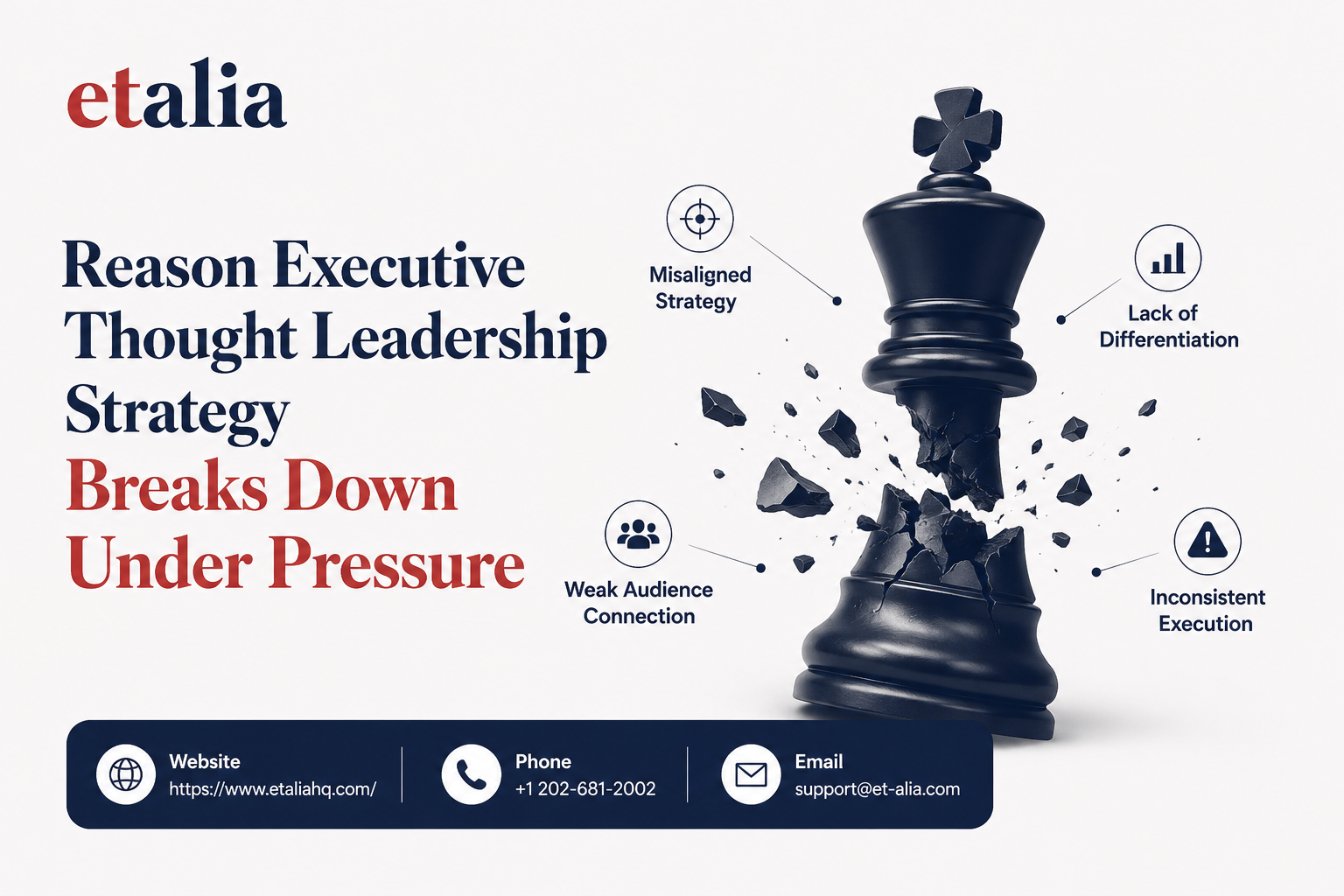
There is a version of executive thought leadership that works in controlled conditions. The keynote goes well. The op-ed draft feels sharp. The spokesperson training session ends on a confident note.
Then the actual moment arrives. A congressional hearing. A hostile journalist. A live panel where the moderator asks the question no one prepared for. And the leader who seemed ready is suddenly not.
This is not a preparation failure. It is a structural one. Most executive thought leadership strategies are built around outputs, not the leader behind them. And when pressure arrives, outputs are not what carries the moment. The leader is.
Executive Thought Leadership Strategy: Output Illusion
A conventional executive thought leadership strategy focuses on what a leader produces: articles, appearances, speeches, and interviews. These are necessary. But they are not sufficient.
The organizations that get the most mileage from their leaders’ communication are not just producing more content. They are building the internal clarity, conviction, and resilience that allow a leader to perform consistently, regardless of circumstances.
When that internal infrastructure is missing, even a well-crafted message can collapse under pressure. A leader who is not fully connected to why they believe what they say will hedge when challenged. They will retreat into jargon when they feel attacked. They will give technically correct answers that leave their audience cold.
Executive performance under pressure is not a separate topic from thought leadership. It is the foundation of it.
What Actually Breaks Under Pressure?
When a high-stakes communication environment arrives, three things typically fail first.
- Specificity: Leaders revert to generalities because generalities feel safer. They stop saying what they actually think and start saying what they assume will not be criticized.
- Voice: The authentic perspective that made the leader interesting in the first place disappears behind careful corporate language. The result sounds polished and says nothing.
- Presence: When leaders are under pressure, they often lose the quality of attention that makes communication land. They are processing the next potential attack instead of engaging with the current moment.
These are not personality flaws. They are predictable responses to high-stakes conditions that most executive communication programs do not prepare for.
Building an Executive Thought Leadership Strategy That Holds
An executive thought leadership strategy that works under real-world conditions starts before the message does. It starts with the leader.
The most durable thought leadership comes from leaders who have done the internal work. They know what they believe and why they believe it. They have tested their perspective against hard questions. They have moved past the habit of caution that serious professional training tends to instill.
This kind of preparation is not therapy. It is strategic. It is the discipline of getting a leader clear enough on their own thinking that they can communicate under pressure without losing coherence.
Once that foundation is in place, the external strategy becomes more effective. Media training works better when a leader is not performing but expressing. Op-Eds land harder when the perspective behind them is genuinely held. Speaking engagements leave a more durable impression when the leader in the room is fully present.
Executive Thought Leadership Strategy: Pressure Test
A useful way to evaluate any executive thought leadership strategy is to apply a pressure test. Ask: What happens to this strategy when things go wrong?
When the publication pushes back on the piece. When the interviewer challenges the leader directly. When a stakeholder in the room is visibly skeptical. When the news cycle turns against the organization.
A strategy built only around favorable conditions will fragment under pressure. One built around the leader behind the messages will hold.
The organizations that navigate high-stakes communication moments most effectively do not have better talking points. They have leaders who are clearer, more grounded, and more capable of staying in the conversation even when it becomes uncomfortable.
Why Scientific Leaders Are Especially Vulnerable?
In science, health, and technology sectors, leaders face communication pressures that leaders in other fields rarely encounter. They are expected to translate complex, uncertain, rapidly evolving science into confident, accessible positions. They are often asked to defend conclusions that are probabilistic by nature. They face audiences that range from deeply technical to entirely non-specialist.
At the same time, scientific training rewards caution, qualification, and precision. These are virtues in research. They can become obstacles in public communication, where the first impression often determines whether an audience keeps listening.
Executive performance under pressure in these sectors requires learning to lead with clarity without abandoning rigor. That is a specific skill set. It develops through practice, strategic feedback, and the kind of internal work that most organizations do not build into their leadership development.
Executive Thought Leadership Strategy That Compounds
The goal of a well-designed executive thought leadership strategy is not a single successful moment. It is a cumulative presence that builds credibility, opens relationships, and advances the organization’s mission over time.
That kind of compounding requires consistency. And consistency under real-world conditions requires leaders who are built for pressure, not just for performance.
When internal clarity meets external strategy, thought leadership stops being a communications function and becomes a leadership asset. That is when it starts doing real work for the organization.
Start the Conversation Around Executive Thought Leadership Strategy
Etalia works with scientific and institutional leaders to build the executive presence and strategic communication infrastructure their missions depend on. If your organization is ready to develop thought leadership that holds under pressure, visit etaliahq.com or schedule a conversation at etaliahq.com/schedule.
FAQs
Q1: What is executive thought leadership strategy, and how does it differ from general PR?
Ans: Executive thought leadership strategy is the structured development of a leader’s public voice, credibility, and strategic presence. PR manages reputation and coverage. Thought leadership strategy shapes the perspective behind the coverage. It is proactive, long-term, and rooted in the leader’s genuine expertise and point of view, not just in news cycles.
Q2: Why do executives underperform in high-pressure communication situations even after coaching?
Ans: Most communication coaching focuses on technique and message delivery. It does not address the internal disconnection that happens when a leader faces real pressure. When a leader is not fully clear on their own perspective, coaching helps in controlled conditions but breaks down under challenge. Executive performance under pressure improves most durably when internal clarity is developed first.
Q3: How should an organization measure whether its executive thought leadership is working?
Ans: Measure outcomes, not outputs. The number of articles published or interviews given is a leading indicator, not a result. The actual results are the relationships opened, the funding conversations advanced, the policy access earned, and the stakeholder trust built over time. Organizations that measure only outputs tend to optimize for volume. Organizations that measure outcomes optimize for impact.
Q4: How do executive thought leadership strategy and executive performance under pressure connect?
Ans: They are two sides of the same coin. Strategy defines what a leader says, where they say it, and to whom. Performance determines how effectively they communicate it when conditions are not ideal. A strong strategy with a weak performer will underdeliver. A strong performer without a coherent strategy will produce attention without impact. Both are necessary for thought leadership that actually advances an organization’s mission.
