

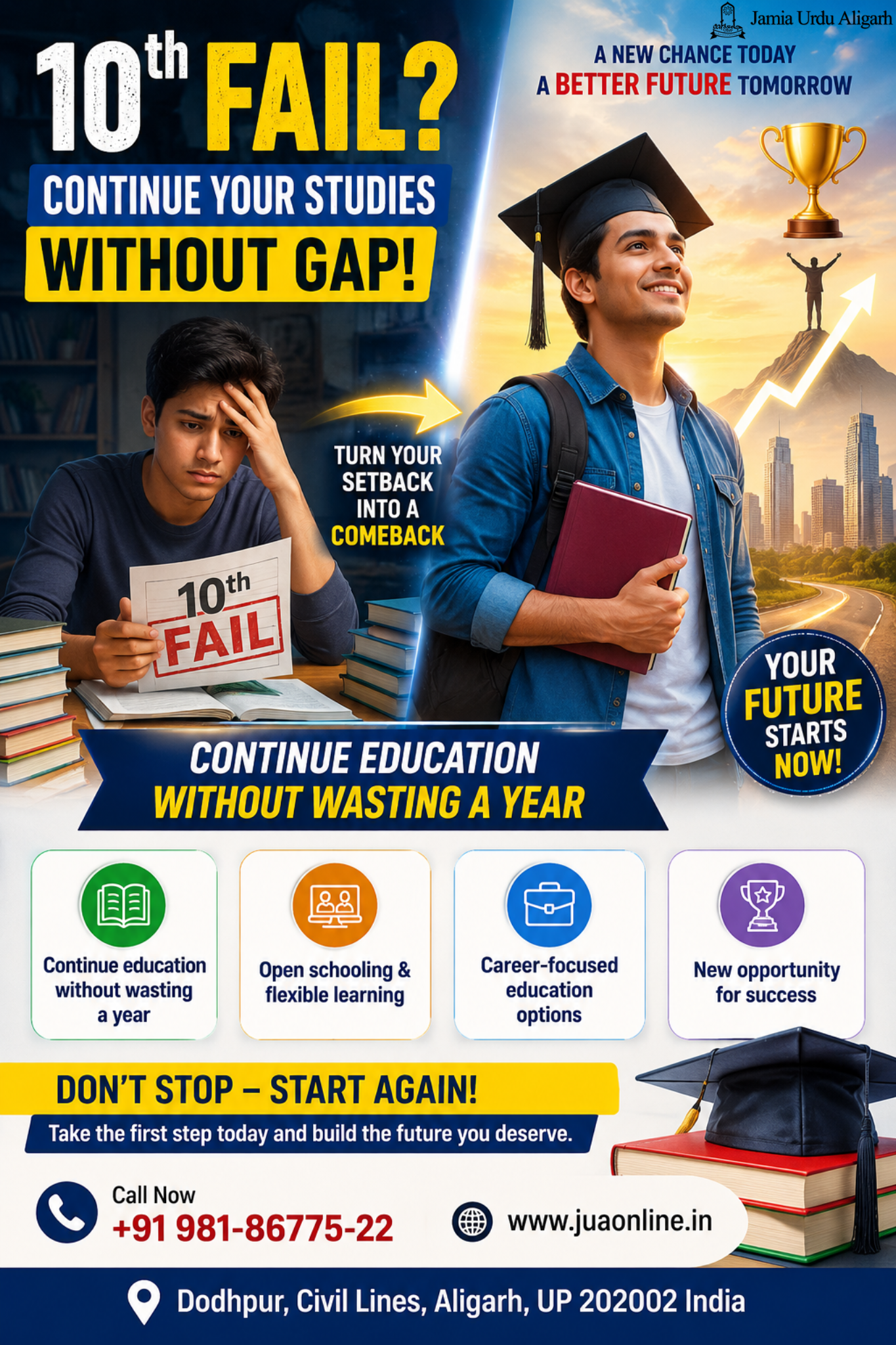
Failing your 10th board exam can feel like the end of the road — but it is not. Every year, thousands of students who are labelled as 10th fail go on to rebuild their academic careers, earn recognised qualifications, and build successful futures. The key is knowing your options and acting on them without losing time. This guide explains everything you need to know about continuing your education after a 10th fail, including admissions, online exams, and government-approved pathways in India.
What to Do After a 10th Fail: Your First Steps
If you have just received your result and the anxiety is setting in, take a breath — you have more options than you think. Here is what to do immediately after a 10th fail:
- Do not delay. The longer you wait, the harder it becomes to re-enter the education system. Act within weeks, not months.
- Assess why you failed. Was it a specific subject, exam anxiety, personal circumstances, or irregular schooling? Understanding the cause helps you choose the right path forward.
- Explore open and distance learning. You do not need to repeat an entire year sitting in a regular school. Distance education boards in India allow you to appear for board exams independently.
- Look into vocational options. Skill-based programmes can run alongside your academic recovery, giving you practical qualifications while you prepare for re-examination.
- Seek admission in a recognised programme. Government-approved institutions offer structured courses for students who need to complete their secondary education without a gap year penalty.
The most important message: a 10th fail result is a setback, not a full stop.
How to Pass 10th After Fail: Pathways Available in India
India has a well-developed open schooling ecosystem specifically designed for students in exactly this situation. Here are the main routes to pass 10th after a fail:
1. National Institute of Open Schooling (NIOS)
NIOS is the largest open schooling system in the world and is fully recognised by the Government of India. Students can appear for the Secondary Level examination (equivalent to Class 10) without age restriction, without a school leaving certificate, and without a fixed academic year. Exams are conducted twice a year, giving you multiple chances to clear subjects.
2. State Open School Boards
Most Indian states have their own open school boards that conduct secondary-level examinations. These are recognised at par with regular board results for higher education admissions and government jobs.
3. Recognised Urdu and Language Medium Boards
For students who studied in Urdu medium or prefer language-based education systems, boards like Jamia Urdu Aligarh offer government-approved secondary and senior secondary programmes. These institutions have been serving students for decades and provide a credible, accessible route back into formal education.
10th Fail Admission: What You Need to Know
Getting 10th fail admission into a recognised programme is simpler than most students realise. Open and distance learning institutions typically require:
- A basic identity document (Aadhaar card, birth certificate, or previous school records)
- No minimum marks requirement from the failed attempt
- No age bar in most open school systems
- A nominal registration fee
Many institutions accept admissions throughout the year or in two windows (April–May and October–November), aligning with exam cycles. You do not need a transfer certificate or a school leaving certificate to enrol.
Online Exam Options: Flexibility for Today’s Learner
One of the most significant developments in Indian education is the availability of online exam systems and digital study resources. Open learning students can now:
- Access study material through official portals and mobile apps
- Appear for practical or theory exams at designated examination centres close to home
- Track results and re-registration online
- Study at their own pace without attending daily classes
This flexibility is especially valuable for students who failed due to health issues, family responsibilities, economic pressure, or irregular schooling — not a lack of ability.
Recognised Boards in India for Open and Distance Learning
A common concern among students and parents is whether a qualification obtained through open schooling will be accepted by colleges, employers, and government bodies. The answer is yes — recognised boards in India for open schooling carry full validity. Key recognised bodies include:
- NIOS — Central Government recognised, valid pan-India
- State Open School Boards — Recognised by respective state governments
- Jamia Urdu Aligarh — A DNEA (Darul Uloom Nadwatul Arabia) affiliated institution recognised for its secondary and senior secondary programmes, especially for Urdu-medium students
- IGNOU (for higher levels) — Recognised for undergraduate and postgraduate programmes
Degrees and certificates from these boards are accepted for college admissions under UGC guidelines, government job applications, and professional courses.
About Jamia Urdu Aligarh: A Trusted Path for Students
Jamia Urdu Aligarh is one of India’s respected institutions offering government-approved education programmes through the open and distance learning model. It is affiliated with DNEA (Darul Uloom Nadwatul Arabia) and recognised by the relevant educational authorities, making its qualifications valid across India.
Jamia Urdu Aligarh offers the following programmes:
- 10th / Adeeb — Secondary Level Programme, equivalent to Class 10
- 12th / Adeeb-e-Mahir — Senior Secondary Programme, equivalent to Class 12
- Skill and Vocational Programmes — Practical, job-oriented courses to build employable skills alongside academic qualifications
- Open and Distance Learning Programmes — Flexible study options designed for students who cannot attend regular classes
Whether you are a 10th fail student looking to recover your qualification, a working individual who could not complete schooling, or a family supporting a child through educational disruption — Jamia Urdu Aligarh provides a structured, affordable, and credible path forward.
Frequently Asked Questions (FAQ)
Q1. Can a 10th fail student get direct admission without repeating the full year? Yes. Open schooling systems in India, including NIOS and Jamia Urdu Aligarh, allow students to enrol and appear for board exams without repeating a full academic year in school.
Q2. Is a certificate from an open school board valid for college admissions? Absolutely. Certificates from recognised boards in India — including NIOS and government-approved open boards — are accepted by universities and colleges under UGC guidelines.
Q3. What is the minimum age to appear for the 10th exam through open schooling? NIOS allows students aged 14 and above to appear for the Secondary Level exam. Most open boards have similar or no strict age restrictions.
Q4. Can I study through an online exam system at home? You can access study materials, recorded lectures, and resources online. Examinations, however, are conducted at designated centres. Many centres are widely distributed, making them accessible even in smaller towns.
Q5. Is Jamia Urdu Aligarh government approved? Yes. Jamia Urdu Aligarh is a recognised institution affiliated with DNEA and operates under government-approved educational frameworks, ensuring that its certificates carry full validity.
Q6. What if I failed only one or two subjects? Open schooling boards typically allow compartment or subject-wise re-examination. You may only need to clear the failed subjects rather than reattempt the full exam.
Q7. How do I enrol in Jamia Urdu Aligarh’s programmes? You can contact Jamia Urdu Aligarh directly through their official channels. Admission processes are straightforward, with minimal documentation requirements, and staff can guide you through the right programme for your situation.
Conclusion
A 10th fail result does not define your future — your response to it does. India’s open and distance learning system is one of the most accessible in the world, offering multiple pathways, flexible timelines, and fully recognised qualifications to students who need a second chance. From NIOS to state open boards, and from skill programmes to language-medium institutions, the doors are genuinely open.
Jamia Urdu Aligarh stands as a trusted brand in this space — providing government-approved, DNEA-affiliated secondary and senior secondary education to students who deserve the opportunity to continue learning on their own terms. If you or someone you know is looking for a clear, structured, and credible route back into education after a 10th fail, Jamia Urdu Aligarh’s programmes are worth exploring without delay.
Your education journey is not over. It is simply taking a different route.
