

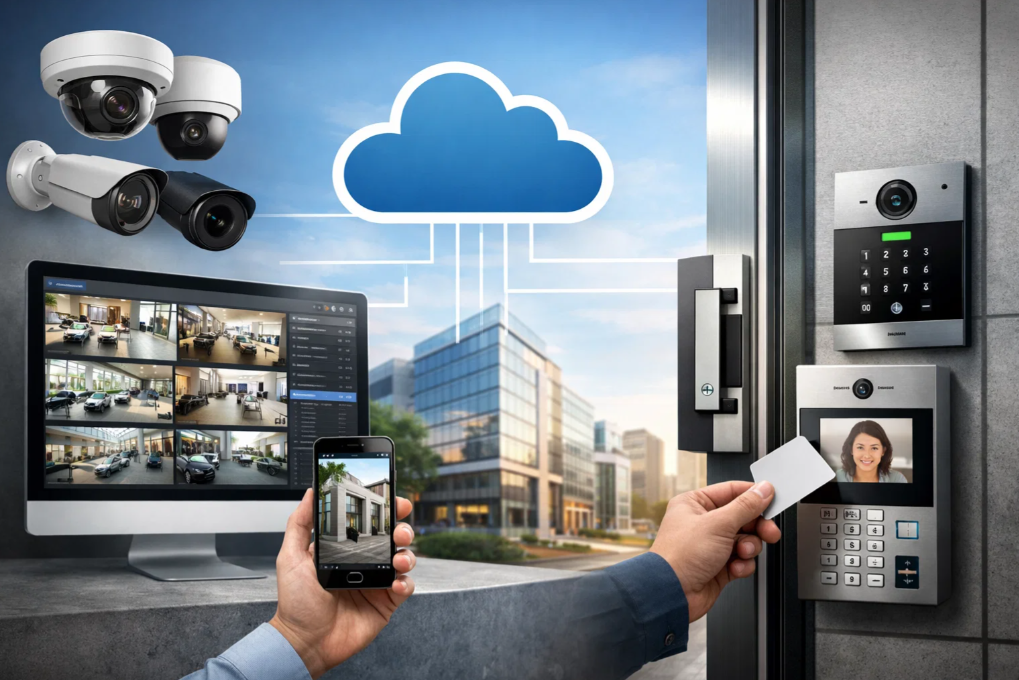
Enterprise security is undergoing a fundamental transformation. Traditional, siloed security systems—where video surveillance, door control, and access management operate independently—are no longer sufficient to protect modern organizations. As businesses expand across multiple locations, adopt hybrid work models, and face increasingly sophisticated security threats, the demand for integrated, cloud-based security solutions has never been greater. Integrated Cloud Video Surveillance & Door Control represents the next evolution of enterprise security. By unifying video surveillance systems with advanced access control software on a cloud platform, organizations can achieve greater visibility, stronger security, improved operational efficiency, and better decision-making.
This article explores why integrated cloud-based video surveillance and door control is the future of enterprise security, how it works, and the benefits it delivers to organizations seeking scalable, intelligent, and resilient security solutions.
The Changing Landscape of Enterprise Security
Enterprise environments today are more complex than ever. Organizations operate across offices, campuses, warehouses, data centers, and remote facilities, often spread across regions or countries. At the same time, security risks are escalating, including:
- Unauthorized access and insider threats
- Theft of physical and digital assets
- Compliance and regulatory pressures
- Operational disruptions and safety incidents
Traditional on-premise security systems struggle to keep pace with these challenges. Legacy video surveillance systems often store footage locally, require manual monitoring, and lack integration with access control platforms. Door control systems may log entry events but fail to provide real-time visual context.
As a result, security teams are forced to manage multiple systems, analyze disconnected data, and respond reactively rather than proactively. This fragmentation leads to blind spots, delayed responses, and higher operational costs.
What Is Integrated Cloud Video Surveillance & Door Control?
Integrated Cloud Video Surveillance & Door Control is a unified security approach that combines:
- Cloud-based video surveillance systems
- Advanced access control and door management software
- Centralized monitoring and analytics
All components operate on a shared platform, enabling seamless communication between video feeds, access events, and user credentials.
For example, when a door is accessed using a badge or mobile credential, the system can automatically link the event to live or recorded video footage. Security teams gain instant visual verification of who accessed a door, when it occurred, and under what circumstances.
Cloud architecture ensures that data is securely stored, accessible remotely, and scalable without the limitations of on-premise hardware.
Why Cloud-Based Security Is the Future
1. Scalability Without Infrastructure Constraints
Cloud-based security systems eliminate the need for extensive on-site servers and storage devices. Organizations can easily scale their video surveillance systems and door control infrastructure as they grow, add new locations, or increase camera coverage.
New devices can be deployed and configured remotely, significantly reducing installation time and costs. This flexibility is especially critical for enterprises with dynamic operational needs.
2. Centralized Management Across Locations
Managing security across multiple facilities is a major challenge for enterprises. Integrated cloud platforms provide a single pane of glass for monitoring video feeds, controlling doors, and managing user access across all sites.
Security administrators can:
- Grant or revoke access permissions instantly
- Monitor live video from any location
- Review access logs and video footage from a central dashboard
This centralized approach improves consistency, accountability, and operational efficiency.
3. Enhanced Reliability and Data Protection
Cloud platforms offer built-in redundancy, automated backups, and disaster recovery capabilities. Unlike traditional systems that rely on local storage vulnerable to damage or theft, cloud-based video surveillance ensures critical security footage remains protected and accessible even during outages or emergencies.
The Power of Integration: Video Surveillance Meets Door Control
Integration is the key differentiator that elevates modern security systems beyond basic monitoring.
Real-Time Visual Verification
When video surveillance systems are integrated with door control, every access event can be visually verified. Security teams can immediately confirm whether access attempts are legitimate or suspicious, reducing false alarms and improving response times.
For example:
- A forced door opening triggers instant video playback
- Tailgating incidents can be visually identified
- Access denied events can be reviewed alongside camera footage
This level of context is invaluable for incident investigations and audits.
Smarter Incident Response
Integrated systems enable automated workflows. If a security breach occurs, the system can:
- Lock down specific doors
- Alert security personnel
- Highlight relevant camera feeds
- Log all actions for compliance and review
This proactive approach minimizes risk and ensures faster, more effective incident resolution.
Advanced Access Control Software: The Intelligence Layer
At the heart of integrated security lies advanced access control software. Modern platforms go beyond simple badge readers and door locks, offering intelligent features that enhance both security and efficiency.
Flexible Credential Management
Advanced access control supports a wide range of credentials, including:
- Smart cards and key fobs
- Mobile credentials
- Biometric authentication
Access rights can be customized by role, time, location, or security level, ensuring users only access areas relevant to their responsibilities.
Automation and Policy Enforcement
Security policies can be automated to enforce compliance and reduce manual intervention. For example:
- Temporary access for contractors can expire automatically
- High-security zones can require multi-factor authentication
- Doors can lock or unlock based on schedules or occupancy
This automation reduces human error and strengthens overall security posture.
Operational Efficiency Through Unified Security
Beyond protection, integrated cloud video surveillance and door control delivers significant operational benefits.
Reduced Administrative Burden
Centralized systems streamline administrative tasks such as onboarding, offboarding, and access audits. Changes can be applied instantly across all locations without physical reconfiguration.
Data-Driven Insights
Integrated platforms generate valuable data that can be analyzed to improve operations, including:
- Foot traffic patterns
- Peak access times
- Security incident trends
These insights help organizations optimize space usage, staffing, and safety protocols.
Lower Total Cost of Ownership
By reducing hardware requirements, minimizing maintenance, and improving efficiency, cloud-based integrated security systems often result in lower long-term costs compared to traditional solutions.
Use Cases Across Enterprise Environments
Corporate Offices
Integrated systems improve employee safety, prevent unauthorized access, and support hybrid work models with flexible credential management.
Manufacturing and Warehousing
Video surveillance combined with door control helps secure valuable assets, monitor restricted zones, and ensure compliance with safety regulations.
Healthcare and Education
Facilities benefit from enhanced visibility, rapid incident response, and secure access to sensitive areas without compromising user convenience.
Data Centers and Critical Infrastructure
High-security environments rely on integrated systems for strict access control, real-time monitoring, and detailed audit trails.
The Role of Millennium in Advanced Access Control
Millennium has emerged as a trusted provider of advanced access control software designed to integrate seamlessly with video surveillance systems. By focusing on flexibility, scalability, and open architecture, Millennium enables organizations to build customized security ecosystems tailored to their specific needs.
Millennium’s solutions support:
- Cloud and hybrid deployments
- Integration with leading video surveillance platforms
- Centralized management across enterprise environments
This approach empowers businesses to modernize their security infrastructure without disrupting existing operations.
Compliance, Privacy, and Security Considerations
As security systems become more powerful, organizations must also address data privacy and regulatory compliance. Cloud-based platforms offer advanced encryption, role-based access, and audit logging to help meet compliance requirements.
Enterprises should ensure their integrated security solutions align with industry standards and local regulations, protecting both physical assets and sensitive data.
Preparing for the Future of Enterprise Security
The future of enterprise security lies in intelligent, integrated, and cloud-driven solutions. As technologies such as AI-powered video analytics, machine learning, and predictive security continue to evolve, integrated cloud video surveillance and door control systems will become even more powerful.
Organizations that invest in these solutions today position themselves to:
- Respond faster to security threats
- Scale effortlessly as they grow
- Improve operational efficiency
- Create safer, smarter environments
Conclusion
Integrated Cloud Video Surveillance & Door Control is no longer a luxury—it is a necessity for modern enterprises. By unifying video surveillance systems with advanced access control software on a cloud platform, organizations gain unmatched visibility, control, and efficiency.
As security challenges grow more complex, the ability to monitor, manage, and respond from a single, intelligent system will define the future of enterprise security. Solutions that embrace integration, scalability, and innovation—such as those enabled by Millennium—will lead the way toward safer, more resilient organizations.
