

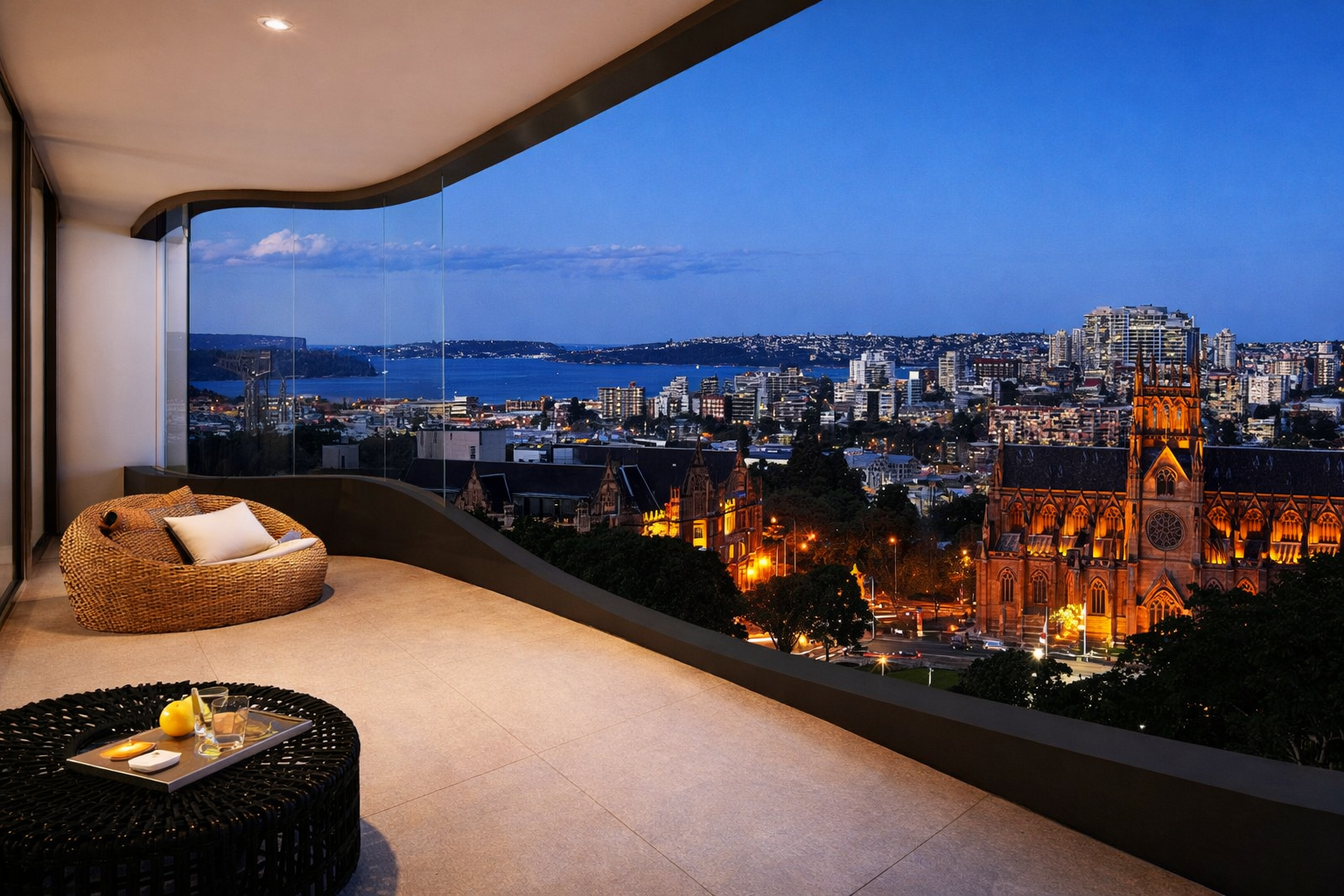
Sydney’s skyline isn’t just a backdrop. It’s an architectural asset that transforms houses into homes worth millions more than their land value alone would suggest. When property values in premium Sydney suburbs can swing by 30 to 40 percent based purely on view quality, you start to understand why the city’s most sought after residential architects Sydney professionals treat sightlines with the same reverence a jeweller treats diamonds.
The harbour city’s unique topography creates what urban planners call “view corridors” that stretch across the CBD, the Harbour Bridge, the Opera House, and the Pacific Ocean beyond. These vistas have become so valuable that entire architectural practices now specialise in maximising them. We’re not talking about simply positioning a window anymore. Modern luxury home design in Sydney has evolved into a sophisticated discipline where every angle, every material choice, and every structural decision serves the primary goal of framing and celebrating that million dollar view.
Here’s something most people don’t realise. A 2023 analysis by CoreLogic found that harbour view properties in Sydney’s eastern suburbs commanded a premium of $2.8 million over comparable homes without views. That’s not a typo. Nearly three million dollars in added value for what amounts to strategic design decisions made during the planning phase.
The Economics Behind View Centric Design
Let’s talk numbers because they tell a compelling story.
Sydney’s luxury property market operates on different principles than standard residential development. When residential architects Sydney teams work on high end projects, they’re not just building homes. They’re creating appreciating assets where the view itself becomes a quantifiable component of value.
Research from the University of Technology Sydney’s Institute for Sustainable Futures revealed that properties with unobstructed Sydney Harbour views appreciated 4.7 percent faster annually than similar properties without views over a fifteen year period. Compound that growth, and you’re looking at substantial wealth creation driven largely by architectural choices made before the first brick was laid.
But here’s where it gets interesting.
The value isn’t uniform across all views. A northerly aspect overlooking the harbour consistently outperforms eastern ocean views by roughly 15 percent in resale value, according to Domain Group’s 2024 Prestige Property Report. Western sunset views over the city skyline rank third, while southern views command the lowest premiums unless they capture specific landmarks like the CBD or airport approach paths over Botany Bay.
Savvy architects factor these market realities into every design decision. Window placement isn’t aesthetic anymore. It’s financial strategy.
Architectural Techniques That Maximise Skyline Engagement
The best luxury home architects in Sydney employ a toolkit of techniques that go far beyond simply installing large windows.
Floor to ceiling glazing has become standard, but the execution matters enormously. Modern developments use low iron glass that eliminates the greenish tint of standard glazing, creating crystal clear views that make the skyline feel closer and more vivid. Some practices specify glass with UV filtering that protects interiors without compromising visual clarity, a critical consideration when you’re investing upwards of $50,000 in custom curtain wall systems.
Structural cantilevers push living spaces beyond the building envelope, suspending residents above the landscape. The Horizon Apartments in Darlinghurst, designed by SJB Architects, feature cantilevered balconies that extend 3.5 metres from the facade, creating the sensation of floating above the cityscape. This isn’t just dramatic. It’s functional design that expands the viewing angle by approximately 40 degrees compared to traditional balcony construction.
Interior planning follows what architects call “view hierarchy.” Primary living spaces always capture the best vistas. Bedrooms, bathrooms, and service areas occupy the secondary aspects. Open plan designs eliminate interior walls that might obstruct sightlines, creating what one prominent Sydney architect described to me as “visual flow” where the skyline becomes visible from multiple vantage points throughout the home.
Ceiling heights in luxury developments now routinely exceed 3.2 metres in living areas, with some penthouses pushing to 4 metres or higher. This vertical dimension dramatically enhances the perception of the view, creating what environmental psychologists call “spatial grandeur” that triggers measurably positive emotional responses in occupants.
The Technical Challenges of Building for Views
Designing for views creates engineering challenges that standard residential construction never encounters.
Wind loading becomes critical when you’re installing large expanses of glass in elevated positions. Sydney’s coastal location means architects must specify glazing systems rated for wind speeds exceeding 200 kilometres per hour. The structural framework supporting these systems often requires custom engineering, adding $150,000 to $300,000 to construction costs for a typical luxury residence.
Thermal performance presents another hurdle. Glass, even modern high performance glazing, transfers heat far more readily than insulated walls. Northern harbour views, while commanding the highest premiums, also invite intense solar gain that can overheat interiors and drive energy costs through the roof without proper mitigation.
The solution involves layered strategies. External motorised louvres provide shading while maintaining views. High performance double glazing with argon gas fills and low emissivity coatings reduce heat transfer by up to 60 percent compared to single pane glass. Some architects specify electrochromic smart glass that tints automatically in response to sunlight, though at roughly $1,500 per square metre, it remains a premium option.
Acoustic isolation matters more than most people anticipate. Properties in Potts Point or Elizabeth Bay with stunning views of the city also contend with urban noise pollution. Laminated acoustic glass, often combined with secondary glazing systems, can reduce noise transmission by 40 to 50 decibels, creating serene interiors despite the bustling cityscape beyond.
Strategic Site Selection and Orientation
Before architects ever put pencil to paper, site selection determines what’s possible.
Sydney’s topography creates distinct microclimates and view opportunities across relatively short distances. Properties on the northern slopes of Bellevue Hill enjoy fundamentally different solar access and vista potential than southern slope sites just 500 metres away. Understanding these nuances separates competent designers from exceptional ones.
Aspect analysis involves detailed solar studies that map sun paths across seasons. A site that seems perfect in winter might suffer from excessive western sun in summer, degrading both comfort and the viewing experience as harsh glare washes out the skyline. Architects use specialised software to model these conditions, informing decisions about glazing placement, shading systems, and even landscape design.
View corridors require protection through strategic design. When a development features harbour views peeking between existing buildings, architects carefully position and size windows to optimise that specific sightline. Future development on neighbouring sites represents a risk that due diligence must assess. Council zoning overlays, height restrictions, and heritage controls all factor into evaluating how secure a view corridor might be over the property’s lifetime.
Some architects actively design for view sharing within multi residence developments. Rather than giving penthouse owners the only harbour access, thoughtful planning creates oblique viewing angles that allow lower floor units to capture partial views, increasing saleable value across the entire building. This approach has become increasingly common as Sydney’s luxury market matures and buyers become more sophisticated about view quality versus pure elevation.
Material Selection That Enhances Rather Than Competes
The materials surrounding a view influence how we perceive it.
Reflective surfaces amplify natural light and create the illusion of expanded space, but they can also generate glare that diminishes the viewing experience. The best architects balance these factors through careful material selection. Matte finish natural timbers, stone with subtle veining, and textured concrete provide visual interest without competing for attention with the skyline beyond.
Colour palettes increasingly trend toward neutrals that recede visually. Whites, soft greys, and warm beiges create calm interiors that position the view as the primary visual focus. This isn’t just aesthetics. Environmental psychology research demonstrates that neutral interiors with dramatic natural views generate lower stress responses and higher satisfaction ratings than bold interiors with similar view access.
Transparency extends beyond the obvious glass selections. Interior materials increasingly incorporate translucent and semi transparent elements that allow light and views to penetrate deeper into floor plans. Glass internal partitions, open metal staircases, and even perforated screens all contribute to visual connectivity with the skyline.
Some architects specify motorised window treatments that disappear entirely when retracted, eliminating even the minimal visual obstruction of curtain tracks or blind housings. These systems, often custom fabricated, can cost $5,000 to $8,000 per window but deliver uncompromised views when deployed.
The Future of View Oriented Architecture in Sydney
Sydney’s architectural landscape continues evolving in response to view value economics.
Adaptive reuse projects increasingly target buildings with view potential that was never optimised in their original construction. Former industrial structures in Pyrmont and Alexandria are being transformed into luxury residences specifically because their elevated positions and large floor plates allow for dramatic skyline engagement that wasn’t economically viable when they housed warehouses or factories.
Technology promises to expand what’s architecturally possible. Structural glass is becoming stronger and thinner, allowing for larger unsupported spans and more adventurous cantilevered designs. Smart glass technology is dropping in price, suggesting it might become standard in luxury construction within the next decade rather than remaining a premium option.
Climate adaptation will influence future view oriented design as Sydney faces increased extreme weather events. Architects are already specifying impact resistant glazing systems that can withstand severe storms while maintaining optical clarity. Some practices are exploring the integration of photovoltaic glass that generates electricity while preserving transparency, though current technology sacrifices too much light transmission for most luxury applications.
The emerging concept of “borrowed views” is gaining traction, where architects design to capture vistas of public parkland, golf courses, or other protected green spaces that offer visual relief and implied connection to nature, even when traditional skyline views aren’t available. This approach acknowledges that view value extends beyond harbour and city vistas to encompass any protected, pleasant outlook.
Design Philosophy That Puts Views First
The most successful luxury home architects in Sydney share a common philosophy.
They understand that in a city where view endowed land is increasingly scarce, every design decision either enhances or diminishes the primary asset. This mindset influences everything from structural systems that minimise internal columns to lighting design that doesn’t reflect on windows, from furniture specifications that don’t obstruct sightlines to landscape design that frames rather than blocks vistas.
It’s an approach that requires discipline. Architects must sometimes resist dramatic interior gestures that would compromise view access. The view itself becomes the architectural statement, with the built form serving as a carefully crafted frame.
This philosophy also recognises that view engagement changes throughout the day and across seasons. Morning light transforms the harbour into sheets of silver. Afternoon sun silhouettes the CBD against golden skies. Evening brings the jewelled spectacle of city lights reflecting on water. Architects increasingly design for these temporal variations, positioning living spaces and outdoor areas to capture specific lighting conditions at particular times.
The result is homes that function as viewing instruments, precisely calibrated to their specific site conditions and designed around the singular goal of celebrating Sydney’s incomparable skyline. When executed properly, the architecture almost disappears, leaving residents with an unmediated connection to the city’s most valuable visual asset.
That’s worth a premium. The data proves it. More importantly, the lived experience confirms it. In a city as visually stunning as Sydney, making the view the hero isn’t just good architecture. It’s essential design thinking that creates lasting value and profound daily pleasure for those fortunate enough to call these view oriented homes their own.