

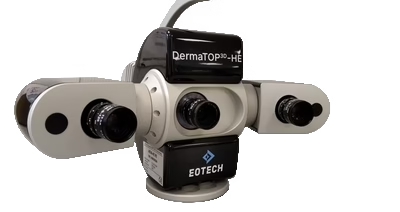
Skin changes are often visible but can be very difficult to quantify. It’s one thing to know that something has changed, but it’s another thing entirely to see that it’s changed in an easily comparable way. The Skin imaging technology plays a major role in making it easier.
The advantage of 3D image tools like AEVA-HE is that shifts in texture, fine lines, folds, and local contour can be recorded. The feature is also more useful when you are trying out or testing treatments or products that may have very minor, visually different results.
Introduction to skin imaging technology
Skin imaging technology is a group of tools that capture and measure the skin surface. The tools are non-invasive, and the changes can be captured beyond images and videos. The system is capable of mapping textures, determining the extent of wrinkles and roughness, and tracking the changes, such as shape and volume.
The technology is a 3D skin analyser, which basically means high-resolution 3D skin topography. It creates a 3D model of the skin and converts it into numerical values for analysis. It improves skin assessment accuracy with such quantifiable changes.
Who should opt for the skin imaging technology?
Skin imaging technology is mainly for people who need results they can measure, real changes in tracking wrinkles, pores, folds, and volume on face zones. Some of the reasons to use the technologyare:
- Testing product efficacy for cosmetics and other products for skin.
- To track the outcome of the treatment or the product by the dermatologist.
- Plastic surgeons who need objective tracking of parts of the face throughout the treatment or the procedural visits.
- Studies where both the shape and texture of the skin matter, like slimming, firming, and anti-cellulite evaluations.
Get the best of Skin imaging technology!
When investing in a 3D skin analyzer, it’s not so much about obtaining an in-focus 3D image but more about obtaining equipment that becomes part of your workflow because it’s designed for your work, repeatedly, without making every experiment or test into an exercise in frustration. Medelink’s strategy comes across as practical rather than overbearing.
The context of AEVA-HE is in a very clear topography & imaging environment, so you’re not wondering if it’s for local facial areas, body areas, or specific drug efficacy. The device is positioned for quantified assessment in cosmetic, dermatology, and aesthetic applications. This is important because you want a device that provides figures you can measure against in a second session, rather than just images.
To wrap it up:
Skin imaging technology helps you move from surface-level results to measurable, comparable results more easily. Whether you are looking at fine lines, textures, folds, or other minute changes in facial or bodily contours, a solid 3D imaging platform helps you measure your progress in a way that works well across multiple study points. The goal of an effective system for AEVA-HE-based facial and bodily studies remains simple: better proof points for your studies, in a way you stand behind.
