

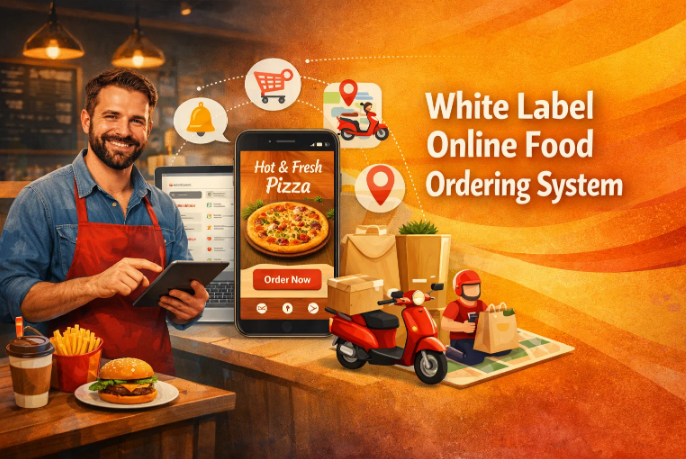
The food delivery industry has experienced massive growth over the past decade. Consumers now expect the convenience of ordering meals online and having them delivered quickly to their homes or workplaces. This shift in consumer behavior has created opportunities for entrepreneurs, restaurant chains, and startups to launch their own digital food ordering platforms.
However, building a food delivery platform from scratch can be complex, expensive, and time-consuming. Businesses need ordering systems, vendor management tools, payment integration, delivery tracking, and customer applications. This is where a white label online food ordering system becomes an effective solution.
A white label online food ordering system enables businesses to launch their own branded food delivery platform using ready-made technology. Instead of developing software from the ground up, companies can deploy a customizable solution that includes essential features such as ordering, vendor management, delivery tracking, and payment systems.
This article explores how businesses can launch their own food delivery platform using a white label online food ordering system, the underlying technology involved, the architecture of modern food delivery platforms, and the key considerations for building scalable digital ordering ecosystems.
Understanding a White Label Online Food Ordering System
A white label online food ordering system is a ready-to-use software solution that allows businesses to operate their own branded food ordering and delivery platform. The core technology is built by developers, but it can be rebranded, customized, and deployed under another company’s identity.
Unlike traditional marketplace platforms that operate under a central brand, white label solutions allow organizations to maintain full control over their platform’s branding, user experience, and operations.
In technical terms, a white label online food ordering system typically includes several integrated components. These components work together to handle customer orders, restaurant listings, delivery logistics, and administrative management.
Most systems are delivered as a modular platform consisting of:
- Customer-facing web or mobile applications
- Vendor or restaurant management dashboards
- Delivery driver applications
- Administrative control panels
- API-based integrations for payments, maps, and notifications
These components form the foundation of a scalable food delivery ecosystem.
The Rise of Digital Food Delivery Platforms
Online food ordering has become a standard service across urban markets. Mobile-first consumer behavior, digital payments, and improved logistics infrastructure have accelerated the growth of food delivery platforms.
Businesses entering this space require robust digital infrastructure to manage real-time orders, vendor relationships, and delivery coordination.
A white label online food ordering system simplifies the process of entering this market by providing the technological backbone required to run a multi-vendor marketplace.
Many entrepreneurs who aim to build regional food delivery networks rely on white label food delivery app solutions because they allow rapid platform deployment while maintaining brand ownership.
From a technological perspective, these platforms combine several modern software components including cloud hosting, microservices architecture, mobile frameworks, and real-time data processing.
Core Architecture of a Food Delivery Platform
Launching a digital food ordering ecosystem requires a strong backend architecture. A white label online food ordering system generally follows a layered architecture that separates the user interface, business logic, and data management systems.
This architecture ensures that the platform can scale as the number of users, vendors, and delivery agents increases.
Frontend Layer
The frontend layer is responsible for user interaction. This includes customer mobile applications, restaurant dashboards, and delivery driver apps.
Modern platforms often use frameworks such as React, Flutter, or React Native to create responsive applications that work across multiple devices.
The frontend connects to backend systems through APIs, enabling real-time communication between users and the platform.
Backend Layer
The backend layer manages the core functionality of the platform. It processes orders, manages user accounts, handles vendor data, and coordinates delivery operations.
Most white label online food ordering system platforms use backend technologies such as Node.js, Python, Java, or PHP. These systems handle request processing, business logic, and data synchronization.
Backend services also manage authentication, payment processing, notifications, and order tracking.
Database Layer
The database layer stores platform data including user profiles, restaurant menus, order history, and delivery details.
Relational databases like PostgreSQL or MySQL are commonly used for structured data, while NoSQL databases such as MongoDB handle flexible data structures and high-volume queries.
Efficient database architecture is critical to ensure fast order processing and reliable system performance.
Cloud Infrastructure
Cloud infrastructure enables food delivery platforms to scale dynamically based on user demand.
Most modern white label online food ordering system deployments use cloud platforms such as AWS, Google Cloud, or Microsoft Azure.
Cloud services provide load balancing, container orchestration, automated backups, and high availability, which are essential for platforms handling thousands of simultaneous orders.
Role of a White Label Food Delivery App
A white label food delivery app represents the customer-facing component of a food delivery ecosystem. It enables users to browse restaurants, place orders, track deliveries, and make payments.
From a technology perspective, the application must deliver a seamless and responsive user experience. Performance optimization, intuitive navigation, and secure payment integration are critical elements.
Mobile applications typically support:
- Real-time order tracking
- Push notifications
- GPS-based delivery updates
- Multiple payment methods
- Customer reviews and ratings
A white label food delivery app can be customized to reflect the branding and design requirements of the business deploying the platform.
This flexibility allows companies to differentiate their platforms while leveraging an existing technological framework.
Multi-Vendor Food Delivery Platforms
Many modern delivery ecosystems operate as marketplaces that connect multiple restaurants with customers. This model is commonly supported by a multi-vendor food delivery app.
A multi-vendor food delivery app allows multiple restaurants or food businesses to join the same platform and manage their menus, pricing, and orders independently.
Technically, the system must support vendor-specific dashboards where restaurants can update menus, track orders, and manage delivery requests.
Each vendor account operates within the broader marketplace infrastructure while maintaining control over its own operations.
The platform’s backend manages vendor onboarding, commission structures, order routing, and payment settlements.
This multi-vendor architecture enables platforms to scale rapidly by expanding their network of restaurants.
Key Technology Components of a Food Delivery System
Launching a digital food delivery platform requires multiple technology integrations. A white label online food ordering system typically combines several advanced software components.
API Integrations
Application Programming Interfaces (APIs) allow different software services to communicate with each other.
Food delivery platforms use APIs for:
- Payment gateways
- Mapping and location services
- SMS notifications
- Push notifications
- Analytics systems
These integrations help streamline operations and enhance the user experience.
Real-Time Order Management
Real-time processing is essential for managing food delivery operations.
When a customer places an order, the platform must instantly notify the restaurant, assign a delivery driver, and update the customer’s order status.
Real-time communication technologies such as WebSockets and event-driven architecture enable instant updates across the platform.
GPS Tracking and Route Optimization
Delivery tracking is a core feature of modern food ordering systems.
GPS technology allows platforms to monitor driver locations and provide accurate delivery estimates to customers.
Advanced platforms integrate route optimization algorithms to improve delivery efficiency and reduce travel time.
Payment Processing Systems
Digital payments are central to the online ordering experience.
A white label online food ordering system integrates secure payment gateways that support multiple payment methods, including cards, digital wallets, and online banking.
Payment systems must also comply with industry security standards to protect financial data.
Role of Food Delivery App Development Companies
Developing complex marketplace platforms requires specialized technical expertise. Many businesses collaborate with a food delivery app development company to design and deploy their systems.
These companies focus on building scalable applications that support large volumes of users, vendors, and delivery agents.
A food delivery app development company typically works on:
- Mobile application development
- Backend architecture
- Cloud infrastructure setup
- API integrations
- Platform testing and deployment
Organizations seeking enterprise-grade platforms often explore services offered by top food delivery app development companies that specialize in marketplace ecosystems.
These companies bring experience in designing high-performance systems capable of handling real-time operations.
Platform Scalability and Performance
Scalability is one of the most important technological factors when launching a food delivery platform.
As user numbers increase, the system must handle higher volumes of orders, data processing, and delivery coordination.
A white label online food ordering system must be built with scalable infrastructure that can support growth without affecting performance.
Modern platforms use technologies such as containerization, Kubernetes orchestration, and distributed databases to ensure scalability.
Load balancing and caching systems also help maintain fast response times even during peak order periods.
Security and Data Protection
Food delivery platforms manage sensitive data including personal information, payment details, and transaction records.
Security must therefore be a core component of any white label online food ordering system.
Platforms typically implement encryption protocols, secure authentication systems, and role-based access controls.
Other security practices include:
- SSL encryption for data transmission
- Secure API authentication
- Data backup and disaster recovery systems
- Fraud detection mechanisms
These measures help protect both users and businesses from potential security risks.
Integration with Logistics and Delivery Systems
Delivery coordination is a key part of any food ordering ecosystem.
A multi-vendor food delivery app must integrate logistics management tools that connect customers, restaurants, and delivery agents.
These systems manage delivery assignments, route planning, and driver performance tracking.
Logistics software often includes features such as geolocation tracking, automated dispatch systems, and delivery status updates.
The integration of logistics technology ensures that orders move smoothly from restaurants to customers.
Analytics and Data Insights
Data analytics plays a critical role in optimizing food delivery platforms.
A white label online food ordering system collects valuable data on customer behavior, order patterns, and vendor performance.
This data can be analyzed to improve operational efficiency and enhance the customer experience.
Common analytics capabilities include:
- Order volume analysis
- Restaurant performance metrics
- Customer engagement insights
- Delivery efficiency reports
Advanced platforms may also incorporate machine learning algorithms to forecast demand and optimize delivery routes.
Customization and Platform Flexibility
One of the main advantages of a white label online food ordering system is its ability to be customized for different business models.
Businesses may choose to operate a local delivery marketplace, a restaurant chain ordering platform, or a niche food delivery service.
The platform can be configured to support these different models through customizable workflows, branding options, and operational settings.
Customization also allows businesses to adapt the platform to local market requirements and regulatory environments.
Challenges in Building Food Delivery Platforms
Although white label solutions simplify development, launching a food delivery ecosystem still involves several technological challenges.
System performance must remain stable during peak hours when large numbers of users place orders simultaneously.
Delivery logistics can also become complex as the number of restaurants and delivery agents grows.
Platform operators must continuously update their systems to ensure compatibility with new devices, operating systems, and payment technologies.
Collaboration with experienced top food delivery app development companies can help businesses address these challenges through advanced system architecture and ongoing technical support.
Future Technologies in Food Delivery Platforms
The food delivery industry continues to evolve as new technologies emerge.
Artificial intelligence, predictive analytics, and automation are beginning to play a larger role in food delivery platforms.
AI algorithms can analyze historical data to forecast order demand and optimize delivery routes.
Voice ordering, chatbot support, and smart kitchen integrations are also becoming part of modern food ordering ecosystems.
A white label online food ordering system that incorporates these technologies can support more advanced operational capabilities.
As the industry evolves, platforms will increasingly rely on automation and data-driven decision-making.
Conclusion
The digital transformation of the food industry has created new opportunities for businesses to launch their own delivery platforms. However, building complex marketplace systems from scratch can be resource-intensive and technically demanding.
A white-label online food ordering system offers a practical technological solution by providing ready-made infrastructure for online ordering, vendor management, and delivery coordination.
By combining cloud-based architecture, real-time processing systems, mobile applications, and analytics tools, these platforms enable businesses to create scalable digital food delivery ecosystems.
Whether deployed as a white label food delivery app for a single brand or as a multi-vendor food delivery app supporting multiple restaurants, the underlying technology forms the backbone of modern food ordering platforms.
Collaboration with a specialized food delivery app development company or exploring solutions offered by top food delivery app development companies can further enhance platform capabilities and ensure robust system performance.
As food delivery technology continues to advance, businesses that leverage scalable and adaptable digital infrastructure will be better positioned to operate successful online food ordering platforms in an increasingly competitive market.
