

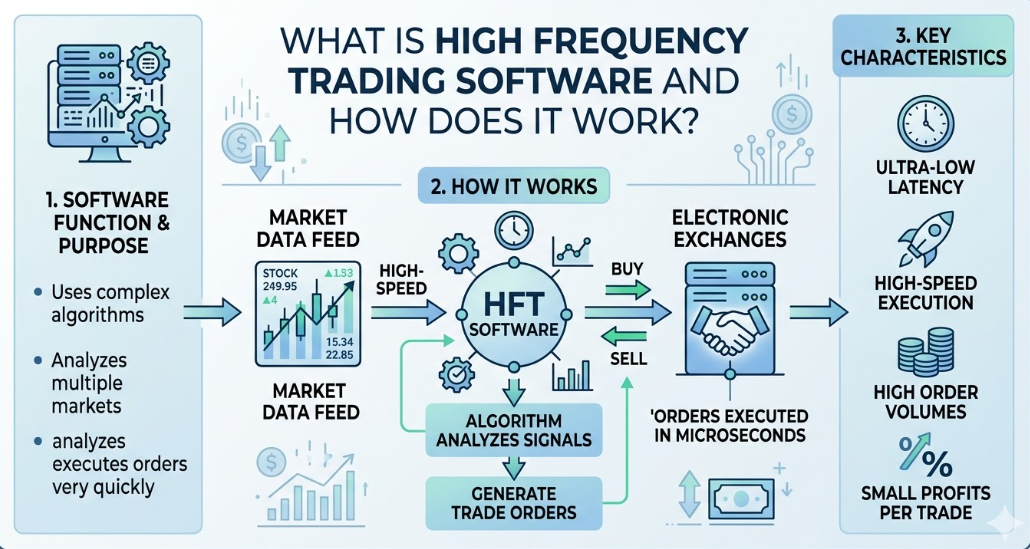
In the modern era of finance, speed and precision define success. In global markets where stock prices can fluctuate in milliseconds, traders need more than intuition they need technology that can process immense volumes of data and act faster than the blink of an eye. This is where high frequency trading software development becomes a game-changer. High Frequency Trading (HFT) software is a sophisticated system designed to execute thousands of trades in seconds using automated algorithms and ultra-low-latency infrastructure. Unlike traditional trading that relies on human judgment and slower reaction times, HFT software uses real-time market data, advanced analytics, and machine learning to identify opportunities and execute trades almost instantaneously. For financial institutions, hedge funds, and proprietary trading firms, the development of HFT software is not optional it is a strategic necessity that directly impacts profitability and competitive advantage.
High frequency trading software goes beyond simple automation; it is a finely tuned ecosystem of strategy, speed, and risk management. The software is typically hosted on high-performance servers physically located close to stock exchanges, a practice known as colocation, to reduce transmission delays. The algorithms embedded in these systems continuously analyze market microstructure, track liquidity, monitor order books, and detect even tiny price discrepancies. With this level of computational power, HFT software can place, modify, or cancel orders within microseconds, capitalizing on inefficiencies that no human trader could exploit. The development process of such software is intricate, often requiring expertise in network architecture, algorithmic modeling, statistical analysis, and financial regulations, making High Frequency Trading Software Development a highly specialized field.
Core Components of High Frequency Trading Software
High frequency trading software is more than just code—it is a complex orchestration of modules that work together to execute trades efficiently and reliably. One of the most critical components is the market data feed handler. This module collects live data from multiple exchanges and consolidates it for the algorithmic engine to process. Given the volume of trades and quotes generated every second, the data feed handler must operate with ultra-low latency and high throughput. Even a delay of a few microseconds can mean the difference between profit and loss.
The trading strategy engine is the heart of HFT software. It applies mathematical and statistical models to determine when and how to execute trades. Strategies often include market making, in which the system continuously quotes buy and sell prices to capture the spread; statistical arbitrage, which identifies and exploits pricing inefficiencies across related instruments; and momentum trading, which reacts to short-term trends and price movements. In recent years, machine learning models have been integrated into trading engines, allowing the software to detect evolving patterns and adapt dynamically to changing market conditions.
Equally important is the order management system (OMS), which coordinates the placement, modification, and cancellation of orders across different exchanges. The OMS ensures trades are executed in accordance with strategy while maintaining compliance with regulatory requirements. Finally, risk management modules are essential for monitoring exposure, enforcing position limits, and preventing catastrophic losses during market anomalies. Every component of HFT software must operate seamlessly, as any bottleneck can compromise performance and profitability.
How High Frequency Trading Works in Practice
High frequency trading is all about exploiting small, fleeting opportunities that exist for milliseconds or microseconds. Consider an example where a stock is listed on multiple exchanges with slightly different prices. An HFT system can instantly buy the stock on the exchange where it is undervalued and simultaneously sell it on the exchange where it is overvalued. This is known as arbitrage trading, and while the profit per trade is minimal, the system can execute thousands of such trades in a second, accumulating significant returns over time.
The execution of high-frequency trades relies heavily on predictive modeling. Algorithms analyze historical and live market data, including price fluctuations, order book depth, trade volumes, and even macroeconomic indicators, to forecast short-term price movements. Some advanced systems integrate sentiment analysis from news sources and social media platforms to anticipate market reactions before they manifest in pricing. This blend of speed, analytics, and predictive modeling gives HFT software its unique edge, allowing traders to capitalize on market inefficiencies invisible to traditional methods.
Moreover, high frequency trading often involves market making strategies. By continuously quoting buy and sell prices, HFT systems provide liquidity to markets, earning profits from the spread while simultaneously managing risk. The rapid-fire nature of these transactions means that HFT participants often have extremely thin margins per trade but can achieve substantial profitability due to volume and precision. It’s a delicate balance where milliseconds matter, making robust High-Frequency Trading Software Development critical to maintaining a competitive advantage.
Binary Options and Algorithmic Integration
While HFT is traditionally associated with equities, futures, and forex, the same principles apply to binary options trading. Binary options trading platform development enables traders to automate decision-making by leveraging algorithmic strategies similar to those in HFT systems. Binary options are financial instruments that offer fixed returns based on price predictions, and the speed at which these trades are executed can dramatically improve profitability. By integrating high-frequency algorithms into binary options platforms, developers can provide features such as automated position management, real-time analytics, and instant execution to minimize latency and human error.
Binary options platforms with HFT capabilities require a seamless interface between algorithmic engines and user-facing applications. Advanced backtesting modules allow traders to simulate strategies using historical data before deploying them live. Additionally, the platform must maintain robust security protocols and ensure compliance with financial regulations to safeguard user assets. This integration of speed, analytics, and user experience enables traders to capitalize on fleeting opportunities, creating a highly competitive environment in the binary options space.
Risk Management Challenges in High Frequency Trading
Despite its advantages, high frequency trading is not without risks. The very features that make HFT profitable—automation, speed, and volume—can amplify losses during unexpected market events. System failures, network latency, or programming errors can trigger cascading failures, sometimes resulting in “flash crashes.” Regulatory authorities have implemented stringent guidelines requiring transparency, monitoring, and limitations on high-frequency practices to reduce systemic risk. For example, financial watchdogs may require circuit breakers, order-to-trade ratios, and pre-trade risk checks to prevent market manipulation.
Developers address these challenges by implementing multiple layers of risk management. Real-time monitoring tools track exposure and detect abnormal trading patterns. Automated stop-loss systems can halt trading if losses exceed predefined thresholds. Stress testing ensures software performance under extreme volatility, while failover mechanisms provide redundancy in case of hardware or network failures. Properly designed High Frequency Trading Software Development is not just about speed—it is about building a resilient system that protects capital while optimizing profits.
The Role of Infrastructure and Low-Latency Networks
The performance of HFT systems is heavily dependent on infrastructure. Low-latency networks, high-speed servers, and proximity hosting are essential to minimize the time it takes for orders to reach exchanges. Many HFT firms colocate their servers in the same data centers as exchanges to shave microseconds off communication times. Advanced networking technologies, including fiber optics, microwave transmission, and even proprietary protocols, are leveraged to achieve ultra-fast connectivity.
Hardware acceleration techniques, such as field-programmable gate arrays (FPGAs) and graphics processing units (GPUs), are increasingly integrated into HFT systems to process complex calculations at unmatched speeds. Efficient memory management and optimized software architecture ensure minimal delays in executing trading strategies. In essence, every component—from algorithms to physical hardware—is tuned to perfection, underscoring the intricate nature of High Frequency Trading Software Development.
Market Impact and Ethical Considerations
High frequency trading has transformed global markets, increasing liquidity and narrowing spreads, but it has also sparked ethical and regulatory debates. Critics argue that HFT favors large institutions over retail traders, creates market volatility, and may facilitate unfair practices such as quote stuffing and layering. Proponents counter that HFT improves market efficiency, reduces trading costs, and provides liquidity that benefits all participants.
Financial regulators around the world have responded with rules designed to maintain fairness and transparency. Measures such as minimum resting times for orders, trade reporting obligations, and strict surveillance of algorithmic strategies are now standard. For firms involved in HFT, understanding and complying with these regulations is as important as optimizing speed and strategy, further highlighting the critical role of professional High Frequency Trading Software Development.
Future Trends in High Frequency Trading
The evolution of HFT software is far from over. Artificial intelligence and machine learning are increasingly central to strategy development, enabling systems to adapt dynamically to changing market conditions. Quantum computing holds the promise of processing massive datasets and complex algorithms exponentially faster than traditional systems, potentially revolutionizing the speed and sophistication of HFT. Blockchain technology and decentralized finance (DeFi) platforms are also opening new avenues for automated, transparent trading beyond traditional exchanges.
Cloud-based HFT platforms are emerging as a way for smaller trading firms to access high-speed trading without the need for expensive colocation. Hybrid systems combining low-latency infrastructure with scalable cloud computing may become the norm, balancing speed, flexibility, and cost-efficiency. Platforms that incorporate best practices in trading software development will be able to provide secure, scalable, and high-performing solutions that adapt to future market demands.
Conclusion
High frequency trading has reshaped modern financial markets, turning milliseconds into competitive advantages and redefining the concept of trading itself. High Frequency Trading Software Development empowers firms to leverage speed, automation, and sophisticated algorithms to exploit fleeting opportunities that are invisible to human traders. From equities and derivatives to binary options, integrating advanced trading platforms provides precision execution, comprehensive risk management, and enhanced profitability. As technology advances, the integration of artificial intelligence, cloud computing, and decentralized finance will further expand the potential of HFT, making it an indispensable tool for traders aiming to stay ahead in an increasingly fast-paced financial world. Investing in expert Binary Options Trading Platform Development and professional trading software development is the key to mastering the complexities of high frequency trading and achieving sustainable success in modern markets.
