

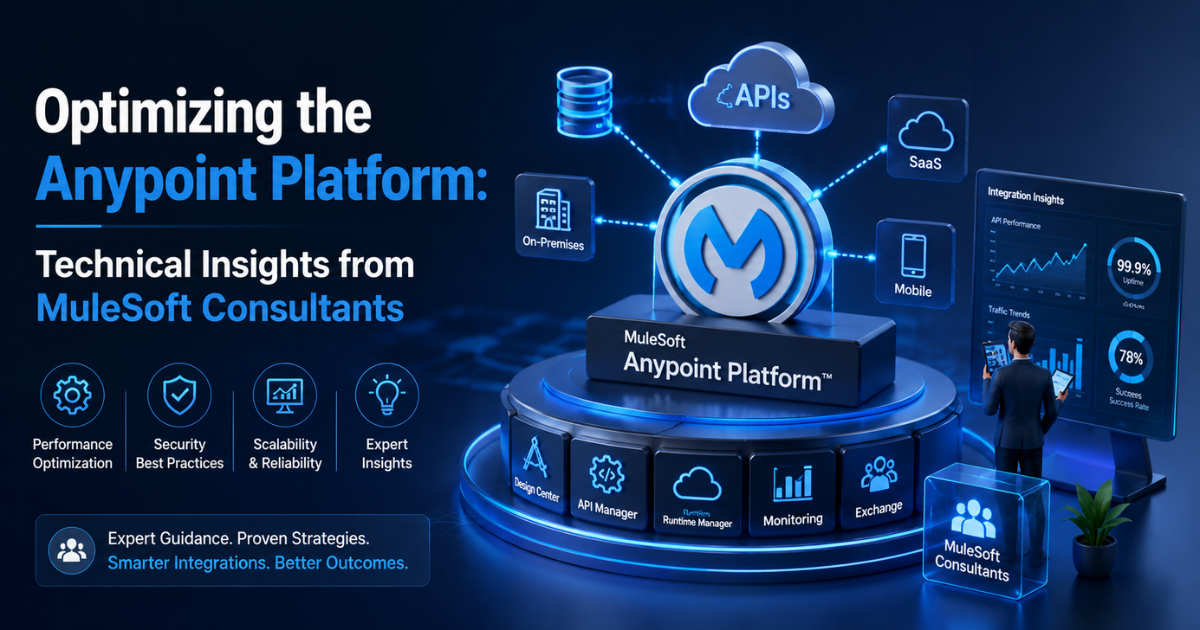
Modern enterprises face a massive data challenge. The average organization now uses over 1,000 different applications. However, only 29% of these apps connect effectively. This gap creates massive inefficiency. MuleSoft Consulting helps bridge this divide. It focuses on turning fragmented systems into a unified network. To succeed, technical teams must move beyond basic connectivity. They must optimize the Anypoint Platform for speed and scale.
The Foundation of API-Led Connectivity
Successful integration starts with a clear architecture. MuleSoft Consulting Services advocate for the API-led approach. This method breaks integration into three distinct layers.
- System Layer: These APIs access raw data from core systems like ERPs or databases. They hide the complexity of the underlying technology.
- Process Layer: These APIs combine data from multiple system APIs. They follow specific business logic or workflows.
- Experience Layer: These APIs format data for the end-user. This might be a mobile app, a web portal, or a partner system.
This structure prevents “spaghetti code.” It allows teams to reuse assets. Reusing a single API can save a company over $50,000 in development costs per project.
Technical Performance Tuning
Optimization requires a deep look at the runtime environment. Many teams struggle with high latency or memory leaks. MuleSoft Consulting identifies these bottlenecks early.
1. Memory Management and Workers
CloudHub uses workers to run applications. Each worker has a specific amount of vCores and memory. A common mistake involves over-allocating vCores. This wastes money. A better approach uses vertical or horizontal scaling based on data.
Technical teams must monitor “Heap Memory” usage. If the heap reaches 80% capacity, performance drops. Use tools like Anypoint Monitoring to set alerts. These alerts notify you before the application crashes.
2. Optimizing DataWeave 2.0
DataWeave is the primary transformation engine in MuleSoft. Inefficient code here slows down every transaction. Experts follow these rules:
- Avoid Variable Overuse: Too many variables consume memory.
- Use Streaming: Enable streaming for large payloads. This prevents the system from loading the entire file into memory.
- Selectors: Use specific selectors rather than deep descendants (..) when possible. This reduces CPU cycles.
Security Standards for Enterprise Integration
Security is not an afterthought. It is a core component of MuleSoft Consulting Services. Every API represents a potential entry point for hackers. In 2023, API-related breaches increased by 40% globally.
1. Implementing Edge Security
Anypoint Flex Gateway provides a fast way to secure APIs. It acts as a shield. You can apply policies without changing the underlying code.
- Rate Limiting: This prevents “Denial of Service” attacks.
- IP Whitelisting: This ensures only trusted partners access your data.
- JWT Validation: This confirms the identity of the person calling the API.
2. Secrets Management
Never hardcode credentials in your Mule application. Use a “Properties File” and encrypt it. Better yet, integrate with an external Vault like HashiCorp. This keeps passwords and API keys out of your source code.
The Role of a Center for Enablement (C4E)
A C4E is a functional group that drives integration success. It is not a centralized bottleneck. Instead, it provides the tools for other teams to build their own integrations. MuleSoft Consulting often starts by building a C4E.
- Standardization: Create templates for logging and error handling.
- Discovery: Use Anypoint Exchange to share APIs across the company.
- Governance: Ensure all teams follow the same security protocols.
Statistics show that companies with a mature C4E build integrations 3x faster. They also reduce their maintenance costs by 30%.
Advanced Monitoring and Analytics
You cannot fix what you cannot see. Visualizing the flow of data is essential for optimization. MuleSoft Consulting Services implement advanced telemetry.
1. Visualizer and Insights
Anypoint Visualizer creates a map of your API network. It shows which APIs talk to each other. It also highlights failed links in red. This allows for “Mean Time to Recovery” (MTTR) reductions.
2. Custom Dashboards
Standard metrics often miss business context. You can create custom dashboards in Anypoint Monitoring. These might track:
- Total revenue processed through an API.
- The number of failed orders in a specific region.
- The average response time for VIP customers.
Managing the DevOps Pipeline
Continuous Integration and Continuous Deployment (CI/CD) is vital for speed. Technical consultants automate the testing and deployment of APIs. This removes human error from the process.
- MUnit Testing: Every API must have a suite of MUnit tests. These tests should cover at least 80% of the code.
- Automated Build: Use Maven to compile the code.
- Deployment: Use the Anypoint CLI or Jenkins to push the code to CloudHub.
Automated pipelines reduce deployment errors by 50%. They also allow teams to release updates daily instead of monthly.
Handling Large Data Volumes
Manufacturing and retail companies often move millions of records daily. Moving this data requires specific patterns.
- Batch Processing: Do not process records one by one. Use the Batch Job component. It splits large datasets into smaller chunks.
- Reliability Patterns: Use Anypoint MQ or RabbitMQ. If a target system goes down, the message stays in the queue. It does not get lost.
- Parallel Processing: Use the “For Each” scope with parallel settings to speed up execution.
Common Pitfalls to Avoid
Even with MuleSoft Consulting, teams can make mistakes. Avoiding these five errors will keep your platform healthy.
| Pitfall | Technical Impact | Solution |
| Point-to-Point Links | High maintenance and brittle code. | Adopt API-led architecture. |
| Ignoring Logs | Impossible to debug production issues. | Use a centralized log manager like ELK or Splunk. |
| Large Payloads | High latency and memory crashes. | Implement pagination and streaming. |
| No Documentation | New developers cannot understand the code. | Use RAML or OAS for every API. |
| Over-Engineering | Excessive complexity and slow delivery. | Stick to the simplest solution that meets the requirement. |
The Value of Professional Guidance
Why do companies invest in MuleSoft Consulting Services? The platform is powerful but complex. A single misconfiguration can lead to high costs. For example, leaving an API open can result in millions of unnecessary calls. These calls consume vCores and increase your bill.
Expert consultants bring “Design Patterns” from other industries. They know what works at scale. They help you avoid “Technical Debt.” This debt occurs when you build quick, messy solutions that you must fix later. Reducing technical debt saves a company an average of 25% of its IT budget over five years.
Future Trends in Integration
The integration landscape is shifting toward automation and AI. The Anypoint Platform now includes AI-assisted coding. This helps developers write DataWeave scripts faster.
- Universal API Management: Manage APIs regardless of where they run. This includes APIs on AWS, Azure, or on-premise servers.
- Event-Driven Architecture: Move from “request-response” to “real-time events.” This is crucial for IoT and instant notifications.
- Hyperautomation: Combine RPA (Robotic Process Automation) with MuleSoft to automate legacy desktop tasks.
Conclusion
Optimizing the Anypoint Platform is a continuous journey. It requires a mix of architectural discipline and technical precision. By leveraging MuleSoft Consulting, organizations can transform their IT landscape. They move from slow, disconnected systems to an agile, API-led enterprise.
Focus on the three layers of connectivity. Monitor your memory usage closely. Secure every endpoint with the Flex Gateway. Most importantly, build a culture of reuse through a C4E.MuleSoft Consulting Services provide the roadmap. However, the technical team must execute the plan. Success leads to faster innovation and lower operational costs. In the modern digital economy, integration is the engine of growth. Efficient integration is the fuel that keeps that engine running.
