

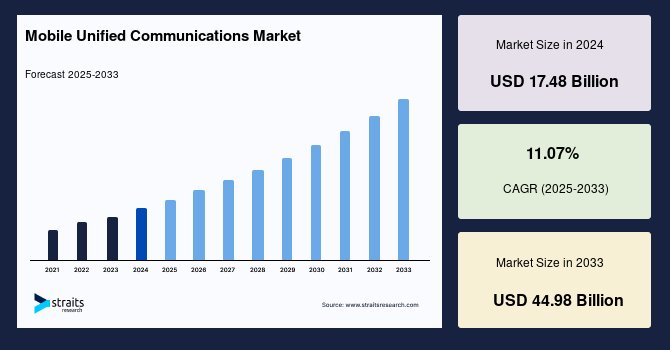
The global mobile unified communications market is witnessing significant growth due to increasing demand for seamless enterprise communication, rising adoption of remote and hybrid work models, and growing integration of mobile technologies across business operations. According to the latest report by Straits Research, the global mobile unified communications market was valued at USD 17.48 billion in 2024 and is projected to grow from USD 19.42 billion in 2025 to reach USD 44.98 billion by 2033, registering a CAGR of 11.07% during the forecast period (2025–2033).
Mobile unified communications solutions integrate voice, video, messaging, conferencing, and collaboration tools into a single mobile platform, enabling organizations to improve workforce productivity, operational efficiency, and communication flexibility. These solutions are increasingly being adopted across industries including IT and telecommunications, healthcare, education, government, BFSI, and retail to support real-time communication and business continuity.
Market Drivers
One of the major drivers of the mobile unified communications market is the rapid shift toward remote and hybrid work environments. Enterprises are increasingly implementing mobile communication platforms to support distributed workforces, improve collaboration, and ensure uninterrupted business operations. Mobile unified communication systems allow employees to securely access enterprise communication tools from smartphones, tablets, and laptops, enhancing workplace flexibility and productivity.
Another significant growth factor is the rising adoption of bring-your-own-device (BYOD) policies across organizations. Businesses are increasingly integrating unified communication solutions with employee-owned mobile devices to improve mobility and reduce infrastructure costs. The growing use of smartphones and enterprise mobility applications is significantly contributing to market expansion.
Technological advancements such as Voice over Internet Protocol (VoIP), Web Real-Time Communication (WebRTC), Session Initiation Protocol (SIP) trunking, and Voice over LTE (VoLTE) are also supporting market growth. These technologies are enhancing the quality of audio and video communication while improving scalability and user experience across enterprise communication systems.
Additionally, increasing deployment of cloud-based unified communication services is accelerating market expansion. Cloud-based platforms provide cost-effective, scalable, and easily deployable communication solutions, making them highly attractive for small and medium-sized enterprises as well as large organizations.
Market Challenges
Despite strong growth prospects, the mobile unified communications market faces several challenges. One of the primary restraints is the growing concern regarding data security and privacy. Mobile communication platforms often handle sensitive enterprise information, making them vulnerable to cyberattacks, unauthorized access, and data breaches.
Another challenge is the lack of interoperability among different communication platforms and vendor ecosystems. Organizations frequently encounter compatibility issues when integrating multiple communication tools and legacy infrastructure systems.
High deployment and maintenance costs associated with advanced unified communication systems may also limit adoption among small and medium-sized enterprises. Infrastructure upgrades, employee training, and network optimization requirements can increase implementation complexity.
Furthermore, network reliability and bandwidth limitations in certain regions may impact communication quality and user experience, especially for video conferencing and real-time collaboration applications.
Market Segmentation
The mobile unified communications market is segmented based on deployment type, solution, organization size, end-use industry, and region.
By deployment type, the market is categorized into cloud-based and on-premise solutions. Cloud-based deployment is expected to witness the fastest growth due to lower operational costs, scalability, and increasing adoption of subscription-based communication services.
Based on solution, the market includes instant and unified messaging, audio and video conferencing, IP telephony, and others. Instant and unified messaging account for a significant market share owing to increasing enterprise demand for real-time communication and collaboration tools.
By organization size, the market is segmented into SMEs and large enterprises. Large enterprises dominate the market due to extensive communication infrastructure requirements and growing investments in enterprise mobility solutions.
Based on end-use industry, the market includes enterprises, education, government, healthcare, and others. The enterprise segment holds a major market share due to increasing digital transformation initiatives and growing adoption of collaborative work environments.
Regional Insights
Europe dominates the global mobile unified communications market due to increasing demand for advanced communication technologies, strong enterprise mobility adoption, and rising investments in cloud-based collaboration solutions. Countries such as Germany, the United Kingdom, and France are major contributors to regional market growth.
Asia-Pacific is expected to witness the fastest growth during the forecast period. Rapid digitalization, increasing smartphone penetration, expanding IT infrastructure, and growing adoption of remote work practices across China, India, Japan, and Southeast Asia are driving regional market expansion.
North America also represents a significant market share, supported by advanced telecommunications infrastructure, strong cloud adoption, and increasing demand for enterprise collaboration tools. The United States remains a key contributor owing to rising investments in digital workplace technologies and mobile workforce management.
Latin America and the Middle East & Africa are emerging markets supported by growing enterprise digitization, expanding mobile connectivity, and increasing adoption of cloud communication platforms.
Key Players Analysis
The mobile unified communications market is highly competitive, with major companies focusing on cloud-based collaboration technologies, AI-powered communication tools, and integrated enterprise mobility solutions to strengthen their market position. Leading companies operating in the market include Cisco Systems Inc., Huawei Technologies Co. Ltd., Avaya Inc., Broadsoft Inc., IBM Corporation, Microsoft Corporation, NEC Corporation, Nokia Networks, Verizon Enterprise Solutions, and Ribbon Communications Inc.
These companies are increasingly investing in AI-driven communication platforms, unified collaboration ecosystems, advanced mobile conferencing technologies, and secure cloud communication services to improve user experience and support the growing demand for enterprise mobility solutions.
For detailed insights, visit: https://straitsresearch.com/report/mobile-unified-communications-market
About Us
Straits Research is a leading market research and intelligence organization specializing in analytics, advisory services, and comprehensive market research reports across multiple industries. The company provides actionable business insights and strategic market intelligence to help organizations identify growth opportunities and make informed business decisions.
Contact Us
Email: sales@straitsresearch.com
Tel: +1 646 905 0080 (U.S.), +44 203 695 0070 (U.K.)
