

The global agriculture insurance market is witnessing steady growth due to increasing climate uncertainties, rising occurrence of natural disasters, and growing awareness regarding financial risk management among farmers. Agriculture insurance provides financial protection to farmers and agricultural businesses against crop losses, livestock damage, weather-related risks, and other uncertainties that may negatively impact agricultural productivity and income.
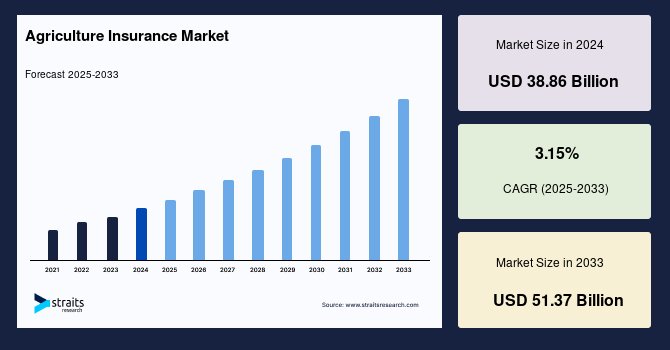
The global agriculture insurance market size was valued at USD 38.86 billion in 2024 and is projected to grow from USD 40.08 billion in 2025 to reach USD 51.37 billion by 2033, growing at a CAGR of 3.15% during the forecast period (2025–2033).
The increasing frequency of extreme weather events, rising government support for crop insurance programs, and growing adoption of advanced agricultural technologies are major factors driving market growth. In addition, increasing awareness regarding risk mitigation and financial stability in the agricultural sector is further supporting the expansion of the agriculture insurance market globally.
Market Drivers
One of the primary drivers of the agriculture insurance market is the increasing impact of climate change on agricultural production. Droughts, floods, storms, and unpredictable rainfall patterns are creating significant financial risks for farmers, increasing the demand for comprehensive insurance coverage.
Another major growth factor is the growing support from governments and agricultural organizations. Many countries are implementing subsidized crop insurance schemes and financial assistance programs to protect farmers against crop failure and income loss.
The adoption of precision agriculture and digital farming technologies is also fueling market growth. Advanced satellite monitoring, remote sensing, weather forecasting, and data analytics are improving risk assessment accuracy and enabling insurers to develop customized insurance solutions.
Additionally, rising global food demand and increasing investments in agricultural productivity are contributing significantly to market expansion by encouraging farmers to secure their farming operations against potential risks.
Market Challenges
Despite favorable growth prospects, the agriculture insurance market faces several challenges. One of the major concerns is the complexity of risk assessment and claim settlement processes. Agricultural losses are often influenced by unpredictable environmental conditions, making accurate evaluation difficult.
Another challenge is the low penetration of insurance services in developing and rural regions due to limited awareness, affordability concerns, and lack of access to financial services.
The market also faces high operational costs associated with claim verification, policy administration, and data collection in geographically dispersed agricultural areas.
Additionally, fraudulent claims, inconsistent regulatory frameworks, and fluctuations in agricultural commodity prices may impact market stability and insurer profitability.
Market Segmentation
The agriculture insurance market is segmented based on insurance type, coverage type, distribution channel, and end user.
By insurance type, the market includes crop insurance, livestock insurance, aquaculture insurance, and others. The crop insurance segment dominates the market due to increasing risks associated with adverse weather conditions, pest infestations, and crop yield losses.
The livestock insurance segment is also witnessing significant growth owing to rising investments in animal farming and increasing concerns regarding disease outbreaks and livestock mortality.
By coverage type, the market is categorized into multi-peril crop insurance, revenue insurance, yield insurance, and others. The multi-peril crop insurance segment accounts for a major market share due to comprehensive coverage against multiple agricultural risks, including weather-related losses and natural disasters.
Revenue insurance is also gaining popularity because it protects farmers against both production losses and fluctuations in market prices.
By distribution channel, the market includes banks, insurance companies, brokers and agents, digital platforms, and others. Insurance companies dominate the market due to extensive product offerings, government partnerships, and specialized agricultural insurance services.
Digital platforms are experiencing rapid growth owing to increasing adoption of mobile technologies and digital financial services in rural agricultural communities.
By end user, the market is segmented into farmers, agricultural cooperatives, agribusiness companies, and others. Farmers account for the largest market share due to increasing awareness regarding crop protection and financial risk management.
Agribusiness companies and cooperatives are also contributing significantly to market growth through large-scale agricultural operations and commercial farming activities.
Regional Insights
Regionally, the agriculture insurance market is analyzed across North America, Europe, Asia-Pacific, Latin America, and the Middle East & Africa.
North America dominates the global market due to strong government-backed crop insurance programs, advanced agricultural infrastructure, and widespread adoption of precision farming technologies. The presence of established insurance providers and large-scale commercial farming operations further supports regional market growth.
Europe also holds a substantial market share driven by increasing climate-related agricultural risks, supportive government policies, and growing awareness regarding sustainable farming practices.
Asia-Pacific is expected to witness the fastest growth during the forecast period. Rising agricultural dependence, increasing climate variability, expanding government insurance initiatives, and growing digitalization in countries such as China, India, Japan, and Australia are driving regional market expansion.
The growing need to protect smallholder farmers and improve agricultural resilience is further contributing to market growth across the region.
Latin America and the Middle East & Africa are emerging markets with increasing agricultural activities, rising awareness regarding financial protection, and improving access to insurance and banking services.
Key Players Analysis
The agriculture insurance market is highly competitive, with several global and regional insurance providers focusing on digital transformation, risk analytics, and customized insurance products to strengthen their market presence.
Companies are increasingly investing in satellite imaging, artificial intelligence, big data analytics, and weather forecasting technologies to improve underwriting accuracy and streamline claims processing.
Manufacturers and insurers are also emphasizing strategic collaborations with governments, financial institutions, and agritech companies to expand insurance accessibility and improve farmer engagement.
Continuous advancements in climate risk modeling, digital agriculture platforms, and precision insurance solutions are expected to intensify market competition during the forecast period.
For detailed insights, visit: https://straitsresearch.com/report/agriculture-insurance-market
About Us
Straits Research is a leading research and intelligence organization, specializing in research, analytics, and advisory services, along with providing business insights and research reports.
Contact Us
Email: sales@straitsresearch.com
Tel: +1 646 905 0080 (U.S.), +44 203 695 0070 (U.K.)
