

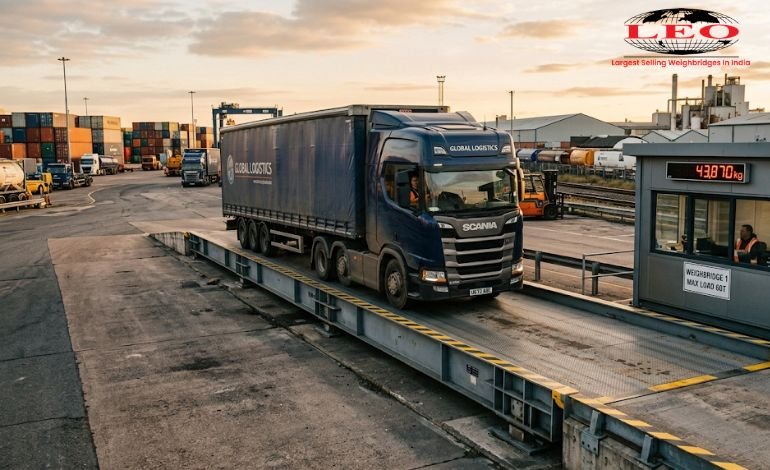
Whether you’ve seen a massive truck rolling onto a large metal platform at a factory gate, a mining site, or a logistics hub — you’ve witnessed a weighbridge in action. But what exactly is a weighbridge, how does it work, and why does it matter for your business?
This guide covers everything you need to know — from the basic definition to types, components, uses, and how to choose the right one.
Table of Contents
- What Is a Weighbridge?
- How Does a Weighbridge Work?
- Key Components of a Weighbridge
- Types of Weighbridges
- What Is a Weighbridge Used For?
- Weighbridge vs. Other Weighing Systems
- How Accurate Is a Weighbridge?
- How to Choose the Right Weighbridge
- Weighbridge Maintenance Tips
- Frequently Asked Questions
What Is a Weighbridge?
A weighbridge (also called a truck scale or weigh bridge) is a large, heavy-duty platform scale used to weigh entire vehicles — including their cargo — without requiring the goods to be unloaded. The platform is built into the ground or installed at ground level, and the vehicle drives onto it to be weighed.
Weighbridges are capable of measuring loads ranging from a few tonnes to over 150 tonnes, making them ideal for industries that regularly move bulk materials like coal, grain, cement, aggregates, steel, and waste.
In simple terms: A weighbridge tells you exactly how much a loaded truck weighs — and by subtracting the truck’s empty weight (tare weight), you can calculate the precise weight of the cargo alone (net weight).
This is known as the gross-tare-net method and is the foundation of all weighbridge operations.
How Does a Weighbridge Work?
A weighbridge works by distributing the vehicle’s weight across a series of load cells — electronic sensors that convert mechanical force (weight) into an electrical signal. Here’s the step-by-step process:
Step 1: Gross Weighing
The fully loaded vehicle drives onto the weighbridge platform. The load cells measure the total weight — this is the gross weight (vehicle + cargo).
Step 2: Tare Weighing
The empty vehicle returns to the weighbridge (or its empty weight is retrieved from a stored record). This is the tare weight.
Step 3: Net Weight Calculation
The weighbridge software automatically calculates:
Net Weight = Gross Weight − Tare WeightThis net weight represents the actual weight of the material being transported — which is what’s invoiced, taxed, or recorded.
Step 4: Data Recording
Modern weighbridges print a ticket or transmit data digitally, capturing the vehicle registration, date, time, gross, tare, and net weights for full traceability.
Key Components of a Weighbridge
A weighbridge is made up of several critical components that work together:
| Component | Function |
|---|---|
| Weighbridge Platform (Deck) | The steel or concrete surface the vehicle drives onto |
| Load Cells | Sensors beneath the platform that measure weight |
| Junction Box | Combines signals from multiple load cells |
| Indicator / Controller | Displays the weight reading digitally |
| Weighbridge Software | Records, processes, and prints transaction data |
| Printer | Produces a physical weighment slip/ticket |
| Barriers / Traffic Lights | Control vehicle flow and safety |
Load Cells — The Heart of Every Weighbridge
Load cells are the most critical component. Most modern weighbridges use digital load cells or analog load cells made of high-grade steel with strain gauges bonded inside. When weight is applied, the steel deforms slightly, the strain gauge resistance changes, and this change is converted into a weight reading.
A standard 60-foot weighbridge typically uses 6 to 8 load cells, each rated for a specific capacity. The combined capacity of all load cells equals the total weighbridge capacity.
Types of Weighbridges
There are several types of weighbridges designed for different installation environments and operational needs.
1. Pitless Weighbridge (Surface-Mounted)
A pitless weighbridge is installed at ground level without requiring excavation. The platform sits above the ground on a concrete foundation, with approach ramps on both ends.
Best for: Sites where excavation is difficult, soil is unstable, or a quick installation is needed.
Advantages:
- Faster and cheaper to install
- Easier maintenance access to load cells
- No water accumulation issues
- Can be relocated if needed
Disadvantages:
- Requires ramps, which take up more space
- Slightly higher platform height may be an issue for very low vehicles
2. Pit-Type Weighbridge (In-Ground)
A pit-type weighbridge is installed in an excavated pit, with the platform sitting flush with the ground surface. Vehicles drive straight onto it — no ramps needed.
Best for: Busy sites with high vehicle throughput, limited space, or where a flat drive-through is preferred.
Advantages:
- No ramps required — saves space
- Easier and faster vehicle access
- Preferred for permanent, high-usage installations
Disadvantages:
- Higher civil construction cost
- Risk of water and debris collection in the pit
- More complex maintenance access
3. Portable / Mobile Weighbridge
A portable weighbridge uses individual axle-weighing pads or modular sections that can be transported and set up at different locations.
Best for: Temporary sites, road enforcement, or businesses that need weighing at multiple locations.
4. Axle Weighbridge
An axle weighbridge is a shorter platform that weighs one axle at a time. The total vehicle weight is calculated by summing individual axle weights.
Best for: Road transport regulation, detecting overloaded axles that can damage roads and vehicles.
5. Multi-Platform Weighbridge
Some large vehicles are longer than a single platform. A multi-platform weighbridge uses two or more connected platforms to accommodate longer trucks, trailers, or road trains.
Quick Comparison: Pitless vs. Pit-Type
| Feature | Pitless | Pit-Type |
|---|---|---|
| Installation Cost | Lower | Higher |
| Civil Work Required | Minimal | Significant excavation |
| Maintenance Access | Easy | Difficult |
| Space Required | More (ramps) | Less |
| Vehicle Access | Via ramps | Drive-through |
| Water Drainage Issues | None | Possible |
| Best Use Case | Flexible/temporary | Permanent, high-traffic |
What Is a Weighbridge Used For?
Weighbridges are indispensable across a wide range of industries:
Logistics & Transport
Trucking companies use weighbridges to verify loads comply with legal weight limits, preventing overloading fines and road damage.
Mining & Quarrying
Coal, iron ore, sand, and aggregate producers weigh every loaded truck leaving the site to calculate tonnage sold and royalties owed.
Agriculture
Grain elevators, rice mills, and fertilizer depots use weighbridges to measure incoming and outgoing commodity volumes accurately.
Steel & Manufacturing
Steel plants weigh raw material deliveries and finished product dispatches for inventory control and billing.
Waste Management
Landfills and recycling plants charge customers based on the weight of waste brought in, making weighbridges essential for revenue collection.
Government & Road Transport
Highway authorities use weighbridges to catch overloaded vehicles that damage road infrastructure and pose safety risks.
Construction
Ready-mix concrete, fly ash, and construction material deliveries are weighed to ensure accurate billing and material tracking.
Weighbridge vs. Other Weighing Systems
| Weighing System | Capacity | Best For |
|---|---|---|
| Weighbridge | 10 – 150+ tonnes | Entire vehicles and heavy loads |
| Platform Scale | Up to 5 tonnes | Pallets, drums, small equipment |
| Crane Scale | Varies | Suspended loads |
| Floor Scale | Up to 10 tonnes | Forklifts, small vehicles |
| Axle Weighpad | Per axle | Mobile weighing, road checks |
No other weighing technology matches the weighbridge’s ability to handle fully loaded heavy vehicles in a single measurement.
How Accurate Is a Weighbridge?
A properly calibrated weighbridge can achieve an accuracy of ±20 kg on a 60-tonne capacity scale — that’s an accuracy of 0.033%, or 1 part in 3,000.
Accuracy depends on:
- Load cell quality — Higher-grade load cells (OIML Class C3 or better) deliver greater precision
- Regular calibration — Most jurisdictions require annual calibration by a certified authority
- Environmental factors — Wind, temperature extremes, and vibration can affect readings
- Platform condition — Debris, uneven loading, or mechanical wear reduces accuracy
- Software settings — Proper zero-point calibration before each shift matters
In India, weighbridges used for trade must be verified and stamped by the Weights & Measures Department under the Legal Metrology Act, 2009.
How to Choose the Right Weighbridge
When buying or installing a weighbridge, consider these key factors:
1. Capacity
Choose a weighbridge with a rated capacity at least 20–25% above your maximum expected vehicle weight. For most truck applications in India, a 60-tonne capacity is standard.
2. Platform Size (Length × Width)
Platform length must accommodate your longest vehicle. Common sizes:
- 40 feet (12 m) — Standard two-axle trucks
- 60 feet (18 m) — Six-axle trucks and tippers
- 80 feet (24 m) — Multi-axle trucks, trailers
Width is typically 3 metres (10 feet) as standard.
3. Pit-Type vs. Pitless
Based on your site layout, budget, and vehicle type. (Refer to the comparison table above.)
4. Load Cell Technology
- Analog load cells — Cost-effective, widely used
- Digital load cells — More accurate, easier to diagnose faults remotely
5. Software & Integration
Modern weighbridges connect to ERP systems, CCTV cameras, RFID vehicle tags, and automatic number plate recognition (ANPR) systems. Choose software that integrates with your existing operations.
6. Manufacturer Reputation & After-Sales Support
The weighbridge itself is only as good as the support behind it. Look for manufacturers with:
- ISO-certified manufacturing
- On-site installation and calibration
- Rapid spare parts availability
- Local service engineers
Weighbridge Maintenance Tips
A weighbridge is a long-term asset — proper maintenance extends its life and ensures accuracy:
- Clean the platform regularly — Remove debris, mud, and stones that can affect weight readings
- Inspect load cells quarterly — Look for physical damage, moisture ingress, or cable wear
- Calibrate annually — Or more frequently if required by your industry or regulator
- Check approach ramps — Ensure they are level and free of potholes
- Test the zero balance — Verify the empty platform reads zero before every shift
- Keep drain channels clear — Especially for pit-type installations to prevent water damage
- Service the indicator and software — Keep firmware updated and database backed up
Frequently Asked Questions
Q: What is the difference between a weighbridge and a weigh bridge? They are the same thing — “weighbridge” is the standard spelling, though “weigh bridge” is also commonly used.
Q: How long does it take to weigh a truck on a weighbridge? A typical transaction takes 2–5 minutes, including the vehicle driving on, the weight being recorded, and a ticket being printed. Automated systems with RFID and ANPR can reduce this to under 60 seconds.
Q: Can a weighbridge work without electricity? No — electronic weighbridges require power for the load cell indicators and software. However, backup power systems (UPS) can keep operations running during outages.
Q: What is the lifespan of a weighbridge? A well-maintained weighbridge typically lasts 15–25 years. Load cells may need replacement every 8–12 years depending on usage.
Q: What is the legal requirement for weighbridges in India? Commercial weighbridges must be verified under the Legal Metrology Act, 2009 and stamped by the state Weights & Measures Department. Annual re-verification is mandatory.
Q: How much does a weighbridge cost in India? Weighbridge prices in India range from ₹8 lakhs to ₹25+ lakhs depending on capacity, platform size, type (pitless vs. pit), and software. Pit-type installations add civil construction costs.
Final Thoughts
A weighbridge is far more than just a large scale. It is a critical business tool that ensures accurate billing, regulatory compliance, inventory control, and operational efficiency across industries.
Whether you are setting up a new logistics yard, a coal depot, a grain mill, or a construction site, investing in the right weighbridge — from a reliable manufacturer — will pay for itself many times over through accurate measurement and reduced disputes.
About Leotronic Scales Pvt. Ltd.
Leotronic Scales Pvt. Ltd. (leoscale.com) is one of India’s trusted weighbridge manufacturers and suppliers, headquartered in Amritsar, Punjab. With decades of experience, Leo offers a complete range of pitless and pit-type weighbridges, platform scales, and weighing solutions for industries across India.
📞 Contact Leo for a Weighbridge Consultation | 🌐 View Products at leoscale.com
Also Explore : Why Australians Prefer Home Delivery For Fresh Protein During Winter Months
