

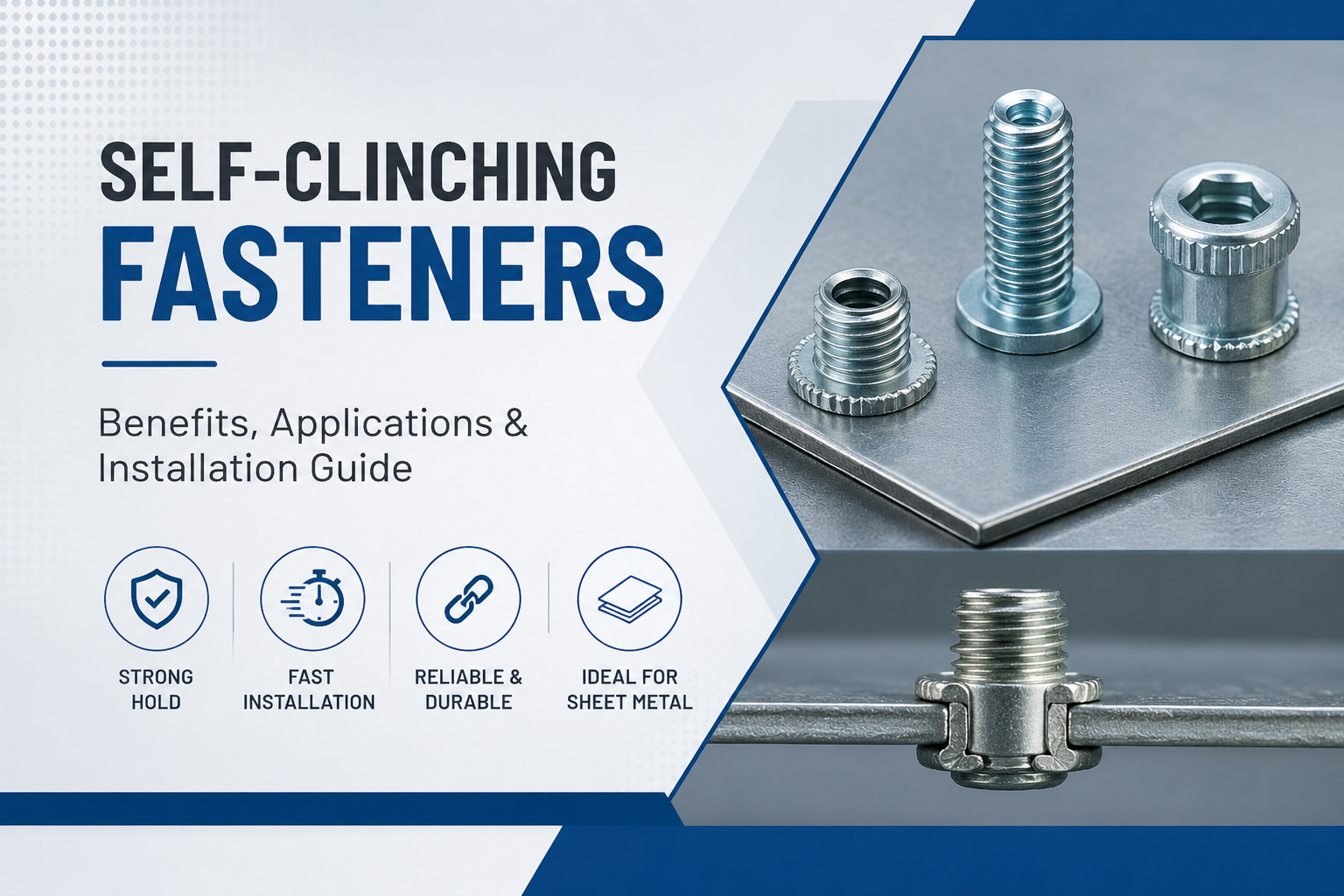
Self-clinching fasteners are a common fastening technique intended to provide strong and permanent threads in thin sheet materials. These fasteners are usually assembled into metal sheets using a pressing process that enables the fastener to be firmly implanted in the material. Installed, they provide strong load bearing threads without the need for welding, loose hardware or extra support components. They are a critical part of contemporary production and assembly procedures because they may offer strong attachment sites in sheet metal.
What Are Self Clinching Fasteners?
Self-clinching fasteners are unique parts that are firmly anchored in ductile metal sheets when driven in with enough force. When installed, the fastener forces the surrounding sheet material into an undercut groove, or other properly shaped depression, in the fastening body. This mechanical interlock avoids rotation and pullout in service.
How Self Clinching Fasteners Work
The installation procedure for self clinching fasteners is a controlled material displacement operation. The sheet material is provided with a hole of suitable size and the fastener is driven into the hole by a squeezing force produced by a press or installation machine. The softer sheet material flows under pressure into the annular groove or knurled region of the fastener. This results in a permanent mechanical lock between the fastener and the sheet metal.
The installation technique does not include heat or welding, and so helps maintain the mechanical qualities of the surrounding material. When firmly placed the fastener is flush with the sheet surface and resists rotation and axial movement. If the amount of pressing power is not proper or the substance of the sheet is not acceptable, the performance of fastening may be impaired and incorrect fastening performance may occur. Proper installation is important.
Self-Clinching Fastener Types
There are several kinds of self-clinching fasteners available based on the application needs. Self-clinching nuts are often utilized to give a strong internal thread in thin sheet materials. These nuts enable you to screw or bolt over and over again without harming the sheet metal.
Self-clinching studs provide permanent external threads that stick out of the sheet surface. These are extensively used for attaching components and assemblies.
Advantages of Self-Clinching Fasteners
Self-clinching fasteners provide several benefits over conventional fastening techniques. Installation is quite quick and it is easy to fit into automated production processes. The self-clinching fasteners provide high resistance to vibration, rotation and pull-out forces. Their constant mechanical interlock enables dependable operation even under harsh operational circumstances.
Another big benefit: space efficient. The fastener being flush to the sheet surface also allows for smaller product designs. The ability to produce stubs with shorter lengths is especially important in electronics and light setups where space is a premium.
High Load Handling Capacity
The robust load-bearing capability is one of the main reasons why industries utilize self-clinching fasteners. Fasteners, when properly put, will hold loads well in the sheet material and provide good thread strength in thin pieces of metal.
The mechanical interlock developed during installation aids in the resistance of torque and axial stresses during operation. This enables the assemblies to retain their structural integrity during vibration, frequent usage and dynamic loads.
Self-clinching fasteners are typically used in situations where the fasteners need to be assembled and disassembled repeatedly. They offer strong reusable threads that resist stripping and wear. They are strong and reliable so they may be used in light and heavy industrial applications.
Benefits of a Space-Saving Design
Today’s goods are shrinking and shrinking, notably in the electronics, telecommunications and consumer products arenas. Self clinching fasteners benefit producers since they do not protrude far from the surface of the sheet, saving space.
The flush mount approach minimizes component interference and enables thinner product profiles. This is particularly beneficial in enclosures, panels and electronic housings when interior space is restricted.
Traditional methods of attaching typically need extra hardware or thicker material to provide enough thread strength. Self-clinching fasteners alleviate several of these limits and allow for lightweight product designs. Their compact construction also enhances the aspect of the products and the lay-out of the assembly.
Enhanced Manufacturing Efficiency
Self-clinching fasteners provide a huge benefit in productivity. The installation method is straightforward and rapid, and is well suited to large volume production situations. As the fastener is permanently embedded in the sheet material, no subsequent welding, adhesives or complicated assembly techniques are required.
This minimizes labour costs and manufacturing cycles. The reduced handling of stray hardware also contributes to streamlining production processes. Fasteners are installed at early stages of manufacturing, which enhances the efficiency of the workflow and minimizes total complexity of assembly.
Vibration And Loosening Resistance
Vibration may cause conventional fasteners to gradually loosen, notably in machinery, transportation systems and industrial equipment. Self-clinching fasteners are permanently incorporated into the sheet, providing considerable resistance to loosening.
Even when subject to constant vibration and dynamic stress, the mechanical interlock prevents rotation and movement. This increases the assembly dependability and minimizes the maintenance required.
Uses in the Electronics Industry
One of the main consumers of self-clinching fasteners is the electronics sector. Thin sheet metal enclosures, panels and chassis need dependable threaded connection points without adding product size or weight.
Self-clinching fasteners are often employed in servers, communications systems, control panels, medical devices and computer hardware. The space-saving design allows large densities of electronic assembly without sacrificing the performance of the fastening.
Furthermore, these fasteners enhance serviceability by allowing frequent installation and removal of components without destroying the enclosure material. They have a sleek look and mount flush, excellent for precision electronic equipment.
Automotive Manufacturing Applications
Self-clinching fasteners are used by automotive manufacturers in body panels, dashboard assemblies, brackets, electrical systems and lightweight structural components.
The automobile sector requires fastening systems that are strong, vibration resistant, lightweight and easy to assemble. Self-clinching fasteners satisfy these criteria and facilitate high-volume manufacturing operations.
Aerospace Industry Applications
The aircraft sector needs fastening systems that can tolerate vibration, temperature fluctuations and harsh operating conditions while decreasing weight. Self-clinching fasteners are often employed in aircraft interiors, access panels, electrical systems and lightweight structural assemblies. They have good strength to weight ratio and may be installed in a compact manner for aeronautical applications .
A joint failure may threaten operational safety, and so reliable fastening performance is crucial in aeronautical systems. Self-clinching fasteners may enhance the integrity of an assembly and minimize the need for maintenance. Advanced materials and precise production make them even more suited to aeronautical settings.
Conclusion
As manufacturing technologies continue to evolve, self-clinching fasteners remain an important solution for lightweight and high-performance assemblies. Fastener World (India) continues to support industrial applications with dependable fastening expertise and quality fastening solutions designed for modern engineering and manufacturing requirements.
