

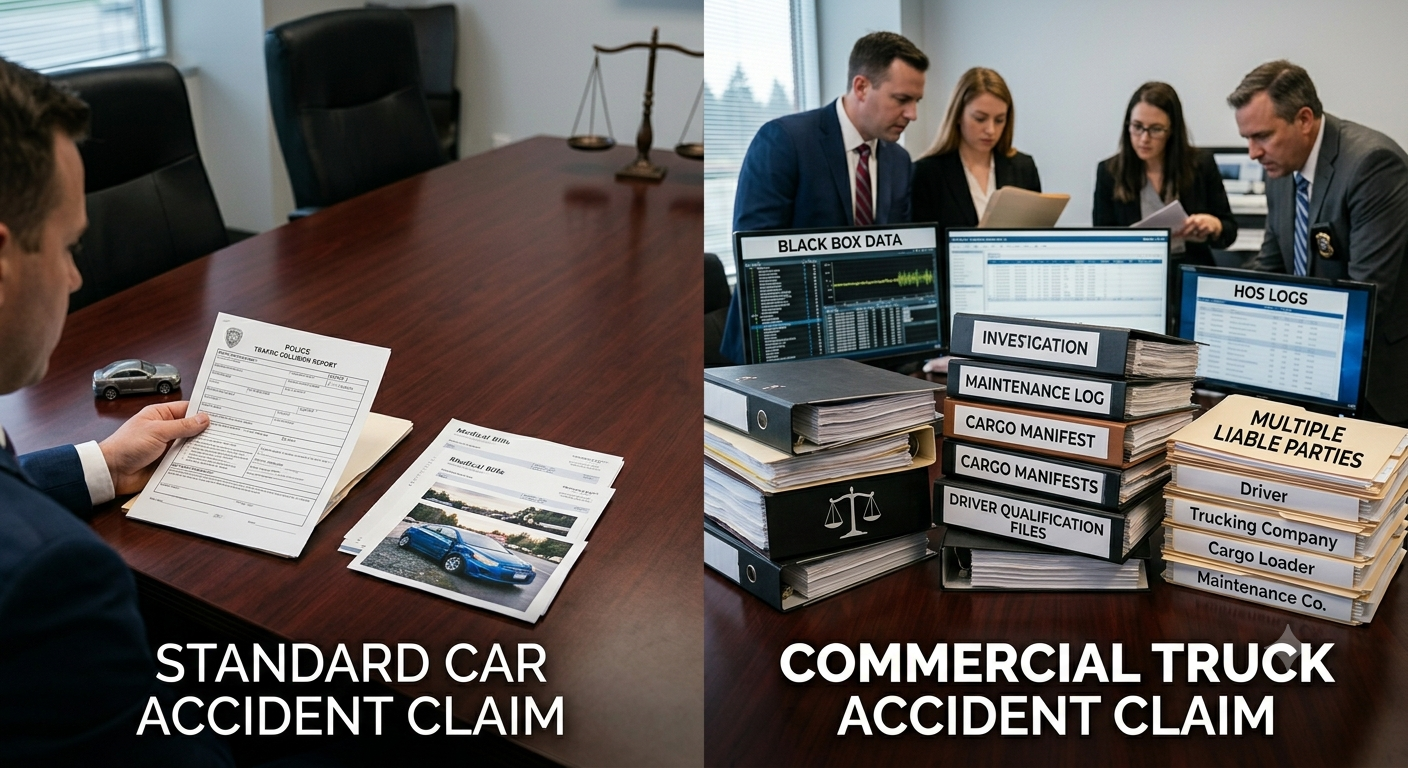
At first glance, a truck accident may seem similar to a typical car accident. Both involve motor vehicles, insurance companies, and injury claims. However, truck accident cases are often much more complicated. The size of commercial trucks, the severity of injuries, federal regulations, and the number of potentially responsible parties make these claims significantly different from ordinary car accident cases.
Understanding these differences is important for anyone injured in a collision involving an 18-wheeler, semi-truck, tractor-trailer, or other commercial vehicle. Victims often seek guidance from an experienced truck accident lawyer to navigate the unique challenges associated with commercial trucking claims.
The Severity of Injuries Is Often Greater
One of the biggest differences between truck accident claims and car accident cases is the severity of injuries.
Commercial trucks can weigh up to 80,000 pounds when fully loaded. In comparison, the average passenger vehicle weighs only a fraction of that amount.
As a result, truck accidents frequently cause:
- Traumatic brain injuries (TBI)
- Spinal cord injuries
- Paralysis
- Internal organ damage
- Severe fractures
- Amputations
- Burn injuries
These catastrophic injuries often require extensive medical treatment and lead to significantly higher compensation claims than typical car accident injuries.
Truck Accident Cases Often Involve Multiple Liable Parties
In many car accident cases, liability usually rests with one or both drivers.
Truck accident claims are different because multiple parties may share responsibility.
Potentially liable parties include:
- Truck drivers
- Trucking companies
- Cargo loading companies
- Maintenance providers
- Truck owners
- Vehicle manufacturers
For example, a truck driver may have been speeding while the trucking company failed to properly train the driver. In such cases, both parties could be liable for damages.
Identifying all responsible parties is critical because it may increase the compensation available to victims.
Federal Regulations Play a Major Role
Unlike passenger vehicle drivers, commercial truck drivers and trucking companies must comply with federal regulations.
The Federal Motor Carrier Safety Administration (FMCSA) establishes rules governing:
- Driver qualifications
- Hours of Service (HOS)
- Vehicle inspections
- Maintenance requirements
- Cargo securement
- Drug and alcohol testing
Violations of these regulations can become powerful evidence in a truck accident claim.
Car accident cases rarely involve this level of regulatory oversight.
Truck Accident Investigations Are More Complex
Truck accident investigations often require significantly more evidence than standard car accident claims.
Important evidence may include:
Black Box Data
Most commercial trucks contain Event Data Recorders that capture information such as:
- Speed
- Braking activity
- Engine performance
- Driver actions before impact
Electronic Logging Devices (ELDs)
ELDs track driving hours and help determine whether a driver violated Hours of Service regulations.
Maintenance Records
Inspection and repair records can reveal whether mechanical failures contributed to the accident.
Driver Qualification Files
These records may show inadequate training, licensing issues, or prior safety violations.
Because trucking companies control much of this evidence, prompt preservation is often essential.
Insurance Coverage Is Usually Higher
Commercial trucking companies are required to carry substantial insurance coverage due to the potential severity of accidents.
Depending on the operation, trucking policies may provide significantly higher coverage limits than typical passenger vehicle insurance.
This can be beneficial for injured victims because:
- Serious injuries often result in large damages.
- Medical expenses can be extensive.
- Long-term care costs may be significant.
However, larger insurance policies also mean insurance companies often fight claims more aggressively.
Trucking Companies Have Immediate Response Teams
After a serious truck accident, trucking companies frequently deploy investigators, attorneys, and insurance representatives almost immediately.
Their objectives often include:
- Protecting company interests
- Preserving favorable evidence
- Limiting liability
- Reducing financial exposure
In contrast, most car accident cases do not involve large corporate defense teams.
This difference makes truck accident claims particularly challenging for injured victims.
Damages Are Often Much Higher
Because truck accidents frequently involve catastrophic injuries, the value of the claim is often significantly greater.
Potential damages may include:
Medical Expenses
Compensation for:
- Emergency treatment
- Surgery
- Rehabilitation
- Future medical care
Lost Income
Victims may recover:
- Lost wages
- Future earnings
- Reduced earning capacity
Pain and Suffering
Serious injuries often result in substantial non-economic damages.
Long-Term Disability
Permanent disabilities may require lifelong care and support.
The higher financial stakes make truck accident litigation more complex than most car accident cases.
Expert Witnesses Are Frequently Needed
Truck accident claims often rely on expert testimony to establish liability and damages.
Common experts include:
- Accident reconstruction specialists
- Medical experts
- Trucking industry professionals
- Economists
- Vocational rehabilitation experts
These specialists help explain technical issues that juries, judges, and insurance companies may not fully understand.
Car accident cases generally require fewer expert witnesses.
Wrongful Death Claims Are More Common
Unfortunately, truck accidents have a higher fatality rate than most passenger vehicle crashes.
Surviving family members may pursue wrongful death claims seeking compensation for:
- Funeral expenses
- Burial costs
- Loss of financial support
- Loss of companionship
- Emotional suffering
Because of the devastating nature of these losses, wrongful death truck accident claims are often highly contested.
Evidence Preservation Is Critical
Evidence in truck accident cases can disappear quickly if action is not taken.
Examples include:
- Black box data being overwritten
- Driver logs being lost
- Maintenance records being altered
- Surveillance footage being deleted
Prompt investigation is often necessary to preserve valuable evidence before it becomes unavailable.
This issue is less common in ordinary car accident claims.
Settlement Negotiations Are Often More Aggressive
Insurance companies handling commercial trucking claims are usually dealing with large potential payouts.
As a result, they often:
- Challenge liability
- Dispute injury severity
- Question medical treatment
- Minimize damages
Victims should expect more aggressive negotiation tactics compared to a standard car accident claim.
Strong evidence and thorough preparation are often necessary to secure fair compensation.
Why Legal Representation Matters in Truck Accident Claims
The complexity of truck accident litigation often makes experienced legal representation especially important. Many victims turn to the best 18 wheeler accident lawyer available to investigate their case and protect their rights. An experienced 18 wheeler truck accident lawyer understands federal trucking regulations, accident reconstruction evidence, and commercial insurance policies. Whether working with an 18 wheeler accident lawyer Texas victims trust or an experienced lawyer for 18 wheeler accident litigation, knowledgeable legal counsel can help identify liable parties and maximize compensation. A skilled Texas truck accident lawyer can also preserve critical evidence and effectively negotiate with trucking companies and insurance carriers.
Conclusion
While truck accident injury claims and car accident cases may appear similar, they differ in many important ways. Truck accident claims often involve more severe injuries, multiple liable parties, federal regulations, complex investigations, larger insurance policies, and higher potential compensation.
Because of these unique challenges, victims injured in commercial trucking accidents should understand that these cases require a different legal approach than standard car accident claims. A thorough investigation, strong evidence, and an understanding of trucking industry regulations are often essential to obtaining fair compensation and holding negligent parties accountable.
