

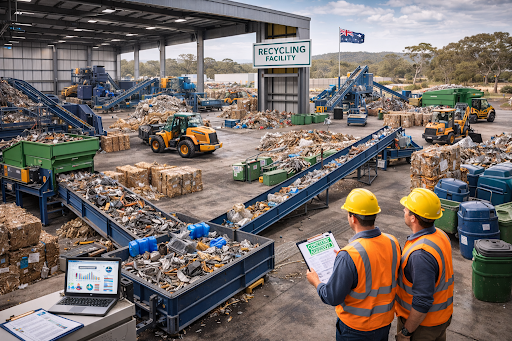
Modern waste systems are evolving rapidly as cities and industries look for more efficient ways to handle increasing volumes of recyclable materials. One of the most widely adopted methods is co mingled recycling, in which different recyclable materials are collected together as a single stream before being separated at specialized facilities. This approach reduces the burden on households and businesses while centralizing sorting at advanced processing plants. In today’s waste ecosystem, it plays a crucial role in improving recovery rates, reducing reliance on landfills, and streamlining collection systems. However, its efficiency heavily depends on the design and capability of downstream processing systems, particularly infrastructure supported by advanced sorting technologies.
What is Co-Mingled Recycling?
Recycling is a system in which materials such as plastics, metals, paper, and glass are collected together in a single container rather than being separated at the source. These mixed recyclables are then transported to material recovery facilities (MRFs), where they are sorted using mechanical and automated processes.
This system simplifies waste disposal for users but shifts the complexity to recycling facilities. The success of this method depends on how effectively materials can be separated later without significant contamination. According to industry practice, this method is widely used in municipal waste systems because it increases participation rates in recycling programs by reducing household-level sorting effort.
How Recycling Works in Modern Systems
The co-mingled recycling process involves multiple stages designed to gradually separate different material types.
Collection and Transportation
Waste is collected in a single stream and transported to processing facilities. At this stage, contamination levels can vary depending on user behavior and local regulations.
Initial Mechanical Sorting
At the facility, large contaminants and bulky materials are removed. Equipment such as conveyors and pre-sorting screens helps regulate material flow.
Separation of Material Streams
Advanced systems then separate recyclables into categories such as paper, plastics, metals, and glass using specialized machinery. This step is critical for ensuring material purity and market value.
Key Challenges in Recycling Systems
While efficient in concept, co-mingled systems face several operational challenges:
Contamination Issues
One of the biggest challenges is contamination from food waste, liquids, or non-recyclable items. Even small levels of contamination can reduce the value of entire batches.
Mixed Material Complexity
Different materials have different physical properties. For example, glass breaks into sharp fragments while plastics may wrap around machinery, making separation more complex.
Sorting Inefficiencies
Although automation has improved, some materials still require manual intervention due to limitations in sensor-based sorting technologies.
Role of Equipment in Recycling
The efficiency of modern recycling systems is largely determined by the quality of equipment used in processing facilities. Advanced machinery enables accurate separation, higher recovery rates, and reduced operational costs.
Infeed Systems
These systems regulate the flow of incoming waste, ensuring consistent processing and preventing blockages in the recycling line.
Screening Equipment
Screens help separate materials based on size and shape, allowing flat materials like paper to be separated from heavier objects like containers.
Optical Sorting Machines
Optical and near-infrared (NIR) systems identify materials based on their chemical composition and color, enabling precise separation of plastics, paper, and other recyclables.
Metal Recovery Systems
Magnetic separators and eddy current systems extract ferrous and non-ferrous metals, improving material recovery efficiency and reducing contamination.
Balers
Once sorted, materials are compressed into compact bales for efficient transportation and resale in recycling markets.
These technologies collectively ensure that co-mingled waste streams are processed effectively and transformed into reusable raw materials.
Importance of Recycling in Sustainable Waste Systems
Co-mingled systems contribute significantly to sustainability goals by making recycling more accessible and scalable. They encourage higher participation rates because users do not need to sort waste at the source. Additionally, centralized sorting allows for the use of advanced technologies that improve material recovery rates.
However, the effectiveness of these systems depends on continuous investment in modern processing facilities and improved public awareness about contamination reduction.
Conclusion
As urban populations grow and waste generation increases, efficient recycling systems are becoming essential. offers a practical and scalable solution by simplifying collection while relying on advanced technology for sorting and recovery. The integration of modern waste management equipment plays a vital role in ensuring these systems operate efficiently, reducing reliance on landfills and supporting circular economy goals. Amid evolving sustainability challenges, it continues to drive innovation in recycling infrastructure. Ultimately, the future of recycling depends on improving both system design and technological capability to handle increasingly complex waste streams.
