

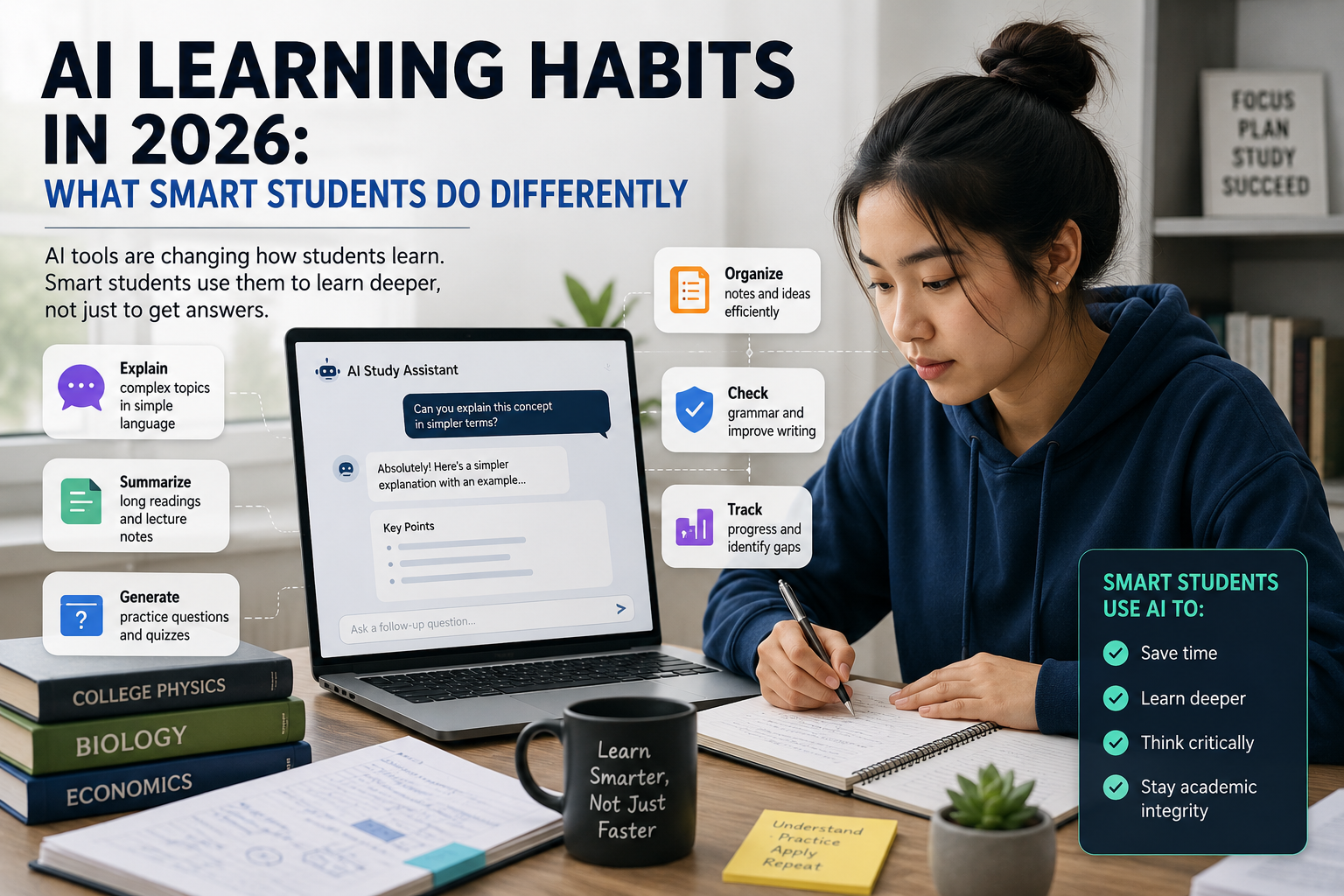
The conversation around AI in education has changed dramatically. Just a few years ago, universities debated whether students should use artificial intelligence at all. By 2026, the discussion looks very different. AI tools have become part of everyday academic life, helping students research topics, organize notes, prepare for exams, and improve their writing.
Yet the students gaining the greatest advantage are not necessarily those using AI the most. They are the ones using it most effectively.
Research on AI adoption across U.S. colleges suggests that a new set of learning habits is emerging. These habits reveal how students can benefit from AI without sacrificing the critical thinking skills that higher education is meant to develop.
The Rise of the AI-Assisted Student
Artificial intelligence is now built directly into many of the platforms students already use. Word processors, note-taking apps, presentation software, and learning management systems increasingly include AI-powered features. As a result, students interact with AI throughout the day, often without thinking about it as a separate technology.
This shift has changed how students approach studying. Instead of searching through multiple websites for answers, they can engage in a conversation with an AI assistant that explains concepts, creates summaries, and generates practice questions in real time.
For many students, this feels like having a personal tutor available at any hour. A difficult economics concept can be broken down into simpler language. A chemistry formula can be explained step by step. A research topic can be organized into a structured outline within minutes.
The appeal is obvious. Students save time and receive immediate support when they need it most.
Why Personalization Is Driving Better Results
One of AI’s strongest educational advantages is its ability to adapt explanations to individual learners.
Traditional classrooms must balance the needs of dozens or even hundreds of students. AI, by contrast, can respond directly to a single student’s questions and learning style. If an explanation feels too advanced, the student can ask for a simpler version. If it seems too basic, they can request a deeper analysis.
This flexibility is particularly valuable for international students studying in English. AI can simplify dense academic language, clarify unfamiliar terminology, and help students focus on understanding concepts rather than struggling with vocabulary alone.
The process resembles having a patient study partner who never becomes frustrated by repeated questions. Students gain confidence because they can explore ideas privately before discussing them in class.
As AI tools continue improving, personalized learning is becoming less of a luxury and more of an expectation.
The Hidden Cost of Taking Shortcuts
The convenience of AI creates a challenge that universities are taking seriously.
Many educators worry that students may use AI to bypass difficult thinking instead of strengthening their understanding. Research cited by educational organizations points to concerns about weaker reading habits, reduced perseverance, and less engagement with challenging academic tasks when AI becomes a substitute for learning rather than a support system.
Imagine a student training for a marathon while driving the course instead of running it. They may know the route, but they never develop the endurance required to finish the race.
The same principle applies to learning. Students who rely on AI-generated answers without understanding the reasoning behind them often struggle when faced with exams, discussions, or assignments that require independent thinking.
The technology itself is not the problem. The issue lies in how it is used.
Human Guidance Still Matters
Despite rapid advances in AI, research consistently shows that human support remains essential in education. AI can explain concepts, but it cannot fully replace mentorship, encouragement, or discipline-specific expertise.
This is where academic support systems continue to play an important role. Students often encounter situations where they need feedback tailored to a specific course, assignment, or instructor expectation. In these cases, resources such as Expertsmind.com’s subject online tutor network can complement AI tools by providing personalized explanations and one-to-one academic guidance that automated systems cannot always deliver.
The strongest learning outcomes often come from combining both approaches. AI provides speed and accessibility, while experienced educators offer context, judgment, and accountability.
Universities themselves are adopting this balanced perspective. Rather than banning AI, many institutions now focus on teaching students how to use it responsibly alongside traditional academic support.
Building Smarter AI Study Habits
The students thriving in 2026 tend to follow a common pattern. They use AI to enhance their learning process rather than replace it.
Instead of asking AI to write an essay, they ask it to critique an outline. Instead of requesting direct answers, they ask for practice questions. Instead of accepting information at face value, they compare AI-generated explanations with textbooks, academic articles, and lecture materials.
Many students are also becoming more transparent about their AI use. Some universities encourage learners to document how AI contributed to brainstorming, research, or editing activities. This approach promotes accountability while helping students reflect on their own learning process.
These habits build something more valuable than efficiency. They develop judgment.
As artificial intelligence becomes increasingly integrated into education and the workplace, the ability to evaluate, question, and refine AI-generated information may become one of the most important skills students can possess.
The future of education will not belong to students who avoid AI entirely, nor to those who depend on it for everything. It will belong to those who understand how to use it thoughtfully. In 2026, the smartest students are not letting AI think for them. They are using it to think better.
