

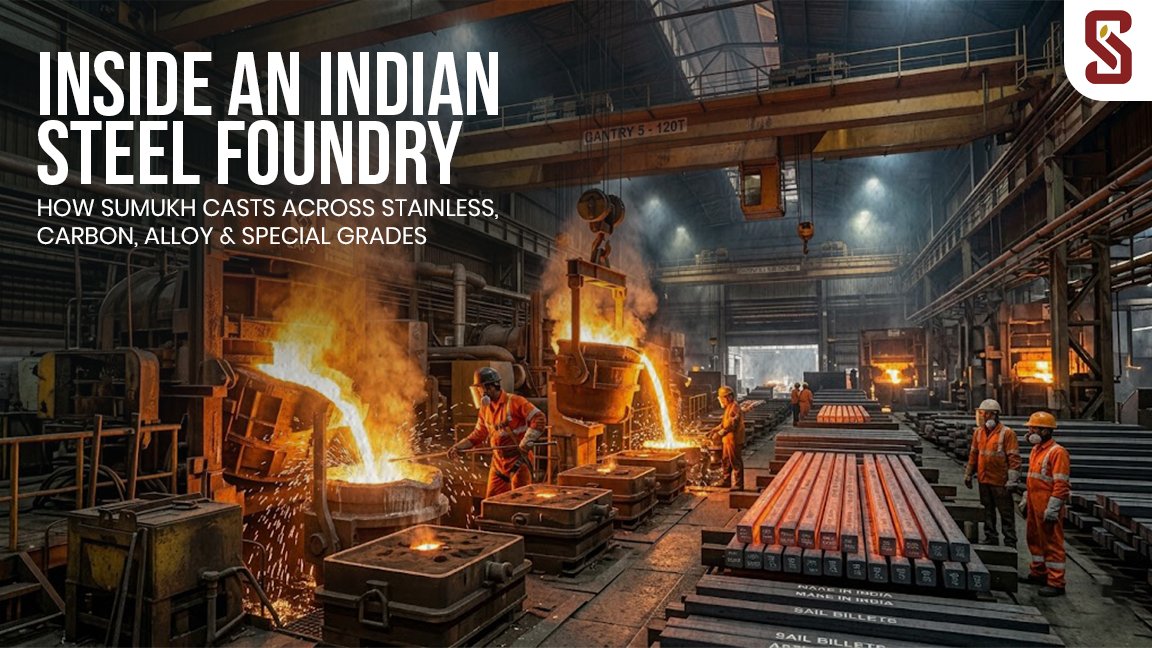
Most articles about choosing a steel casting manufacturer in India talk about the casting and skip the casting bit — the actual making. We’d rather do the opposite. At Sumukh Steel Castings in Kolhapur, the part that decides whether your component is sound or scrap happens long before despatch: in the grade we pick, the moulding route we choose, and the methoding we simulate. So here’s an honest look at how the work actually gets done, and the range we can pour.
We’re an induction-melt foundry running 500 kg and 1,000 kg furnaces, turning out somewhere in the region of 1,200 to 1,800 tonnes a year. That’s a deliberate size — big enough to take serious OEM work, small enough that a job doesn’t get lost in a queue.
It starts with the grade, not the mould
Before anyone talks about patterns, the first question is metallurgical: what does this part have to survive? Get the grade wrong and no amount of clever moulding saves it. Here’s the spread we work across.
Carbon and low-alloy steels
The backbone of structural and general-duty castings — strength and toughness without paying for alloying you don’t need. We pour plain carbon grades and low-alloy compositions for components that have to carry load reliably and machine cleanly.
Stainless steels — CF8, CF8M, CF3, CF3M, CA15, CA6NM
The full austenitic and martensitic range. CF8 and CF8M are the cast equivalents of 304 and 316; the L-grades CF3 and CF3M cover welded and low-carbon duty; CA15 is the martensitic 410-type; and CA6NM is the tougher, more weldable martensitic grade favoured for pump and hydro components. You can read more about our stainless steel casting alloys if you want the detail on each.
Manganese steel — Hadfield / ASTM A128
Austenitic manganese steel is the strange, brilliant one — it work-hardens under impact, so the more you batter it, the harder its surface gets. That makes it the grade for crusher and impact-wear parts that live a hard life.
Heat-resistant steel — HK40
When a casting has to keep its strength and shrug off oxidation at red heat — furnace parts, cooler grate plates, heat-treatment fixtures — HK40 (a 25Cr-20Ni austenitic) is where we go. It’s built to live hot.
Wear-resistant white iron — ASTM A532
For pure abrasion, high-chromium white iron is in a different league on hardness. We use it where the enemy is grit and sliding wear rather than impact — think slurry and material-handling components.
Four moulding routes, picked for the part
There’s no single “best” moulding method — only the right one for the geometry, surface finish, batch size and tolerance you need. We run all four in-house and choose deliberately:
- Shell moulding — our go-to for good surface finish and tight, repeatable dimensions on medium-run parts.
- CO₂ (sodium silicate) — a fast, rigid mould that suits larger or lower-volume work.
- No-bake (furan) — for big castings and complex cores where dimensional stability and clean surfaces matter.
- Lost-foam — for intricate, near-net shapes that would need awkward cores any other way.
Matching route to part is half the craft. A grate plate, a pump impeller and a defence bracket each want a different answer, and pretending otherwise is how foundries get into trouble.
We simulate before we cut steel
This is the step that’s easy to skip and expensive to skip. Every methoding job — the gating, the risers, the feeding — goes through AutoCAST X1 first. We watch the metal fill and solidify on screen, find the hot spots that would have turned into shrinkage porosity, and fix the feeding before any pattern is made. Catching a defect in simulation costs an afternoon. Catching it on the radiography film costs a re-pour.
Then we prove it, heat by heat
Capability means nothing without verification, so nothing leaves on faith:
- Every melt is checked on our Bruker Q4 spectrometer before tapping — chemistry is confirmed, not assumed
- Mechanical testing to the spec — tensile, hardness, impact
- RT and UT for internal soundness; MPI and DPT for the surface
- Dimensional inspection against your drawing, with the paperwork to match
All of it sits under an ISO 9001 system certified by TÜV SÜD, which keeps the discipline consistent rather than person-dependent.
Why the in-house range matters to you
When one foundry can pour carbon, stainless, manganese, heat-resistant and wear-resistant grades and run four moulding routes, you stop juggling vendors. A single supplier who genuinely understands the metallurgy behind each grade is far more useful than five who each do one trick — especially when a part needs judgement rather than a catalogue.
FAQs
What casting weight range can you handle?
Our furnace capacities suit components from small precision parts up to castings in the several-hundred-kilogram range. Send the drawing and we’ll confirm against the specific geometry.
How do you decide which moulding process to use?
It comes down to geometry, surface finish, tolerance and batch size. Shell for finish and repeatability, CO₂ and no-bake for larger work, lost-foam for intricate near-net shapes — we pick per part rather than per habit.
Do you really pour all these grades in one shop?
Yes — carbon and low-alloy, the stainless family (CF8, CF8M, CF3, CF3M, CA15, CA6NM), Hadfield manganese (A128), heat-resistant HK40 and high-chrome wear-resistant iron (A532), all under one roof.
What does casting simulation actually achieve?
It lets us predict how the metal fills and solidifies, so we can design out shrinkage and porosity in the methoding stage — before tooling is cut. Fewer surprises, fewer rejections, faster sampling.
Are your castings traceable for OEM and defence work?
Yes. Heat chemistry, mechanicals, NDT and dimensional records are maintained so each casting can be traced back through its documentation.
Have a drawing that needs the right grade and the right process? Send it to Sumukh Steel Castings and we’ll recommend the grade, the moulding route and the methoding — then back it with simulation and full inspection. Let’s talk specifications.
