

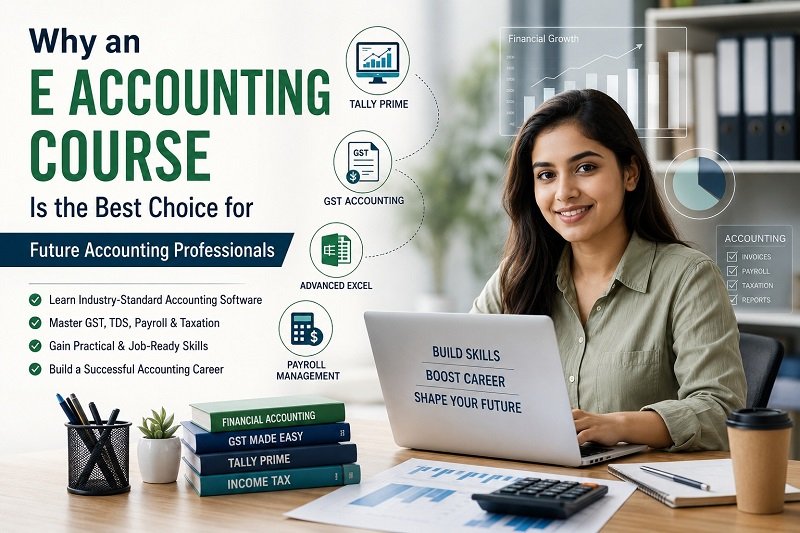
The accounting profession has evolved far beyond traditional bookkeeping. Today, businesses rely on digital accounting systems, GST compliance, cloud-based financial records, and advanced reporting tools to manage their finances efficiently. As companies continue to embrace digital transformation, the demand for professionals with practical accounting software knowledge is increasing rapidly.
Enrolling in an E Accounting Course in Pitampura is one of the smartest career decisions for students, graduates, and working professionals who want to build strong accounting skills and secure rewarding job opportunities. Instead of focusing only on theory, an e-accounting course combines accounting fundamentals with practical software training, making learners job-ready from day one.
Whether you are beginning your accounting journey or upgrading your existing skills, a professional e-accounting course provides the knowledge and confidence required to succeed in today’s competitive business environment.
What Is an E Accounting Course?
An E Accounting Course is a professional training program designed to teach both accounting principles and modern accounting software used by businesses across various industries. The course focuses on practical learning, enabling students to perform real-world accounting tasks with accuracy and efficiency.
Definition and Purpose of E Accounting
E Accounting refers to managing financial transactions electronically using accounting software instead of traditional manual bookkeeping. It simplifies financial management, improves accuracy, and helps businesses comply with tax regulations.
The primary objective of the course is to prepare learners for today’s digital accounting environment by combining accounting concepts with practical software applications.
Key Topics Covered in an E Accounting Course
A comprehensive course generally includes:
- Financial Accounting
- GST Accounting
- Income Tax Basics
- TDS Calculation
- Payroll Processing
- Inventory Management
- Bank Reconciliation
- Financial Reporting
- Business Accounting Practices
Popular Accounting Software You Will Learn
Most professional institutes include training on industry-standard software, such as:
- TallyPrime
- Busy Accounting Software
- Microsoft Excel
- GST Return Filing
- Payroll Management Software
- Inventory Management Tools
Hands-on experience with these applications helps students perform accounting tasks confidently in real business environments.
Why E Accounting Skills Are Essential in Today’s Business Environment
Businesses today expect accounting professionals to possess practical software knowledge alongside theoretical understanding.
Digital Transformation in Accounting
Modern businesses maintain digital financial records, making software proficiency an essential skill for accountants.
Growing Demand Across Industries
Every organization requires qualified accounting professionals to manage daily financial transactions, taxation, payroll, invoicing, and compliance.
Government Compliance and GST Requirements
GST has significantly changed accounting practices in India. Companies require professionals who understand GST billing, return filing, and tax compliance procedures.
Automation and Cloud-Based Accounting
Cloud accounting solutions allow businesses to access financial data securely from anywhere. Learning digital accounting methods prepares professionals for future workplace requirements.
Top Benefits of Choosing an E Accounting Course
An industry-oriented accounting course offers several advantages beyond classroom learning.
Industry-Relevant Practical Skills
Students work on practical accounting scenarios that closely resemble real office environments, helping them gain valuable experience before entering the workforce.
Better Career Opportunities
Organizations actively seek professionals who can manage accounting software without extensive on-the-job training.
Higher Salary Potential
Candidates with practical accounting software expertise often enjoy better salary packages than those with only academic qualifications.
Hands-On Software Training
Practical assignments enable learners to understand voucher entries, ledger creation, GST invoices, taxation, inventory management, and financial reporting.
Improved Accuracy and Productivity
Digital accounting minimizes manual errors while increasing efficiency, making professionals more productive.
Job-Ready Certification
Completing an industry-recognized course demonstrates practical competence and strengthens your resume during recruitment.
Skills You Will Develop Through an E Accounting Course
A professionally designed curriculum develops both technical and analytical accounting skills.
Financial Accounting
Understand journal entries, ledgers, trial balance, profit and loss accounts, and balance sheets.
GST Accounting and Taxation
Learn GST registration, invoice creation, tax calculation, return filing, and compliance procedures.
TDS Calculation and Filing
Gain knowledge of TDS deductions, payments, and statutory requirements.
Payroll Processing
Learn salary calculation, employee deductions, statutory compliance, and payroll management.
Bank Reconciliation
Develop the ability to reconcile bank statements with accounting records accurately.
Inventory Management
Manage stock records, purchase orders, sales entries, and inventory valuation efficiently.
Financial Reporting
Generate reports that help management make informed financial decisions.
Microsoft Excel for Accounting
Master formulas, functions, pivot tables, data analysis, and financial reporting using Excel.
Who Should Enroll in an E Accounting Course?
This course is suitable for individuals from different educational and professional backgrounds.
Commerce Students
Build practical accounting skills alongside academic studies.
B.Com and M.Com Graduates
Improve employability with software-based accounting knowledge.
MBA Finance Students
Develop practical finance and accounting expertise that employers value.
Job Seekers
Acquire industry-ready skills to increase employment opportunities.
Small Business Owners
Manage business finances independently while maintaining proper compliance.
Working Professionals
Upgrade existing accounting skills and improve career prospects.
Entrepreneurs
Understand business finances, taxation, and accounting processes to make better business decisions.
Career Opportunities After Completing an E Accounting Course
Digital accounting skills open doors to numerous career opportunities across industries.
Accounts Executive
Manage financial records, vouchers, invoices, and daily accounting operations.
GST Executive
Handle GST compliance, tax calculations, and return filing.
Tax Consultant
Assist businesses and individuals with taxation and financial compliance.
Payroll Executive
Process employee salaries, deductions, and payroll records.
Junior Accountant
Support accounting teams with bookkeeping and financial reporting.
Accounts Payable Executive
Manage vendor payments and purchase transactions.
Accounts Receivable Executive
Handle customer invoices, collections, and receivables.
Finance Executive
Assist in budgeting, reporting, financial planning, and analysis.
Freelance Accountant
Provide accounting and taxation services to multiple clients independently.
Industries That Hire E Accounting Professionals
Accounting professionals are required across almost every sector.
Manufacturing Companies
Maintain production costs, inventory, and financial records.
Retail Businesses
Manage billing, inventory, and GST compliance.
IT and Software Companies
Support payroll, taxation, and financial reporting.
Banking and Financial Services
Assist with accounting, documentation, and compliance.
E-commerce Companies
Manage online transactions, inventory, taxation, and financial reconciliation.
Chartered Accountant Firms
Work on auditing, taxation, bookkeeping, and financial consulting projects.
Logistics and Supply Chain Companies
Handle invoicing, vendor payments, transportation expenses, and inventory accounting.
Healthcare Organizations
Manage patient billing, payroll, procurement, and financial reporting.
How to Choose the Right E Accounting Course
Selecting the right training institute is just as important as choosing the course itself.
Updated Curriculum
Ensure the syllabus includes the latest GST regulations, accounting practices, and industry requirements.
Practical Software Training
Choose a course that emphasizes hands-on learning rather than only classroom theory.
Experienced Trainers
Qualified instructors with industry experience can provide valuable practical insights.
Live Projects and Case Studies
Real-world assignments improve confidence and problem-solving abilities.
Placement Assistance
Institutes offering interview preparation, resume guidance, and placement support provide added career value.
Industry-Recognized Certification
A recognized certification enhances credibility and improves employment prospects.
Common Mistakes to Avoid When Selecting an E Accounting Course
Choosing Theory Over Practical Learning
Employers prioritize practical knowledge over theoretical concepts alone.
Ignoring Software Training
Software proficiency is now a mandatory requirement for most accounting positions.
Not Checking Placement Support
Placement assistance can significantly improve your chances of securing employment.
Overlooking Course Reviews and Success Stories
Student feedback and placement records provide valuable insight into the quality of training.
Future Scope of E Accounting Professionals
The future of accounting continues to evolve with technology and regulatory changes.
Increasing Demand for Digital Accountants
Businesses increasingly require professionals capable of managing digital accounting systems.
Cloud Accounting and AI Integration
Accounting platforms continue to adopt cloud-based technologies, making software expertise even more valuable.
Remote Accounting Opportunities
Many organizations now hire remote accounting professionals to manage financial operations.
Freelancing and Global Career Prospects
Digital accounting skills enable professionals to work with clients across India and internationally.
Frequently Asked Questions (FAQs)
What is an E Accounting Course?
It is a professional training program that combines accounting concepts with practical software training, including GST, TallyPrime, payroll, taxation, and financial reporting.
Who can join an E Accounting Course?
Commerce students, graduates, working professionals, entrepreneurs, and anyone interested in building a career in accounting can enroll.
Which accounting software is included in the course?
Most courses include TallyPrime, Busy, Microsoft Excel, GST filing software, payroll applications, and inventory management tools.
Is an E Accounting Course good for freshers?
Yes. Freshers gain practical skills that help them secure entry-level accounting positions more easily.
What jobs can I get after completing an E Accounting Course?
Career options include Accounts Executive, GST Executive, Payroll Executive, Junior Accountant, Tax Consultant, Finance Executive, and Freelance Accountant.
How long does an E Accounting Course take to complete?
The duration varies depending on the institute, but most professional courses are completed within a few months.
Does the course include GST and TDS training?
Yes. A comprehensive course covers GST accounting, return filing, TDS calculations, payroll, and taxation.
Is certification important for getting an accounting job?
A recognized certification strengthens your resume and demonstrates practical accounting skills to employers.
Choosing an Computer Institute in Pitampura is an excellent investment for anyone looking to build a successful career in accounting and finance. With practical training in accounting software, GST compliance, payroll management, taxation, financial reporting, and business accounting, you gain the skills employers actively seek.
Whether you are a student, graduate, entrepreneur, or working professional, the right training program can enhance your confidence, improve your employability, and prepare you for long-term career growth. By learning industry-relevant tools and real-world accounting practices, you position yourself for rewarding opportunities in today’s fast-changing financial landscape.
