

A woman in a study group I led years ago admitted, almost apologetically, that she’d skipped most of the Old Testament. Too many genealogies. Too much law, too much war, and not enough of the grace she’d come to faith looking for. I didn’t blame her. Plenty of people feel that way, even people who’ve been in church their whole lives. So what is the Old Testament, really, and why does a book so many find intimidating still carry so much weight for understanding everything that comes after it?
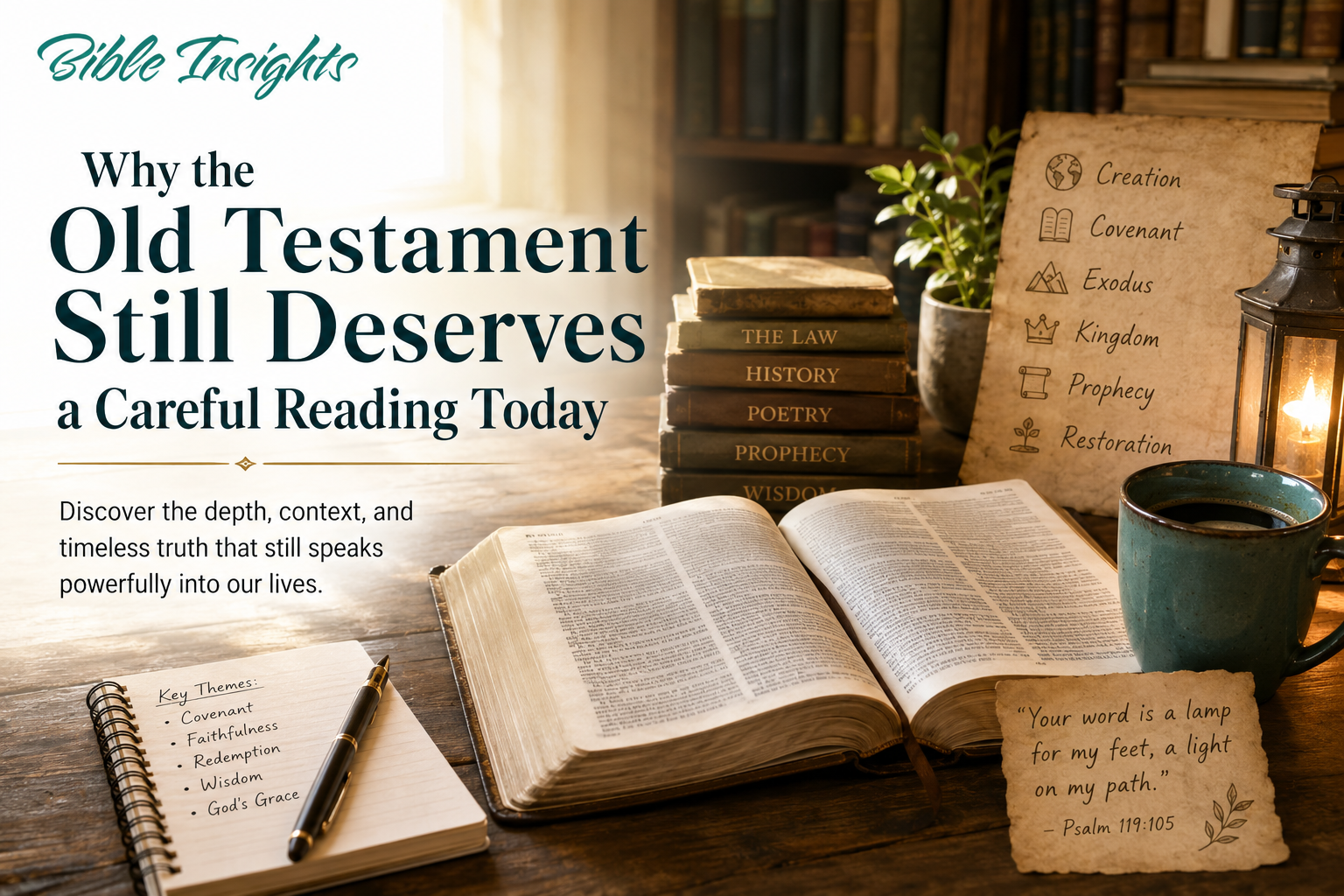
The short answer is straightforward enough. Thirty nine books, written over roughly a thousand years, covering history, law, poetry, prophecy, and wisdom. You could stop there and call it a fair summary. But that description undersells what this collection is actually doing. It isn’t background reading you get through before the “real” story starts. It is the story, or at least the longer half of one continuous narrative. The New Testament simply assumes you already know this world.
Why These Books Were Written the Way They Were
I think what surprises people most, once they start paying attention, is how uneven the Old Testament actually is in tone and purpose. It wasn’t handed down all at once. Prophets, kings, poets, and priests contributed across centuries, each responding to whatever was happening around them at the time. Genesis lays out origins and covenant. Exodus tells a liberation story. Then Leviticus arrives, and this is usually where readers stall out, because it’s less narrative and more instruction, laying out how a newly freed people were supposed to live in relationship with a holy God.
Grasping what is the Old Testament trying to accomplish means seeing that arc as intentional. It’s building something, a picture of who God is, what covenant means, what faithfulness actually looks like in practice, long before the New Testament introduces its central figure. Skip that groundwork and a lot of later teaching loses its footing.
Numbers and Deuteronomy pick up from there, following a generation shaped by wandering and failure and slow renewal. Then Joshua, Judges, Samuel, Kings, and honestly this stretch reads more like messy family history than religious instruction. Faithful leadership and outright disaster sit right next to each other, and nobody bothers to smooth it over. That refusal to sanitize things is, oddly, part of what keeps people coming back.
The Two Misunderstandings I Hear Most Often
There’s a common idea floating around that the Old Testament is basically the harsh, legalistic version of faith that Jesus came along and fixed. I get why people land there, but it doesn’t hold up under any real scrutiny. Grace shows up constantly in these pages, in how patient God is with a people who keep wandering off, in second chances that keep coming even when they haven’t been earned. David fails, publicly and more than once, and what follows isn’t rejection. It’s restoration. That pattern isn’t rare in these books. It’s practically the rhythm of the whole thing.
The other misunderstanding is more of a technical one. People assume every law given to ancient Israel is meant to apply, word for word, to life today. Sorting that out takes a bit more care than most readers expect. Moral commands, ceremonial practices tied to temple worship, and civil regulations written for a specific ancient society aren’t interchangeable categories, even though they show up back to back in the same chapters. A rule about diet and a command against dishonesty were never carrying the same kind of weight, no matter how close together they appear on the page.
A Few Things That Actually Help With Reading It
If you’re wondering how to understand the Old Testament without getting lost, start by asking who wrote a given passage, who they wrote it for, and what was going on when they wrote it. A law given to people who’d just walked out of slavery hits differently than a psalm composed generations later during exile. Context does most of the heavy lifting here.
Genre matters just as much. Poetry isn’t history, and treating it like a factual report misses the point entirely. Prophetic writing leans heavily on symbolic, sometimes strange imagery that was never meant to be read with flat literalism. A reader who expects Ezekiel’s visions and a chapter of genealogies in Chronicles to work the same way is going to end up frustrated, and honestly, that frustration is avoidable.
Where to Actually Start
Here’s the practical part. Ease in with narrative, Genesis, Ruth, that kind of thing, before wrestling with something denser like Leviticus or Numbers. Keep the Psalms close at hand for ordinary life, since their honesty about both struggle and praise still holds up. Save the prophets for later, once you’ve got a handle on the historical backdrop of exile and return, because without that, half of what they’re saying won’t land.
Bible Insight Foundation tends to point newer readers toward pairing the historical books with a rough timeline. Knowing roughly when things happened relative to each other clears up a surprising number of confusing passages. Realizing Isaiah was prophesying well before the exile, for instance, gives his warnings a weight they wouldn’t otherwise carry.
And honestly, pace matters more than people expect. A chapter a day, read slowly, will get you further than an ambitious plan that dies somewhere in the middle of Leviticus three weeks in. I’ve watched that happen more times than I can count.
Why It Still Matters
Nearly every major theme in the New Testament, sacrifice, covenant, kingship, redemption, has roots planted somewhere in these thirty nine books. None of it appears out of nowhere. It’s built on centuries of history and theology that came before.
But the value here isn’t only academic. What makes these pages worth returning to is how unflinchingly honest they are. Abraham doubted more than once. Moses hesitated when God called him. David failed, badly, and in public. None of them are presented as flawless, and yet the story keeps moving forward anyway, carried less by their perfection and more by a steadiness that doesn’t seem to run out.
Bible Insight Foundation keeps encouraging readers to move past a surface level familiarity with these books and actually sit with them. Given some patience and the right context, what is the Old Testament stops feeling like a hurdle standing between you and the New Testament. It starts feeling like exactly what it’s always been: the first half of one long, unfinished story, still speaking honestly into whatever season of life you happen to be in right now.
