

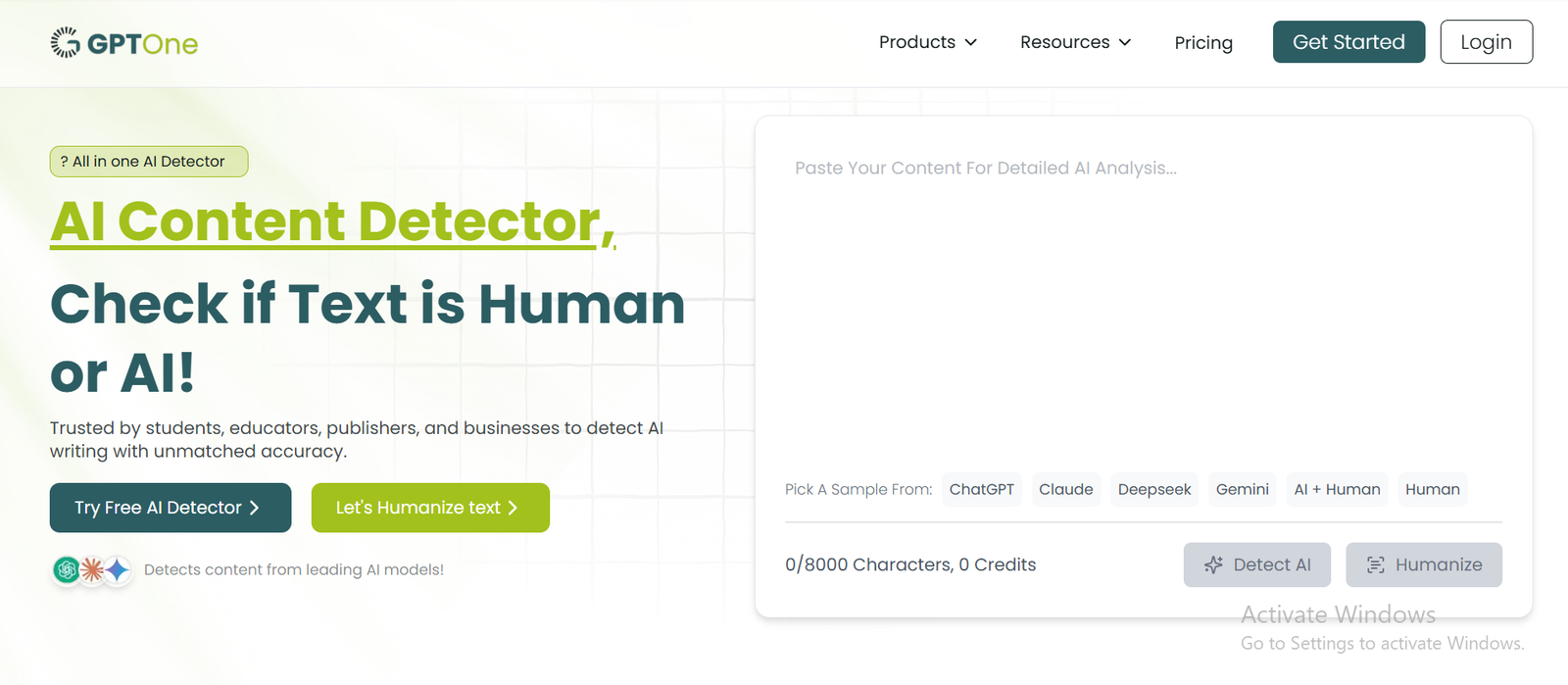
Artificial Intelligence has changed the way people write. Tools like ChatGPT, Claude, Gemini, and other AI writing assistants can create articles, emails, essays, product descriptions, and even entire books within minutes. While this makes content creation faster, it has also increased the demand for reliable AI detection.
Many students, teachers, businesses, publishers, and SEO professionals now use an AI Text Detector to determine whether content was written by a human or generated by AI.
In this guide, you’ll learn how AI detectors work, what they look for, why no detector is 100% accurate, and how GPTOne AI Detector helps identify AI-generated content.
What Is an AI Detector?
An AI detector is a software tool designed to analyze text and estimate whether it was written by artificial intelligence or a human.
Unlike a simple plagiarism checker, an AI detector doesn’t compare text against online sources. Instead, it studies the writing style, sentence patterns, vocabulary, and probability of word choices.
A quality AI detection tool evaluates multiple signals before providing an AI probability score.
If you’re looking for a reliable free AI detector, choosing one that uses advanced language analysis rather than simple keyword matching is important.
How AI Detectors Actually Work
Many people believe AI detectors simply search for common AI phrases. That’s not true.
Modern AI detection systems analyze hundreds of writing characteristics simultaneously.
1. Predictable Word Choices
AI language models generate text by predicting the most likely next word.
Because of this, AI writing often follows highly predictable patterns.
An advanced AI detection tool free solution looks for these predictable sequences that humans are less likely to produce consistently.
2. Sentence Structure
AI-generated text usually contains:
- Similar sentence lengths
- Repeated sentence patterns
- Consistent grammar
- Balanced paragraph structures
Human writers naturally mix:
- Short sentences
- Long explanations
- Questions
- Personal opinions
- Unexpected transitions
This variation helps AI detectors distinguish between human and machine writing.
3. Perplexity Analysis
Perplexity measures how predictable a piece of writing is.
Human writing often includes surprising word choices.
AI writing tends to be more statistically predictable.
Lower perplexity usually indicates AI-generated content, although it isn’t enough on its own.
4. Burstiness
Burstiness measures variation throughout the text.
Human writers naturally create uneven writing with different sentence lengths and writing styles.
AI often maintains a smoother, more consistent rhythm.
Most professional AI detection systems evaluate burstiness together with perplexity.
5. Language Patterns
Modern AI models often produce similar writing habits, including:
- Formal tone
- Balanced paragraphs
- Repeated transitions
- Neutral opinions
- Consistent formatting
An experienced AI Text Detector identifies these recurring patterns.
Can AI Detectors Recognize ChatGPT?
Yes.
Most AI detectors are trained using thousands or even millions of AI-generated samples.
These samples help them recognize common writing characteristics produced by ChatGPT.
However, heavily edited content may become more difficult to classify accurately.
How AI Detectors Identify Claude
Claude generally produces writing that is:
- Natural
- Detailed
- Polite
- Well-organized
Although Claude often sounds more human than many AI models, advanced detection systems still recognize statistical patterns unique to AI-generated text.
How Gemini Content Is Detected
Google Gemini creates highly fluent content with excellent grammar and logical organization.
AI detectors don’t specifically look for “Gemini words.”
Instead, they analyze the statistical behavior of the text itself.
Whether content comes from Gemini, ChatGPT, Claude, or another language model, the detector focuses on writing characteristics rather than the tool’s name.
Can AI Content Avoid Detection?
Some users try to bypass AI detection by:
- Rewriting text manually
- Mixing human edits with AI output
- Using paraphrasing software
- Using a quillbot humanizer
- Changing sentence order
These techniques may reduce AI signals, but they do not guarantee that AI-generated text will appear fully human.
Today’s advanced AI detection systems evaluate overall writing behavior instead of relying on simple phrases.
AI Detection vs AI Plagiarism
Many people confuse AI detection with plagiarism detection.
They are completely different.
AI Detection
AI detection estimates whether the writing was generated by artificial intelligence.
AI Plagiarism Checker
An AI plagiarism checker compares content with published sources to identify copied material.
A document can:
- Pass plagiarism checks
- Still be detected as AI-generated
Likewise, a human-written article can contain plagiarism if copied from another source.
Why AI Detection Isn’t Always Perfect
No AI detector can guarantee 100% accuracy.
Several factors affect results, including:
- Heavy editing
- Very short content
- Mixed AI and human writing
- Technical language
- Creative storytelling
For this reason, AI detection scores should always be treated as probability estimates rather than absolute proof.
Who Uses AI Detectors?
AI detectors are useful for many industries.
Teachers
Schools use AI detection to review student assignments.
Universities
Universities evaluate research papers and essays for AI-generated writing.
Businesses
Companies verify marketing content before publishing.
SEO Agencies
SEO professionals use AI testing to maintain content quality.
Publishers
Publishers review articles to ensure originality and editorial standards.
Benefits of GPTOne AI Detector
GPTOne AI Detector is designed to help users quickly analyze AI-generated content using advanced language analysis.
Some benefits include:
- Fast AI content analysis
- Easy-to-understand reports
- User-friendly interface
- Support for long-form articles
- Reliable AI probability scoring
- Helpful for students, writers, bloggers, and businesses
Whether you’re checking blog posts, academic writing, or business documents, GPTOne makes AI testing simple and accessible.
Tips for Writing More Human Content
If you’re using AI responsibly, consider these tips to make your writing more natural:
- Add personal experiences.
- Include unique examples.
- Vary sentence length.
- Share original opinions.
- Rewrite repetitive sections.
- Use conversational language.
- Verify facts before publishing.
These improvements benefit both readers and search engines.
Choosing the Right AI Checker
When selecting an AI checker free solution, look for features such as:
- Accurate AI detection
- Easy-to-read reports
- Fast processing
- Long document support
- Secure uploads
- Regular model updates
A good detector should provide helpful insights instead of relying on simple guesses.
Is There a Completely Accurate AI Detector?
The short answer is no.
AI writing technology continues to evolve rapidly, and detection technology evolves alongside it.
The best AI detectors combine multiple analytical methods to estimate the likelihood that content was generated by artificial intelligence.
Rather than relying on a single score, users should interpret results alongside their own review and judgment.
Final Thoughts
AI writing tools like ChatGPT, Claude, Gemini, and many others have transformed digital content creation. As AI-generated text becomes more common, reliable detection tools are increasingly important for educators, businesses, publishers, and content creators.
A modern AI detection tool doesn’t simply search for common AI phrases. Instead, it analyzes language patterns, predictability, sentence variation, and writing behavior to estimate whether content is human-written or AI-generated.
If you’re searching for a dependable free AI detector, GPTOne offers an easy way to analyze text and better understand AI-generated writing. Whether you need an AI Text Detector, an AI plagiarism checker, or a practical solution for everyday AI detection, GPTOne AI Detector provides a straightforward experience that helps you evaluate content with greater confidence.
