

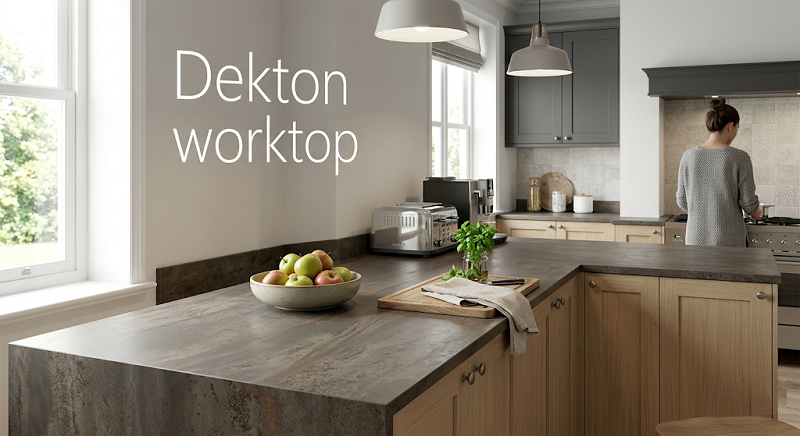
If quartz and granite feel like old news to you, chances are someone’s already pointed you toward sintered stone. A dekton worktop and a neolith worktop are the two names that dominate this category, and they’re often mentioned in the same breath because, frankly, they’re built the same way. That doesn’t mean they’re identical here’s the real comparison.
What Sintered Stone Actually Is?
Both are made through a process that fuses raw minerals (quartz, glass, porcelain-type materials and natural oxides) under extreme heat and pressure, without any resin binder at all. That’s the detail that matters most. Conventional quartz relies on resin to hold everything together, and resin has limits: it doesn’t love UV, and it doesn’t love serious heat. Sintered stone skips the resin entirely, which is why a dekton worktop or neolith worktop can shrug off things that would damage quartz.
Dekton is manufactured by Cosentino, the Spanish company also behind Silestone quartz, using what they call Sinterized Particle Technology. Neolith comes from TheSize, a company that focuses exclusively on sintered stone rather than splitting attention across multiple product lines.
Performance Near-Identical on Paper
Both sit around Mohs 7-8 on the hardness scale, both are non-porous, and both are UV-stable enough for genuine outdoor use something quartz simply can’t offer, since sunlight will yellow its resin over time. Heat resistance is where sintered stone properly shows off: pans straight from the oven can go directly onto either surface without concern, a party trick neither granite nor quartz can fully match.
Where a neolith worktop and a dekton worktop start to diverge is in the format options. Dekton offers a wider thickness range, from 8mm right up to 30mm, alongside some of the largest slab formats on the market, which reduces seams in bigger kitchens. Neolith counters with ultra-thin options down to 3mm, useful for cladding and lightweight applications, alongside its standard countertop thicknesses.
One Honest Drawback
Both materials share the same weak spot: brittleness. The very hardness that makes sintered stone so scratch and heat resistant also makes it less forgiving of a sharp, concentrated impact; a heavy pan dropped edge-first, for example, is more likely to chip a Dekton worktop or Neolith worktop than it would a quartz surface. It’s a trade worth knowing about before you commit, particularly around unsupported overhangs.
Price and Warranty
UK pricing for both typically runs from around £250 up to £1,000 per square metre depending on design, thickness and finish, and both brands back their products with 25-year warranties on countertop applications, provided a qualified installer fits them.
Given how demanding the material is to cut and polish, that installer requirement isn’t just paperwork; sintered stone genuinely needs the right tools and expertise.
Make Your Choice With Koliqi
In practice, most homeowners choose between a Dekton worktop and a Neolith worktop based on the specific colour and pattern that catches their eye rather than any performance gap, since the two perform almost identically in daily use. Dekton’s Stonika range achieves a particularly convincing marble- and quartzite-like look, while Neolith has built a strong reputation for realistic natural-stone reproductions using detailed digital printing.
At Koliqi, we work with both Dekton and Neolith worktops and can talk you through current slab availability, lead times and finishes for your kitchen. If you’re after a surface built for genuinely heavy daily use (hot pans, outdoor kitchens, direct sunlight), sintered stone is worth the conversation, and we’re happy to have it; honestly, with drawbacks included.
