

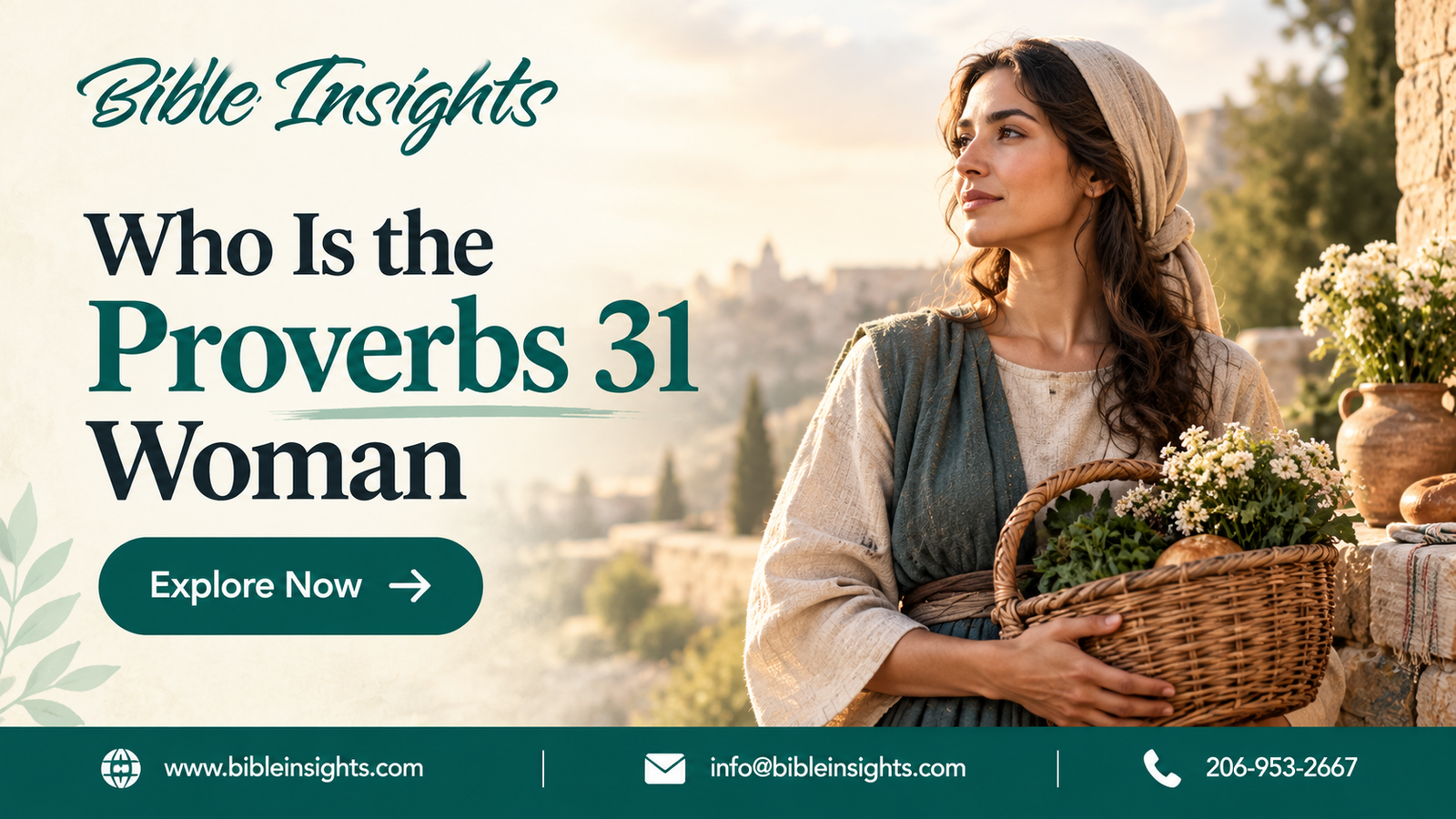
Few chapters in the Bible carry as much weight as the final one in Proverbs. Some readers hear it as a standard to meet, while others hear it as a poem to honor. Both reactions raise the same question: Proverbs 31 praises a woman, but who is she? Is she a real wife with a busy household, Wisdom herself in human form, or a picture of strength that other women in Scripture also share? The text itself gives clues, and so do Jewish and Christian readers who have studied it for centuries. This article walks through the chapter’s structure, the main ways people have understood her, and what the Hebrew phrase behind “noble” or “virtuous” really suggests, so you can read the poem with fresh eyes.
What Is Proverbs 31? Two Voices in One Chapter
The chapter has two parts. Verses 1 to 9 present the words of King Lemuel, an oracle his mother taught him, urging him to rule justly and speak up for people who cannot defend themselves. Verses 10 to 31 form a poem about a capable wife.
That poem is an acrostic. Each of its 22 lines begins with the next letter of the Hebrew alphabet, which makes it easy to memorize and gives the whole piece a sense of completeness, from A to Z. Jewish families traditionally sing it on Friday nights before the blessing over wine.
A Mother’s Advice, Not a Biography
The chapter never names the woman. The only person identified is Lemuel’s mother, who is the teacher here. That detail matters, because many readers treat the woman as one of the biblical figures with a name, a birthplace, and a life story. The text offers none of those.
Instead, the poem works like a mother’s counsel to a son who will carry responsibility. The Hebrew word for strength appears in the advice just before the poem and again at its start, which hints that the two parts belong together.
Three Ways Readers Have Understood Her
Over the centuries, interpreters have settled on three main answers:
- A real wife. The poem describes a woman who manages a household, buys a field, plants a vineyard, sells linen, helps the poor, and teaches with kindness. Many read this as a picture of what a capable wife could be in Israel’s farming and trading world.
- Lady Wisdom. Some early interpreters saw the woman as Wisdom personified, the same figure who calls out to the young in earlier chapters of Proverbs. On this reading, the poem completes the book by showing wisdom at work in daily life.
- An ideal. Others see a composite portrait, a poetic summary of excellence drawn from many women, not a single person.
These views overlap more than they compete. Notice that the poem ends by praising reverence for the Lord, a theme that runs through the whole book.
What “Woman of Valor” Means
The poem opens with the Hebrew phrase eshet chayil. Chayil carries the sense of strength, capability, and valor, a word often used for soldiers and heroes. Its male counterpart, gibbor chayil, appears in stories of warriors. That is why many scholars and translators prefer “woman of valor.”
Translations vary. The King James says virtuous, the NRSV capable, the NIV noble character, and the ESV excellent. Each captures part of the meaning, but none carries the full weight of strength. The same phrase also appears in Proverbs 12:4 and Ruth 3:11.
Valor in Action: Ruth and Her Companions
Ruth gives the clearest example. When Boaz tells her that everyone in the town knows she is an eshet chayil, he is describing a Moabite widow who stayed loyal to her mother-in-law Naomi, worked in the fields, and trusted God in hard circumstances. Her valor is courage and faithfulness, not a perfect home.
Ruth is one of several women of the Old Testament whose strength is plain. Deborah served as prophetess and judge, Abigail acted with wisdom to prevent bloodshed, and Esther risked her life to speak for her people. None resembles the others, yet each shows the kind of capability the poem praises.
The Bible Insight Foundation offers a page on women of the Old Testament for readers who want to meet more of them.
Reading the Poem Without a Checklist
Many women feel pressure after reading this poem. If you try to copy every task, you will probably feel overwhelmed, since the poem compresses a lifetime of skill into one portrait.
A better approach is to ask simple questions:
- What does this line say about wisdom, work, or generosity?
- How might this look in my own season of life?
- Which parts apply to everyone, including men, single readers, and parents?
The chapter honors strength and service, not perfection. That makes it a poem to learn from, not a test to pass.
For more profiles, the Bible Insight Foundation’s pages on biblical figures place each person in context, which helps keep the poem in perspective.
A Poem Meant to Be Praised
So, who is the woman in Proverbs 31? The text points to more than one answer. She can be read as a capable wife, as Wisdom shown in daily life, or as a portrait of valor that Ruth and other women of Scripture also share. What stays constant is the emphasis on strength, generosity, and reverence for God, taught by a mother to her son. If you remember that the chapter is a poem, not a performance review, its message becomes warmer and more freeing. You do not need to match every line. You only need to recognize wisdom, courage, and kindness where they appear, in yourself and in others. In the poem’s own closing spirit, let the work speak for itself.
