

By 2026, 33% of enterprise software applications will include agentic AI capabilities up from under 1% in 2024. An Agentforce consulting partner USA helps businesses deploy autonomous AI agents on the Salesforce platform that handle complex tasks without human intervention. If your team is still managing workflows manually inside Salesforce, you are already behind.
This post covers what an Agentforce consulting partner does, why the right partner matters, which industries gain the most from agentic AI, and the real risks of going it alone.
What Does an Agentforce Consulting Partner Do?
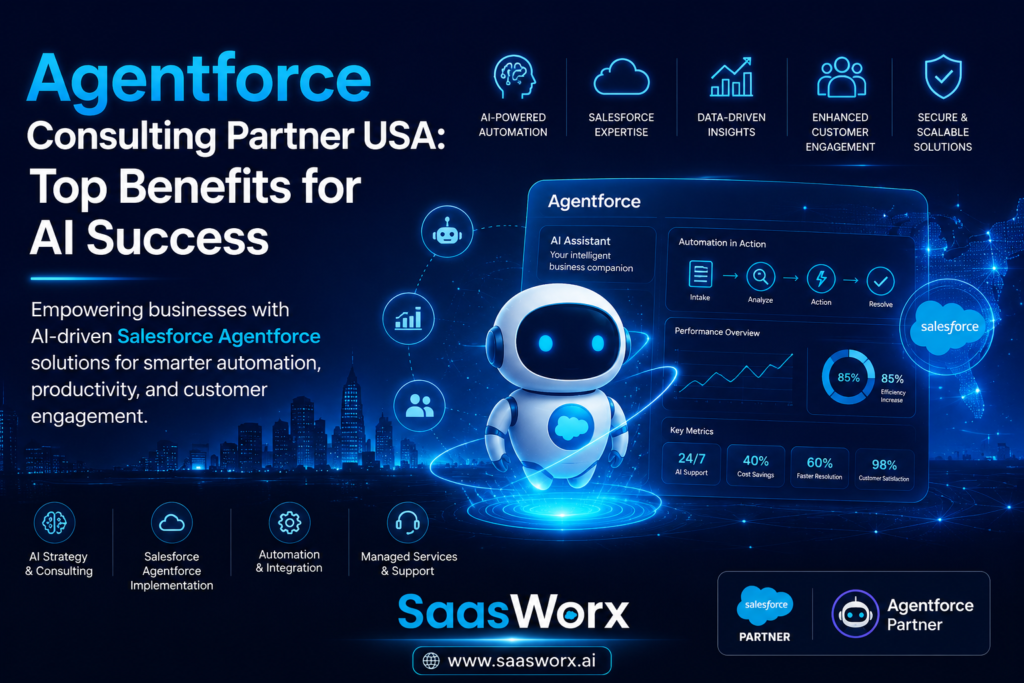
Agentforce Consulting Partner USA
An Agentforce consulting partner designs, configures, and deploys autonomous AI agents inside the Salesforce platform. They map your business processes to agent capabilities, integrate agents with your existing data and systems, and train your teams to manage agent performance over time.
Agent Design and Architecture
Most businesses underestimate what goes into building a working AI agent. A consulting partner begins by auditing your current CRM setup, identifying high-volume repetitive tasks, and deciding where AI agents can act independently versus where human approval is required.
They then design the agent’s memory, reasoning logic, and action set the three layers that determine how an agent understands context, makes decisions, and executes tasks.
Salesforce Data Integration
Agentforce agents work best when they have access to clean, structured data. A consulting partner connects your agents to Salesforce Data Cloud, external APIs, and third-party tools. Poor data integration is one of the top reasons AI agent projects fail in the first 90 days.
Change Management and Team Training
Deploying AI agents changes how sales, service, and ops teams work. An experienced partner runs change management programmes alongside technical delivery so adoption rates stay high and teams trust the agents from day one.
Why Do Businesses Need an Agentforce Partner in 2026?
Businesses need an Agentforce consulting partner in 2026 because the platform’s complexity has grown faster than in-house Salesforce skills. Agentforce is not a drag-and-drop tool it requires prompt engineering, LLM configuration, retrieval-augmented generation (RAG) design, and deep CRM architecture knowledge to deploy correctly.
The Skill Gap Is Real
A 2024 Salesforce survey found that 70% of IT leaders say their teams lack the AI skills needed to implement autonomous agent technology effectively. Hiring that expertise in-house takes months and costs significantly more than working with a dedicated partner already certified on the platform.
Speed to Value
Companies that partner with a certified Agentforce consulting firm go live three times faster than those that self-implement, according to Salesforce ecosystem benchmarks (Source: Salesforce, 2023). Every month of delayed deployment is a month of manual work, missed leads, and slower service resolution.
Reducing Costly Mistakes
Poorly configured AI agents can produce incorrect outputs, loop without resolution, or expose sensitive customer data. A certified consulting partner follows Salesforce’s trust and safety architecture standards from day one avoiding the most common configuration errors that lead to expensive rework.
How Is Agentforce Different from Traditional Salesforce CRM?
Traditional Salesforce CRM automates workflows based on rules a human defines in advance. Agentforce agents reason dynamically they assess context, decide what action to take, and act without waiting for a human trigger. This is the core shift from automation to autonomy.
From Workflow Rules to Reasoning Agents
In standard Salesforce, a workflow rule fires when a specific field changes. An Agentforce agent, by contrast, can read an incoming support email, check the customer’s account history, assess sentiment, decide whether to resolve the issue or escalate, and respond all within seconds.
This level of context-aware action is only possible through LLM-backed reasoning combined with structured CRM data. It is a genuinely different technical discipline from traditional Salesforce administration.
Multi-Agent Orchestration
Agentforce supports multi-agent systems networks of specialised agents that hand off tasks to each other. A sales agent can qualify a lead and pass it to a deal-structuring agent, which then notifies a contract agent. Designing these handoffs correctly requires architectural expertise that goes beyond typical Salesforce admin work.
For a detailed breakdown of how Agentforce agent types map to enterprise use cases, the official Salesforce Agentforce documentation provides the most current guidance.
What Industries Benefit Most from Agentforce AI Agents?
Financial services, high-tech B2B, healthcare, and e-commerce report the highest ROI from Agentforce deployments. These industries share a common trait: high transaction volume, complex customer journeys, and large service teams where AI agents can reduce cost per interaction significantly.
Financial Services and Insurance
Insurers use Agentforce agents to handle first-notice-of-loss calls, policy renewal outreach, and claims status updates tasks that previously required large contact centre teams. McKinsey estimates that AI-powered automation in financial services could reduce operational costs by 25–35% over five years.
B2B SaaS and Technology Companies
SaaS companies deploy Agentforce agents for trial-to-paid conversion workflows, onboarding sequences, and technical support triage. When integrated with product usage data, agents can identify at-risk accounts and trigger proactive outreach before a customer churns.
For US-based technology companies evaluating deployment options, working with an Agentforce consulting partner in the USA ensures agents are configured to match both Salesforce platform standards and the specific data architecture common in SaaS environments.
E-commerce and Retail
Retail brands use Agentforce for post-purchase support, returns processing, and personalised upsell agents. Forrester reports that AI-assisted service interactions have a 15–20% higher customer satisfaction score compared to fully automated rule-based responses (Source: Forrester Research, 2024).
Final Thoughts
The shift from CRM automation to AI-driven agent autonomy is one of the most significant changes in enterprise software in the past decade. Companies that deploy AI agents correctly with the right architecture, data integrations, and team training will operate with a structural cost and speed advantage that is hard to close.
An Agentforce consulting partner USA gives you the technical depth, platform certifications, and change management experience to deploy agents that work reliably from day one. The question businesses should be asking now is not whether to adopt Agentforce it is whether they have the right partner to deploy it well.