

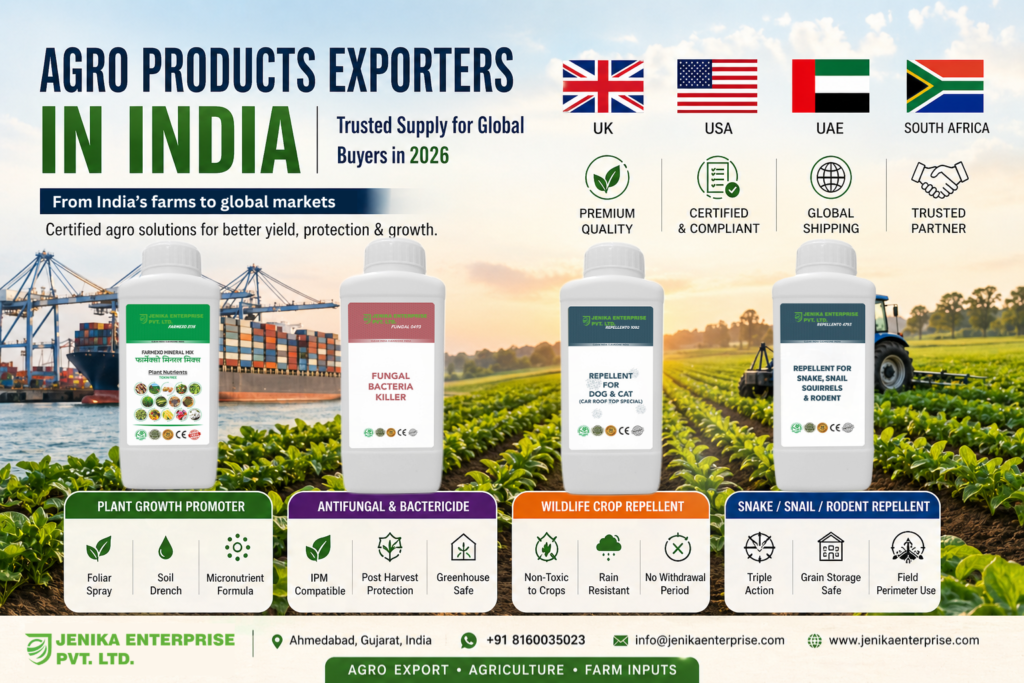
For decades, the global conversation around Indian agriculture was limited to volume. India was the place you went for thousands of tonnes of rice or a shipping container of spices. But as we move through 2026, the narrative has shifted.
International buyers from the UK, USA, UAE, and South Africa are no longer just looking at India for what the land grows—they are looking to India for the science that protects it.
The Shift from Commodities to Solutions
In the past, a farm distributor in London or a wildlife management company in Texas would look to domestic or European manufacturers for crop protection and growth promoters. However, rising manufacturing costs and supply chain bottlenecks in the West have opened a massive door for certified agro products exporters in India.
Today, companies like Jenika Enterprise Pvt. Ltd, based in the industrial and agricultural hub of Ahmedabad, Gujarat, are filling that gap. By combining India’s world-class chemical formulation expertise with significantly lower operational overhead, these exporters are delivering “Agri-Tech” solutions that are 40% to 60% more cost-effective than Western alternatives.
Solving Global Problems with Indian Innovation
What does this look like on the ground? It looks like specialised products designed for global challenges:
Soil Depletion in the UK & South Africa
While standard NPK fertilizers are common, many soils are starving for micronutrients. Advanced mineral mixes like FARMEXO 3116 are being exported from Gujarat to help international farmers restore soil health and improve fruit-set rates.
Wildlife Conflict in the USA
In the United States, wild hog damage is a billion-dollar headache. Indian exporters are now supplying non-toxic, olfactory repellents like REPELLENTO 1092. These products offer a humane, rain-resistant boundary that protects crops without the environmental “hangover” of traditional toxins.
Safety in the UAE
In the agricultural regions of the UAE, snake and rodent control is a matter of both yield protection and worker safety. The export of triple-action repellents ensures that grain storage remains uncontaminated and fields remain safe for labour.
The “Trust Gap”: Certificates and Compliance
The biggest hurdle for any global buyer is trust. How do you know the liquid in the drum matches the label on the bottle? In 2026, the leading agro products exporters in India have closed this gap through rigors transparency.
When sourcing from a reputable exporter, the paperwork is as important as the product. Buyers now look for:
- APEDA Registration: Ensuring the exporter is a recognised entity by the Government of India.
- NABL Lab Reports: Providing a chemical “fingerprint” of every batch to ensure consistency.
- Phytosanitary Certification: Guaranteeing that the products meet the strict biological safety standards of the importing country.
The Strategic Advantage of Gujarat
Geography matters. For a buyer in the UAE or UK, sourcing from an exporter in Ahmedabad provides a logistical edge. With proximity to Mundra Port—one of India’s most technologically advanced maritime hubs—lead times have been slashed. What used to take months in transit is now a streamlined process of WhatsApp tracking and rapid sea freight.
Looking Ahead
The “Made in India” label in the agricultural sector has evolved. It now stands for precision, cost-efficiency, and regulatory compliance. For distributors and wholesalers in the UK, USA, UAE, and South Africa, the question is no longer if they should source from Indian agro-exporters but which partner can provide the most transparent supply chain.
As we look towards the rest of 2026, the bridge between India’s labs and the world’s farms is only getting stronger.
Have specific requirements for your market? Skip the long forms and get a direct response from our export team in Ahmedabad.
Chat with us on WhatsApp: +91 8160035023
for more info click here
