

India’s alcohol industry is on a sharp upward curve. The Indian spirits market is projected to reach USD 64.3 billion by 2030, growing at a CAGR of 7.4%. Contract manufacturing alcohol in India sits at the centre of this growth. Global and domestic brands are choosing third-party distilleries over building their own plants and for very practical reasons.
This model cuts capital costs, speeds up market entry, and gives brands access to established excise licences. In this post, you will learn how contract manufacturing works in the Indian alcohol sector, which states lead in this space, what compliance looks like, and why international brands are actively choosing this route in 2026.
What Is Contract Manufacturing in the Alcohol Industry?
Contract manufacturing in the alcohol industry means a brand owner outsources the production of its spirits blending, bottling, or both to a licensed third-party distillery. The brand retains ownership of its recipe, label, and distribution. The manufacturer provides the facility, raw materials, and regulatory compliance.
In India, this arrangement typically operates under a formal franchise or third-party manufacturing agreement, approved by the relevant state excise authority. The contract distillery produces IMFL or potable alcohol on behalf of the brand, using ENA sourced domestically or from approved suppliers.
How Is This Different from Franchise Bottling?
Franchise bottling is a subset of contract manufacturing. In franchise bottling, a licensed distillery produces a brand’s product under a franchise agreement essentially the brand grants rights to produce and sell within a geography. Contract manufacturing is broader: it may include private label or white label production where the brand name itself is owned and marketed by the outsourcing company.
Many established Indian distilleries, for instance, hold franchise agreements to produce international whisky and rum brands domestically. You can see this model in practice through distillery-level franchise manufacturing arrangements, where a single facility may produce multiple licensed brands across categories.
What Products Are Typically Covered?
The most common categories produced under contract in India are whisky (IMFL), rum, vodka, and gin. Brandy is less common but growing. ENA-based spirits dominate the contract segment because ENA is widely available from grain and sugarcane-based distilleries across Madhya Pradesh, Uttar Pradesh, and Maharashtra.
How Does Alcohol Contract Manufacturing Work in India?
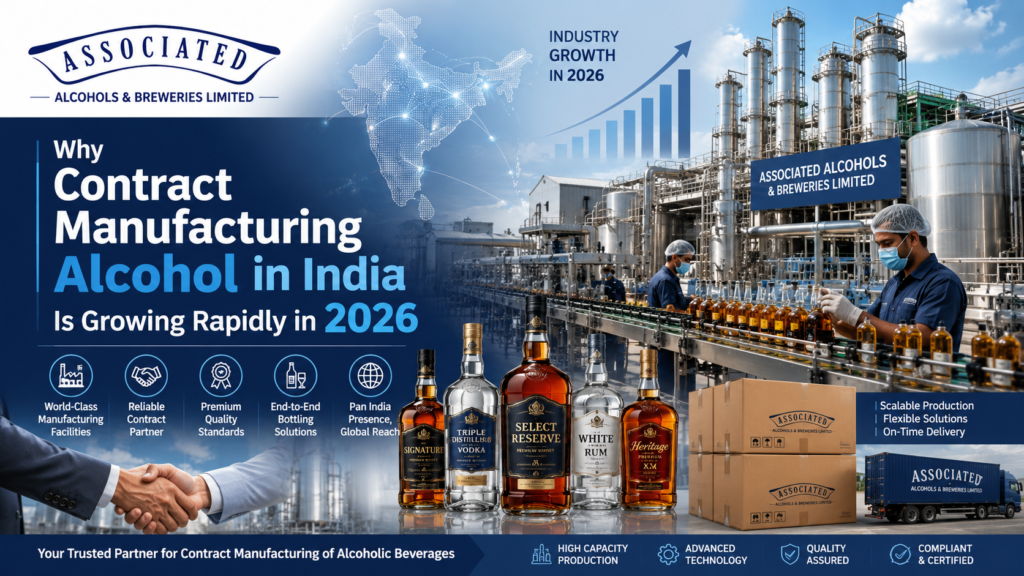
The process moves through four clear stages: regulatory approval, agreement execution, production, and distribution compliance. A brand owner first obtains brand registration in the target state. The contract manufacturer an existing licenced distillery then applies for permission to produce that brand within their facility.
Once the state excise authority approves, production begins under strict batch-level documentation. Each batch is tested for alcohol strength, colour, and flavour profile before bottling. Labels must carry state-approved text and hologram stickers.
The Role of State Excise Policy
Alcohol in India is a state subject under the Constitution. Each state sets its own excise policy, production norms, and approved vendor lists. This means a contract manufacturing arrangement valid in Madhya Pradesh may require separate approval in Rajasthan or Maharashtra. Brands expanding across states need individual agreements and filings in each jurisdiction.
Key Documentation a Brand Must Prepare
Before production starts, a brand owner needs to arrange a registered trademark, a brand approval certificate from the state excise department, a signed third-party manufacturing agreement, a formula approval for the product recipe, and a label approval with all mandatory disclosures. Missing any one of these delays the entire production cycle often by weeks.
Which States in India Are Best for Alcohol Contract Manufacturing?
Madhya Pradesh, Telangana, and Karnataka are currently the most active states for contract manufacturing alcohol in India. Madhya Pradesh stands out due to its large ENA surplus, established distillery infrastructure, and a relatively clear excise framework for third-party production.
Telangana has attracted significant investment in IMFL production due to its organised state-run wholesale model, which guarantees offtake. Karnataka’s progressive excise policy allows craft and mainstream brands to co-exist within the same contract manufacturing framework.
Why Madhya Pradesh Leads
MP produces over 200 million litres of ENA annually, making raw material availability a non-issue. The state also hosts some of India’s largest integrated distilleries, which offer both grain ENA production and IMFL bottling under one roof reducing logistics costs for brand owners.
States With Restrictions to Watch
Certain states like Bihar, Gujarat, and Nagaland are under prohibition and cannot be used as production bases at all. States like Uttar Pradesh have strong local production but complex inter-state movement rules. Brands must factor in transport permit requirements and the potential for double taxation before choosing a manufacturing location.
Why Are Global Brands Choosing Indian Distilleries in 2026?
India is now the world’s largest whisky market by volume, consuming over 1.5 billion litres of whisky per year. For international brands, producing locally through a contract distillery drastically reduces import duty exposure. India’s basic customs duty on bottled spirits stands at 150%, making local contract manufacturing the only commercially viable route for most brands.
Beyond tariffs, contract manufacturing gives global brands speed. Setting up a greenfield distillery in India takes 3–5 years and involves environmental clearances, land acquisition, and multiple licences. A contract arrangement can go live in 6–12 months.
Cost Efficiency Without Compromising Quality
Modern Indian distilleries have invested heavily in continuous column distillation, copper pot stills, and automated bottling lines. Quality output no longer requires building your own plant. Indian contract manufacturers producing for global brands routinely meet international quality benchmarks including ISO 22000 and HACCP compliance.
India’s Demographic Edge
India’s drinking-age population is growing. An estimated 330 million Indians fall between the ages of 25 and 45 the core consumption segment for premium spirits. This creates sustained long-term demand that makes local production investments including contract arrangements commercially sound.
What Are the Legal Requirements for Alcohol Contract Manufacturing in India?
The legal framework for contract manufacturing alcohol in India involves both central and state-level compliance. At the central level, FSSAI registration is mandatory for any food or beverage product, including alcohol, where the product crosses state lines. At the state level, excise registration, brand approval, and formula registration are required before production.
The contract manufacturer must hold a valid distillery or bottling licence. The brand owner must hold trademark registration and excise approval as a separate entity. Both parties must execute a registered agreement that specifies production quantities, quality standards, pricing, and liability terms.
FSSAI Compliance in Alcohol Production
FSSAI’s role in alcohol regulation is limited but growing. For products like beer, wine, and ready-to-drink (RTD) beverages, FSSAI standards apply directly. For IMFL, state excise norms take precedence but FSSAI registration as a food business operator is still required for manufacturing facilities.
Intellectual Property Protection in Contract Agreements
Brand owners must ensure the contract clearly covers IP ownership. The agreement should specify that the manufacturer cannot use the brand’s recipes, trade secrets, or label designs for any other product. Non-disclosure clauses and audit rights are standard in well-drafted agreements and are strongly recommended before production begins.
Conclusion
Contract manufacturing alcohol in India gives brands a practical path to market without building infrastructure from scratch. The model works because India has the raw material, the regulatory framework, and the distillery capacity. The key is choosing the right state, the right manufacturing partner, and getting compliance in order before the first batch runs. As India’s spirits market expands through 2026 and beyond, the brands that move early through this route will hold a structural advantage. The real question is whether the compliance infrastructure is ready to scale as fast as the demand.
