

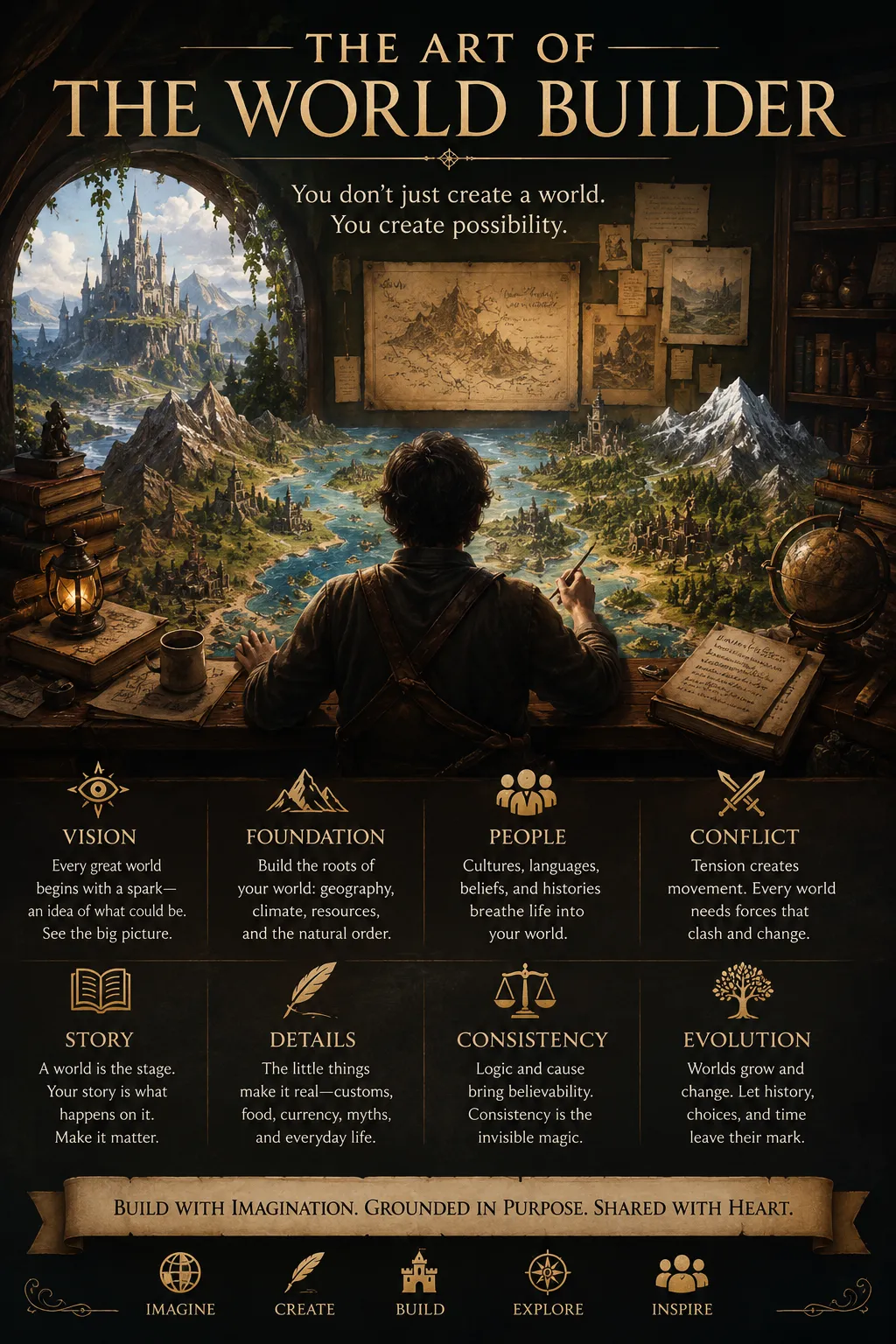
Every unforgettable story exists because someone first imagined a world strong enough to hold it. Before heroes begin their journeys, before wars erupt, before kingdoms rise and fall, a creator shapes the foundation beneath everything: the world itself. This is the role of the world builder — a creator who designs cultures, histories, landscapes, systems, and societies that make fictional universes feel believable.
World building is most commonly associated with fantasy and science fiction, but it exists across every genre. Whether creating a medieval kingdom filled with dragons, a futuristic interstellar civilization, or even a realistic small town with layered history, the world builder gives depth and structure to the narrative. Without strong world building, stories can feel hollow or disconnected. With it, audiences become immersed in places that seem alive long after the final page or scene.
At its core, world building is the process of constructing an imaginary environment with internal consistency. A world builder must think beyond surface details. Mountains, cities, and costumes are only the beginning. The deeper challenge lies in understanding how the world functions. What do people eat? What do they fear? How do governments maintain power? What religions shape morality? What resources are scarce? What myths do children grow up hearing? These questions transform a setting from decoration into a functioning reality.
One of the most important elements of world building is geography. Geography influences nearly everything in civilization. A kingdom surrounded by mountains may become isolated and defensive. Coastal societies often develop strong trade economies and cultural diversity. Harsh deserts create communities that value water, endurance, and survival. Climate, terrain, and natural resources affect politics, warfare, architecture, clothing, and even personality traits within a culture. Skilled world builders understand that environments shape the people who live in them.
History is equally essential. Real societies are built upon centuries of victories, disasters, migrations, revolutions, and traditions. Fictional worlds must feel the same way. A believable kingdom should have historical scars and achievements that influence the present. Ancient wars may still affect borders. Long-dead rulers may still inspire laws or prejudice. Ruins, legends, and forgotten technologies all suggest a deeper past beyond the immediate story. When audiences sense hidden layers beneath the surface, the world gains authenticity.
Culture is another defining aspect of successful world building. Many beginner creators focus heavily on visual aesthetics while overlooking social structures and customs. However, culture determines how people think and behave. Language, religion, art, music, festivals, gender roles, education, and family traditions all contribute to identity. Distinct cultures make fictional worlds memorable because they create variety and conflict. Differences in belief systems often drive tension between groups, enriching both plot and character development.
In fantasy and science fiction, systems of magic or technology also require careful design. A poorly explained system can weaken immersion, while a well-developed one can become one of the story’s greatest strengths. Effective systems operate according to understandable rules and limitations. If magic can solve every problem instantly, conflict loses meaning. If futuristic technology has no consequences or restrictions, the world may feel unrealistic. Limitations create tension, and tension creates engaging storytelling.
Consistency is perhaps the most important principle of world building. Readers and viewers are willing to accept impossible concepts — dragons, time travel, telepathy, immortal beings — as long as the world follows its own established rules. Problems arise when creators contradict those rules without explanation. Internal logic matters more than realism. A fictional world does not need to resemble Earth perfectly, but it must behave in ways that feel coherent within its own framework.
Another challenge for world builders is balance. Some creators spend years developing maps, languages, genealogies, and economic systems but neglect the actual story. World building should support narrative rather than overshadow it. Audiences connect most strongly with characters and emotional experiences. The world exists to enrich those experiences, not replace them. Details become meaningful when they influence human choices, struggles, and relationships.
Many famous creators are celebrated for their world-building abilities. J.R.R. Tolkien developed complete languages, histories, and mythologies for Middle-earth long before writing much of The Lord of the Rings. George R.R. Martin created politically complex kingdoms with competing noble houses, religions, and regional identities in A Song of Ice and Fire. In science fiction, Frank Herbert designed the desert world of Arrakis in Dune, where ecology, religion, politics, and economics are deeply interconnected. These creators demonstrate how detailed settings can become as iconic as the characters themselves.
Modern world building extends beyond novels. Films, television, video games, comics, and tabletop role-playing games all rely heavily on immersive settings. Franchises such as Star Wars and Game of Thrones gained popularity partly because audiences wanted to explore their worlds further. Open-world video games especially depend on environmental storytelling, allowing players to discover lore through ruins, conversations, and exploration rather than direct exposition.
The internet has also changed how world building is shared and developed. Online communities allow creators to collaborate, exchange feedback, and showcase fictional maps, timelines, and concept art. Some independent world builders develop entire universes without intending to publish traditional stories. For many, the creative process itself is the reward.
Despite all the technical aspects involved, the heart of world building remains imagination. A successful world does more than display creativity; it evokes curiosity. Audiences should feel that life continues beyond the edges of the page or screen. The greatest fictional worlds appear vast, layered, and inhabited by people with their own dreams, fears, and histories.
Ultimately, the work of a world builder is an act of possibility. It asks a simple but powerful question: “What kind of world could exist?” From that question emerge kingdoms, galaxies, civilizations, and myths capable of inspiring generations. Through careful design and human understanding, world builders transform imagination into places audiences never want to leave.
