

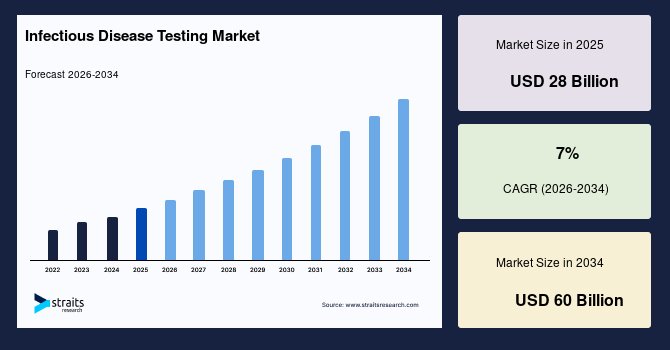
The global infectious disease testing market is experiencing significant growth due to the increasing prevalence of infectious diseases, rising awareness regarding early disease diagnosis, and growing adoption of advanced diagnostic technologies. Infectious disease testing plays a critical role in detecting bacterial, viral, fungal, and parasitic infections, enabling timely treatment and preventing disease transmission.
The global infectious disease testing market size was valued at USD 588.34 million in 2024 and is expected to grow from USD 614.11 million in 2025 to reach USD 865.33 million by 2033, exhibiting a CAGR of 4.38% during the forecast period (2025–2033).
The rising incidence of respiratory infections, sexually transmitted diseases, hospital-acquired infections, and emerging viral outbreaks is a major factor driving market growth. Additionally, advancements in molecular diagnostics, rapid testing technologies, and point-of-care testing solutions are further supporting the expansion of the infectious disease testing market globally.
Market Drivers
One of the primary drivers of the infectious disease testing market is the increasing global burden of infectious diseases such as influenza, HIV, hepatitis, tuberculosis, COVID-19, and sexually transmitted infections. Early and accurate diagnosis is becoming increasingly important to control disease spread and improve patient outcomes.
Another significant growth factor is the growing adoption of molecular diagnostic technologies such as PCR, nucleic acid amplification testing (NAAT), and next-generation sequencing (NGS). These technologies provide highly accurate and rapid detection of infectious pathogens.
The increasing demand for point-of-care testing is also fueling market growth. Portable and rapid diagnostic kits enable faster diagnosis in clinics, emergency settings, and remote healthcare facilities, improving accessibility and treatment efficiency.
Technological advancements in automated laboratory systems, AI-based diagnostics, and multiplex testing platforms are further supporting market expansion. These innovations improve testing speed, accuracy, and workflow efficiency for healthcare providers and laboratories.
Market Challenges
Despite strong growth prospects, the infectious disease testing market faces several challenges. One of the major concerns is the high cost associated with advanced molecular diagnostic systems and laboratory infrastructure.
Another challenge is the lack of skilled laboratory professionals and diagnostic specialists in developing regions, which may limit testing efficiency and accessibility.
Stringent regulatory approval requirements for diagnostic devices and testing kits may also create commercialization challenges for manufacturers.
Additionally, limited healthcare infrastructure and inadequate disease surveillance systems in low-income countries may hinder widespread adoption of advanced infectious disease testing solutions.
Market Segmentation
The infectious disease testing market is segmented based on product type, technology, disease type, and end-user.
By product type, the market includes instruments, reagents and kits, and services. The reagents and kits segment dominates the market due to increasing testing volumes and growing demand for rapid diagnostic consumables.
The instruments segment is also witnessing steady growth owing to increasing adoption of automated molecular diagnostic systems and laboratory analyzers.
By technology, the market is categorized into molecular diagnostics, immunodiagnostics, microbiology, and others. The molecular diagnostics segment holds a significant market share due to its high sensitivity, accuracy, and rapid pathogen detection capabilities.
Immunodiagnostics is also contributing substantially to market growth through increasing use of antigen and antibody testing methods.
By disease type, the market includes respiratory infections, sexually transmitted infections, hepatitis, HIV/AIDS, hospital-acquired infections, and others. The respiratory infections segment accounts for the largest market share due to increasing incidence of influenza, COVID-19, and other viral respiratory diseases.
The HIV/AIDS and hepatitis segments are also witnessing strong growth through rising screening initiatives and public health awareness programs.
By end-user, the market includes hospitals, diagnostic laboratories, academic and research institutes, and others. Diagnostic laboratories dominate the market due to increasing testing demand, advanced laboratory infrastructure, and growing use of high-throughput diagnostic systems.
Hospitals are also witnessing significant growth owing to rising inpatient testing and increasing focus on infection control measures.
Regional Insights
Regionally, the infectious disease testing market is analyzed across North America, Europe, Asia-Pacific, Latin America, and the Middle East & Africa.
North America dominates the global market due to advanced healthcare infrastructure, strong diagnostic industry presence, and high adoption of advanced molecular testing technologies. The United States remains a major contributor with increasing investments in infectious disease surveillance and public health preparedness.
Europe also represents a substantial market share, driven by rising healthcare expenditure, increasing awareness regarding early disease detection, and strong government support for infectious disease control programs.
Asia-Pacific is expected to witness the fastest growth during the forecast period. Rapid population growth, increasing prevalence of infectious diseases, improving healthcare infrastructure, and rising healthcare investments in countries such as China, India, Japan, and South Korea are driving regional market expansion.
The growing adoption of rapid testing technologies and expansion of public healthcare initiatives are further contributing to market growth across the region.
Latin America and the Middle East & Africa are emerging markets with improving diagnostic infrastructure, increasing healthcare accessibility, and rising awareness regarding infectious disease prevention and management. Government-led healthcare modernization initiatives are expected to create future growth opportunities in these regions.
Key Players Analysis
The infectious disease testing market is highly competitive, with several diagnostic companies, biotechnology firms, and healthcare technology providers focusing on rapid testing solutions, molecular diagnostics, and automated laboratory systems to strengthen their market presence. Companies are investing heavily in research and development to improve testing speed, sensitivity, and multiplex detection capabilities.
Manufacturers are also emphasizing strategic collaborations, mergers, acquisitions, and expansion of global distribution networks to enhance market reach and product availability. Product innovation and development of portable and AI-powered diagnostic platforms remain key growth strategies among market participants.
Continuous advancements in molecular biology, automation technologies, digital diagnostics, and point-of-care testing solutions are expected to intensify competition among market players during the forecast period.
For detailed insights, visit: https://straitsresearch.com/report/infectious-disease-testing-market
About Us
Straits Research is a leading research and intelligence organization, specializing in research, analytics, and advisory services, along with providing business insights and research reports.
Contact Us
Email: sales@straitsresearch.com
Tel: +1 646 905 0080 (U.S.), +44 203 695 0070 (U.K.)
