

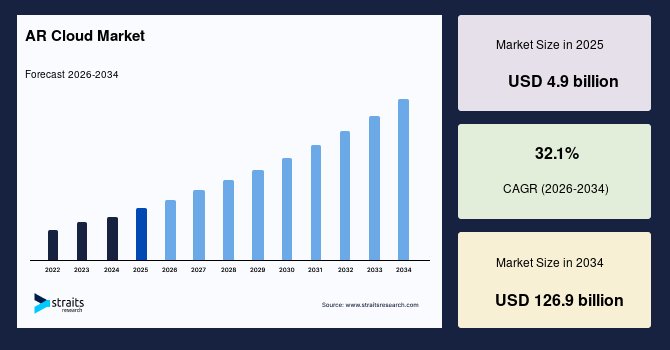
The global AR cloud market is witnessing rapid growth due to increasing adoption of augmented reality (AR) technologies, rising demand for immersive digital experiences, and expanding deployment of cloud-based spatial computing solutions across industries. AR cloud technology enables persistent digital content to be overlaid onto the physical world using real-time mapping, cloud storage, and location-based data sharing.
The global AR cloud market size was valued at USD 827.89 million in 2024 and is projected to grow from USD 1019.55 million in 2025 to reach USD 5393.65 million by 2033, growing at a CAGR of 23.15% during the forecast period (2025–2033).
The increasing penetration of 5G networks, advancements in artificial intelligence (AI), and growing adoption of smart devices and wearable technologies are major factors driving market growth. Additionally, rising investments in metaverse development, smart city infrastructure, and immersive enterprise applications are further supporting the expansion of the AR cloud market globally.
Market Drivers
One of the primary drivers of the AR cloud market is the growing adoption of augmented reality applications across industries such as retail, healthcare, manufacturing, education, gaming, and real estate. AR cloud technology enables interactive and location-aware digital experiences, enhancing customer engagement and operational efficiency.
Another significant growth factor is the rapid deployment of 5G and edge computing infrastructure. High-speed connectivity and low-latency data processing improve the performance of AR applications, enabling real-time spatial mapping and immersive cloud-based experiences.
The increasing popularity of smart glasses, AR headsets, and wearable devices is also fueling market growth. Consumers and enterprises are increasingly adopting AR-enabled hardware for navigation, training, remote collaboration, and entertainment applications.
Technological advancements in AI, computer vision, spatial mapping, and cloud computing are further supporting market expansion. These innovations enable accurate environmental recognition, persistent AR content, and seamless integration between digital and physical environments.
Market Challenges
Despite strong growth prospects, the AR cloud market faces several challenges. One of the major concerns is the high infrastructure cost associated with AR cloud deployment, including advanced hardware, cloud storage, and network connectivity requirements.
Another challenge is data privacy and cybersecurity risks related to location-based data collection and real-time environmental mapping.
Limited interoperability between AR platforms, devices, and software ecosystems may also hinder widespread adoption and seamless user experiences.
Additionally, technical limitations related to battery life, device compatibility, and large-scale spatial data processing may create operational challenges for developers and service providers.
Market Segmentation
The AR cloud market is segmented based on component, deployment mode, application, and end-user.
By component, the market includes software, hardware, and services. The software segment holds a significant market share due to increasing demand for AR development platforms, spatial mapping software, and cloud-based AR content management systems.
The hardware segment is also witnessing rapid growth owing to increasing adoption of AR headsets, smart glasses, sensors, and wearable devices.
By deployment mode, the market is categorized into public cloud, private cloud, and hybrid cloud. The public cloud segment dominates the market due to its scalability, cost efficiency, and widespread use for large-scale AR content storage and processing.
Hybrid cloud solutions are also gaining traction owing to increasing enterprise demand for enhanced data security and operational flexibility.
By application, the market includes gaming and entertainment, retail and e-commerce, healthcare, manufacturing, education, navigation, and others. The gaming and entertainment segment accounts for the largest market share due to rising consumer demand for immersive AR experiences and interactive digital content.
The retail and e-commerce segment is also contributing significantly to market growth through increasing adoption of virtual product visualization, AR shopping experiences, and digital customer engagement solutions.
By end-user, the market includes enterprises, consumers, healthcare organizations, educational institutions, and government agencies. Enterprises dominate the market due to increasing implementation of AR cloud solutions for training, remote assistance, product visualization, and operational optimization.
Healthcare and educational institutions are also increasingly adopting AR cloud technologies for medical visualization, virtual learning, and simulation-based training applications.
Regional Insights
Regionally, the AR cloud market is analyzed across North America, Europe, Asia-Pacific, Latin America, and the Middle East & Africa.
North America dominates the global market due to advanced digital infrastructure, strong presence of AR technology companies, and increasing investments in metaverse and spatial computing technologies. The United States remains a major contributor with widespread adoption of AR applications across entertainment, healthcare, and enterprise sectors.
Europe also represents a substantial market share, driven by increasing adoption of immersive technologies, rising investments in Industry 4.0 initiatives, and growing focus on digital transformation.
Asia-Pacific is expected to witness the fastest growth during the forecast period. Rapid smartphone penetration, expanding 5G infrastructure, increasing gaming and e-commerce industries, and growing investments in AR and AI technologies in countries such as China, India, Japan, and South Korea are driving regional market expansion.
The increasing adoption of smart city projects and digital consumer experiences is further contributing to market growth across the region.
Latin America and the Middle East & Africa are emerging markets with increasing internet penetration, expanding digital ecosystems, and growing awareness regarding immersive technologies. Rising investments in smart infrastructure and digital entertainment are expected to create future growth opportunities in these regions.
Key Players Analysis
The AR cloud market is highly competitive, with several global technology companies, cloud service providers, and AR platform developers focusing on spatial computing, AI-powered mapping technologies, and immersive content solutions to strengthen their market presence. Companies are investing heavily in cloud infrastructure, edge computing, and AR software development to improve scalability and user experience.
Technology providers are also emphasizing strategic collaborations, mergers, acquisitions, and partnerships with telecom companies, gaming developers, and enterprise solution providers to expand their AR ecosystems. Product innovation and development of cross-platform AR solutions remain key growth strategies among market participants.
Continuous advancements in AI, 5G, cloud computing, and wearable AR technologies are expected to intensify competition among market players during the forecast period.
For detailed insights, visit: https://straitsresearch.com/report/ar-cloud-market
About Us
Straits Research is a leading research and intelligence organization, specializing in research, analytics, and advisory services, along with providing business insights and research reports.
Contact Us
Email: sales@straitsresearch.com
Tel: +1 646 905 0080 (U.S.), +44 203 695 0070 (U.K.)
