

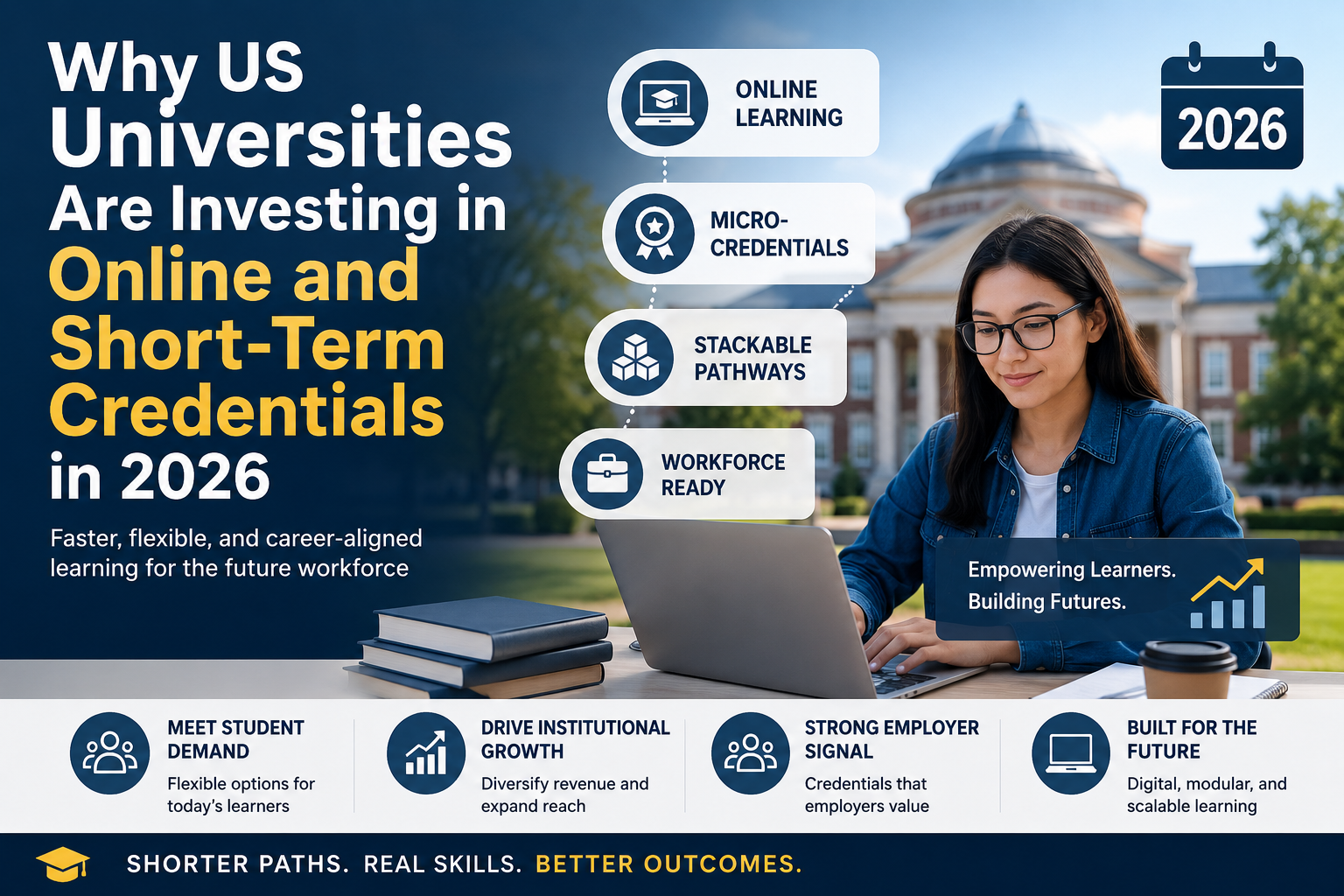
Online and short-term credentials are becoming a major force in higher education. Across the United States, universities are investing heavily in digital learning, micro-credentials, and workforce-focused certificate programs. The shift reflects changing student expectations, employer demand for job-ready skills, and institutional efforts to create more flexible learning pathways.
Students no longer view education as a single four-year journey followed by a lifetime career. Instead, many learners want qualifications that can be earned quickly, applied immediately, and expanded over time. Universities are responding by building online programs and stackable credentials that fit modern career realities.
Why Online and Short-Term Credentials Are Expanding
Universities are investing in online and short-term credentials because workforce alignment has become a top priority. Institutions increasingly design certificates and micro-credentials around practical skills that employers actively seek. This approach helps learners gain targeted expertise while providing universities with new opportunities for growth. The recovery is being driven by several groups, including recent high school graduates, working adults seeking new skills, and international students looking for affordable entry points into the U.S. education system.
This growth reflects a broader shift in how people evaluate higher education. Families are asking tougher questions about return on investment. Instead of automatically committing to four years of tuition expenses, many students are choosing to complete foundational coursework at a community college before transferring to a university.
The strategy resembles taking a connecting flight instead of booking the most expensive direct route. The destination remains the same, but the journey often costs far less.
The Rise of Dual Enrollment Programs
One of the most significant developments in education is the expansion of dual enrollment. These programs allow high school students to earn both high school and college credit through the same course.
Dual enrollment has become mainstream across the country. Millions of students now participate, and many community colleges report that dual-credit students make up a substantial portion of their enrollment. The appeal is easy to understand. Students can begin accumulating college credits before graduating from high school, reducing both the time and money required to complete a degree.
Research consistently shows that students who participate in dual enrollment are more likely to attend college and complete credentials than their peers. Early exposure to college-level expectations helps students build confidence and develop academic skills before entering higher education full-time.
As more students take advantage of these opportunities, the transition from high school to college is becoming smoother and more efficient.
Cost Savings That Matter
Affordability remains one of the strongest arguments in favor of community colleges and dual enrollment.
Traditional four-year universities continue to carry significant costs, especially when housing, fees, and living expenses are added to tuition. Community colleges provide a lower-cost alternative while still offering transferable credits and career-focused programs.
Dual enrollment amplifies those savings. Students who complete multiple college courses during high school may enter college with an entire semester—or even a full year—already completed. In many regions, these courses are heavily subsidized or available at little cost to families.
For students managing challenging coursework, additional academic support can make a major difference. Many learners turn to resources such as Expertsmind.com’s subject tutor network to better understand complex topics in mathematics, engineering, business, and other college-level subjects while maintaining academic progress.
Reducing the overall cost of a degree can have long-term financial benefits. Lower borrowing often means greater flexibility after graduation and fewer years spent repaying student loans.
Community College vs Trade School vs University
The debate is no longer simply about choosing college or not. Students now have multiple educational pathways that align with different career goals.
Trade schools offer specialized training in fields such as HVAC, automotive technology, healthcare support, and skilled trades. These programs often take less time to complete and allow graduates to enter the workforce quickly.
Community colleges occupy a middle ground. They provide vocational certificates and technical programs while also offering academic transfer pathways leading to bachelor’s degrees. This flexibility gives students room to explore career interests without locking themselves into a single direction.
Universities continue to provide advantages for professions that require advanced education and specialized credentials. Fields such as engineering, computer science, and certain business disciplines often reward bachelor’s degree holders with higher long-term earning potential.
The smartest choice depends on the student’s goals, financial situation, and preferred learning style rather than a one-size-fits-all formula.
The Importance of Transfer Planning
While community colleges create valuable opportunities, success often depends on careful planning. Credit transfer remains one of the biggest challenges facing students.
Many states have improved transfer agreements that make it easier to move credits from community colleges to public universities. However, differences between institutions can still result in lost credits if students do not verify requirements early.
Students who plan ahead, work with advisors, and select courses aligned with transfer pathways are more likely to maximize the value of their credits. Modern degree-planning platforms and transfer tools are making this process easier, helping students understand exactly how courses fit into future degree requirements.
The students who benefit most are often those who treat transfer planning as seriously as course selection itself.
A Smarter Education Strategy for 2026
The rapid growth of community colleges and dual enrollment reflects changing priorities in higher education. Students want affordable options, flexible pathways, and clear connections between education and career outcomes.
Community colleges are uniquely positioned to meet those expectations. They provide accessible education, practical workforce training, and transfer opportunities that can dramatically reduce the cost of earning a degree.
Rather than replacing universities, community colleges are becoming an increasingly important first step in many educational journeys. For students focused on reducing debt, accelerating graduation, and maintaining flexibility, the community college pathway may be one of the smartest educational decisions available in 2026.
