

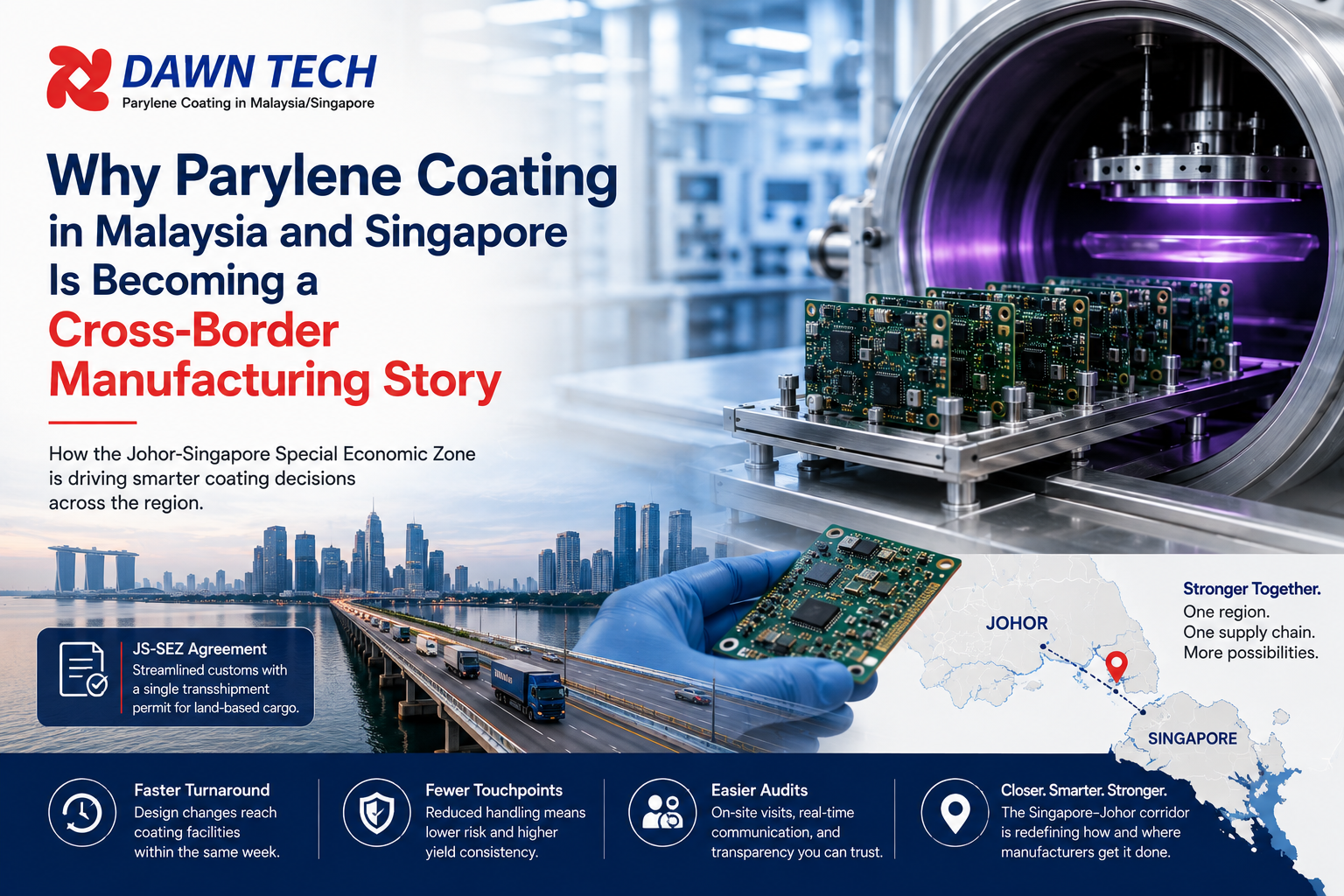
Most people picture a special economic zone as a story about warehouses and tax incentives. Rarely does anyone picture it as a story about coating specifications. But talk to a handful of process engineers moving work between Singapore and Johor right now, and a surprisingly specific detail keeps coming up: where their boards get their protective finish, and whether that decision now has to account for a border. This piece looks at why parylene coating in Malaysia and Singapore has quietly become part of a bigger regional manufacturing shift and what that means for the people actually specifying it.
A Twin-City Supply Chain, Formalized
Singapore and Johor have functioned as an informal manufacturing pair for years: design and R&D concentrated on one side, assembly and finishing spread across the other. What changed is that this arrangement now has a name and a framework behind it. The Johor-Singapore Special Economic Zone agreement, signed by both governments in January 2025, formally designates manufacturing as one of its priority sectors and streamlines the customs process for goods moving between the two sides, including a shift to a single transshipment permit for land-based cargo instead of the two previously required.
For a manufacturing subsector like conformal coating, that’s not abstract policy. It’s the difference between a board sitting in a customs queue for two days and one that clears within hours. Iskandar Puteri, where a fair amount of this coating work already happens, is one of the nine flagship zones named under the agreement.
What This Looks Like in Practice
Picture a Singapore-based medtech startup finalizing a sensor housing design. A few years ago, the practical choice for specialty coating might have been sending the batch to a facility in China or further afield, accepting the shipping time as a cost of doing business. Increasingly, that same team is looking twenty minutes across the causeway instead.
The appeal isn’t just distance on a map. It’s what a shorter distance actually buys:
- A design revision reaching the coating facility the same week it’s finalized, not the same month
- Fewer handling touchpoints between the fabrication house and the coating facility, which matters when a single dropped board means restarting an entire batch
- Easier in-person audits for medtech and aerospace-adjacent clients who need to see a facility’s quality process firsthand, not just read about it in a spec sheet
None of that requires an exotic supply chain. It just requires proximity, and proximity is exactly what this corridor is now built to reward.
Where the Effect Shows Up First
Not every industry feels this shift equally. Consumer electronics assembly, much of it already concentrated in Penang and the Klang Valley, has less urgency around coating turnaround since production runs tend to be larger and more predictable. Medtech and industrial sensor manufacturers are a different story. Their batches run smaller, their designs change more often between prototype and production, and a coating delay has a way of cascading into a missed regulatory submission window rather than just a late shipment.
That’s part of why the medtech and healthcare sector, one of the eleven priority sectors named in the JS-SEZ framework, has been an early adopter of thinking regionally rather than defaulting to whichever overseas facility a fabrication partner already uses. It’s not that overseas suppliers do worse work. It’s that the margin for error on timing is thinner in this segment, and thinner margins reward shorter supply chains.
A Sector Still Figuring Itself Out
It would be an overstatement to call this a settled trend. Plenty of manufacturers still default to whichever coating supplier their fabrication house already has a relationship with, regardless of where that supplier sits geographically. Habit is a powerful force in procurement, and switching costs, even small ones, tend to get deprioritized against a looming production deadline.
What’s shifting is the calculation underneath that habit. As more of the surrounding supply chain, PCB fabrication, component sourcing, and final assembly consolidate around the Johor-Singapore corridor, treating the finishing step as a separate logistics problem starts to look less efficient than it used to. The coating facility doesn’t need to be exotic or far away to do the job well. It increasingly makes more sense for it not to be.
The Takeaway for Engineers Weighing This Decision
None of this means distance is the only variable worth weighing, and a supplier three hours away who genuinely understands your masking requirements still beats one twenty minutes away who doesn’t. But for teams currently defaulting to an overseas coating partner out of habit rather than necessity, the regional picture has changed enough to be worth a second look. The corridor between Singapore and Johor isn’t just getting faster on paper; it’s starting to reshape which sourcing decisions actually make sense.
