

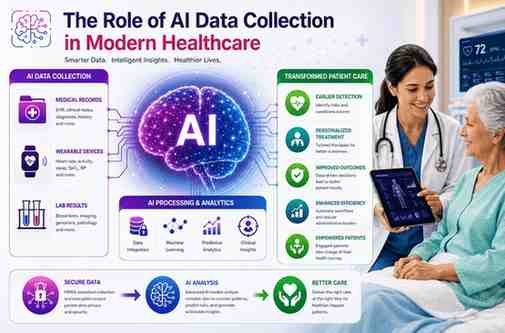
The healthcare industry is experiencing a digital transformation powered by artificial intelligence (AI). From improving patient care to streamlining hospital operations, AI has become an essential technology for modern healthcare organizations. At the heart of this transformation lies AI Data Collection for Healthcare—a process that enables providers to gather, organize, and analyze vast amounts of medical data with speed and accuracy.
Healthcare organizations across the United States generate enormous volumes of patient information every day, including electronic health records (EHRs), medical imaging, wearable device data, laboratory reports, and insurance claims. Traditional methods of collecting and managing this data often result in delays, errors, and inefficiencies. AI-powered data collection is changing that by automating workflows and delivering actionable insights in real time.
What Is AI Data Collection for Healthcare?
AI Data Collection for Healthcare refers to the use of artificial intelligence technologies to automatically capture, process, organize, and analyze healthcare-related data from multiple sources. Unlike manual data entry, AI can extract information from structured and unstructured data, reducing administrative burdens while improving data quality.
Healthcare providers can collect information from:
- Electronic Health Records (EHRs)
- Medical imaging systems
- Wearable health devices
- Remote patient monitoring platforms
- Laboratory and diagnostic reports
- Insurance claims
- Patient surveys and feedback
By consolidating these data sources into a unified system, AI enables healthcare professionals to make faster, more informed clinical decisions.
Emerging Innovations in AI Data Collection for Healthcare
The latest innovations in AI are reshaping how healthcare organizations collect and utilize patient information.
Intelligent Data Extraction
Natural Language Processing (NLP) enables AI systems to extract valuable information from physician notes, discharge summaries, and clinical documentation. Instead of manually reviewing lengthy reports, healthcare professionals receive structured, searchable data within seconds.
This improves documentation accuracy while reducing clinician workload.
Wearable Devices and Remote Monitoring
Smartwatches, fitness trackers, glucose monitors, and remote patient monitoring devices continuously generate health data. AI analyzes this real-time information to detect abnormalities such as irregular heart rhythms, elevated blood sugar levels, or respiratory issues.
This proactive approach helps physicians intervene earlier, improving patient outcomes and reducing hospital admissions.
Predictive Analytics
AI doesn’t just collect data—it predicts future health events. By analyzing historical patient records and real-time information, predictive analytics can identify individuals at high risk for chronic diseases, hospital readmissions, or medical complications.
Healthcare providers can then implement preventive care strategies before conditions worsen.
Computer Vision for Medical Imaging
AI-powered computer vision automates the collection and interpretation of imaging data from X-rays, CT scans, and MRIs. These systems assist radiologists by highlighting potential abnormalities, improving diagnostic accuracy while reducing reporting time.
As imaging volumes continue to rise, AI is becoming an indispensable clinical support tool.
Voice Recognition and Clinical Documentation
Speech recognition technologies powered by AI allow physicians to dictate patient encounters directly into electronic health records. The AI automatically structures the information into standardized medical documentation.
This significantly reduces documentation time while allowing clinicians to spend more time with patients.
Benefits of AI Data Collection for Healthcare
Healthcare organizations are adopting AI because it delivers measurable operational and clinical advantages.
Improved Data Accuracy
Manual data entry often introduces errors and inconsistencies. AI minimizes these issues through automated validation, standardized formatting, and intelligent error detection.
Higher-quality data supports more accurate diagnoses and treatment decisions.
Faster Clinical Decision-Making
When patient data is instantly available and organized, clinicians can quickly access complete medical histories, laboratory results, and diagnostic reports.
This accelerates treatment decisions, particularly during emergencies.
Enhanced Patient Experience
Patients increasingly expect personalized healthcare services. AI helps providers collect comprehensive patient information, enabling customized treatment plans, timely follow-ups, and proactive health management.
Better experiences often lead to higher patient satisfaction and improved health outcomes.
Reduced Administrative Costs
Administrative tasks consume a significant portion of healthcare resources. AI automates repetitive processes such as data entry, coding, claims processing, and document management.
This allows healthcare organizations to reduce operational costs while improving workforce productivity.
Better Population Health Management
AI can analyze healthcare data across entire patient populations to identify disease trends, risk factors, and care gaps.
Public health agencies and healthcare systems use these insights to develop targeted prevention programs and improve community health outcomes.
Challenges in Implementing AI Data Collection
Despite its advantages, implementing AI Data Collection for Healthcare requires careful planning.
Healthcare organizations must ensure:
- Compliance with HIPAA and data privacy regulations
- Strong cybersecurity measures
- High-quality, standardized data sources
- Integration with existing EHR systems
- Transparent AI decision-making processes
Successful implementation also depends on staff training and continuous monitoring to ensure AI systems deliver reliable and unbiased results.
The Future of AI Data Collection for Healthcare
The future of healthcare will be increasingly data-driven. Emerging technologies such as generative AI, federated learning, edge computing, and advanced machine learning models will further enhance data collection capabilities.
Future AI systems will not only collect patient information but also generate predictive care recommendations, automate clinical workflows, and support precision medicine initiatives.
As interoperability between healthcare platforms improves, AI will create a seamless flow of information across hospitals, clinics, pharmacies, laboratories, and insurance providers.
Healthcare organizations that invest in AI today will be better positioned to deliver personalized, efficient, and value-based care in the years ahead.
Conclusion
AI Data Collection for Healthcare is transforming the way healthcare providers gather, manage, and utilize patient information. By automating data collection, improving accuracy, and enabling real-time insights, AI empowers clinicians to make better decisions while enhancing patient care.
As healthcare continues to evolve, organizations that embrace AI-driven data collection will gain a competitive advantage through improved operational efficiency, stronger compliance, and superior patient outcomes.
At One Tech Solutions, we help healthcare organizations harness the power of AI to modernize data collection, streamline workflows, and unlock meaningful insights that drive innovation. By implementing intelligent AI solutions, healthcare providers can build a more connected, efficient, and patient-centered future.
