

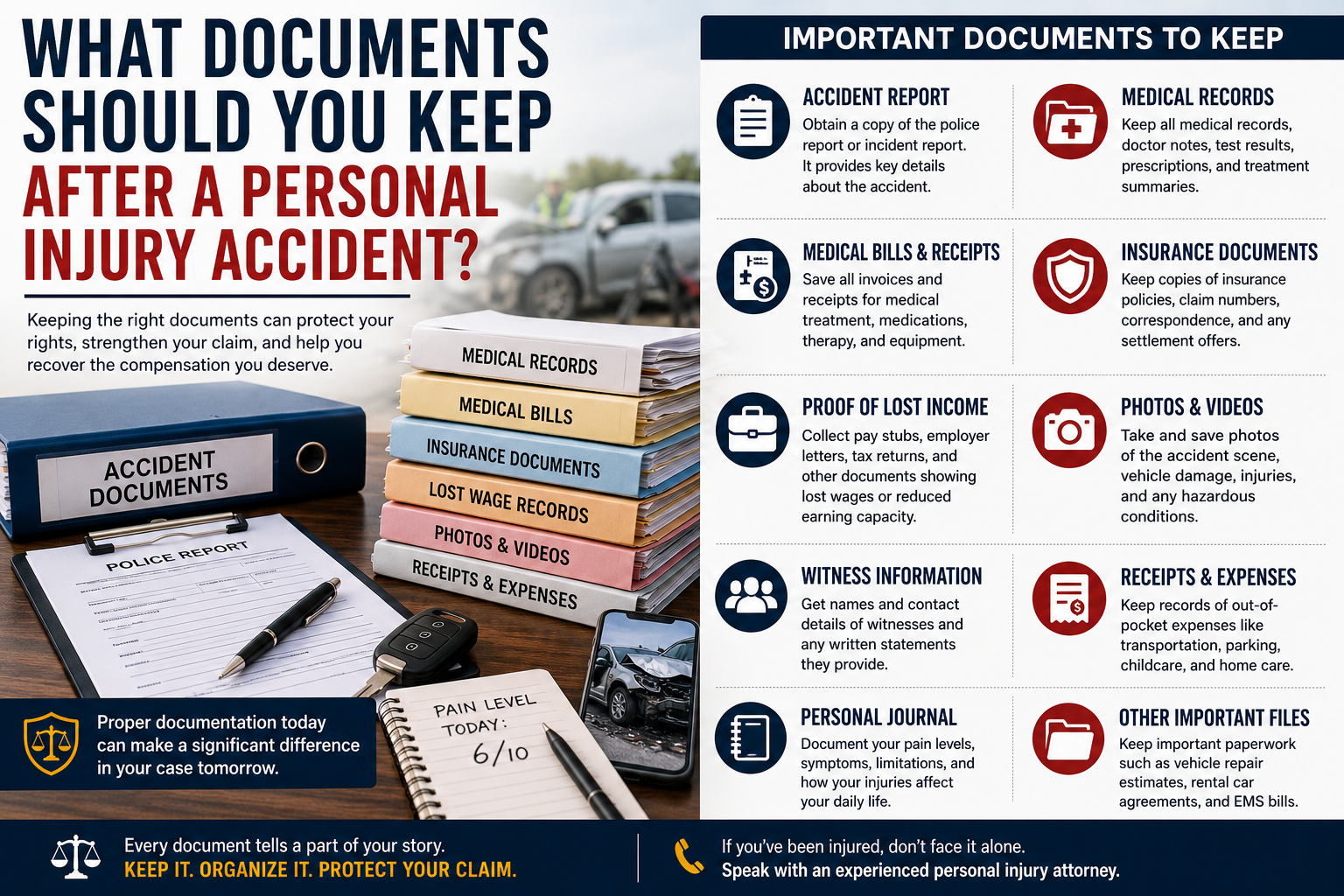
A personal injury accident can leave you dealing with medical treatment, insurance claims, lost income, and uncertainty about what comes next. While your recovery should be the priority, keeping the right documents from the beginning can make a significant difference if you decide to pursue compensation. Proper documentation helps establish what happened, demonstrates the extent of your injuries, and supports the damages you’ve suffered. Working with an experienced Texas personal injury lawyer can also help ensure that important evidence is preserved and your legal rights are protected throughout the claims process.
Why Documentation Matters After an Accident
Every personal injury claim is built on evidence. Whether your accident involved a vehicle collision, unsafe property conditions, defective products, or another act of negligence, documents provide the foundation needed to support your case.
Accurate records can help:
- Prove how the accident occurred
- Document the severity of your injuries
- Show financial losses
- Support settlement negotiations
- Strengthen your case if litigation becomes necessary
The more organized your records are, the easier it may be to demonstrate the full impact of your injuries.
Keep the Official Accident Report
One of the first documents you should obtain is the official accident report prepared by law enforcement or the responding agency.
Depending on the type of accident, this report may include:
- Date and time of the incident
- Location of the accident
- Names of involved parties
- Witness information
- Officer observations
- Preliminary findings regarding fault
Although an accident report does not automatically determine liability, it often serves as valuable evidence during an investigation.
Save All Medical Records
Medical records are among the most important documents in any personal injury claim.
Keep copies of:
- Emergency room records
- Hospital discharge summaries
- Diagnostic imaging results
- Physician notes
- Specialist evaluations
- Physical therapy records
- Rehabilitation reports
- Follow-up appointment summaries
These records help establish the connection between the accident and your injuries while documenting the treatment you received.
Organize Medical Bills and Receipts
Medical expenses often continue long after the initial accident.
Be sure to keep:
- Hospital bills
- Doctor invoices
- Prescription receipts
- Physical therapy bills
- Medical equipment receipts
- Mileage records for medical appointments
These documents help demonstrate the financial impact of your injuries and may support a claim for compensation.
Preserve Insurance Documents
Insurance companies typically generate a large amount of paperwork throughout the claims process.
Keep copies of:
- Claim numbers
- Insurance correspondence
- Settlement offers
- Coverage information
- Emails
- Letters
- Recorded statement notices
Maintaining a complete record of your communications can help avoid misunderstandings and provide a timeline of your claim.
Save Proof of Lost Income
Serious injuries may require time away from work.
If you’ve missed work because of your injuries, retain documentation such as:
- Pay stubs
- Employer verification letters
- Tax returns
- Direct deposit records
- Attendance records
- Disability paperwork
If your injuries reduce your future earning capacity, these documents may also become important evidence.
Keep Photographs and Videos
Visual evidence often tells the story more effectively than written descriptions.
Save photographs of:
- The accident scene
- Vehicle damage
- Property damage
- Visible injuries
- Hazardous conditions
- Roadway conditions
If surveillance footage or dashcam video is available, it should also be preserved whenever possible.
Collect Witness Information
Witnesses can provide independent accounts of what occurred.
Keep records of:
- Witness names
- Phone numbers
- Email addresses
- Written statements, if available
Your attorney may later contact these individuals to support your claim.
Track Out-of-Pocket Expenses
Many accident-related expenses are easy to overlook.
Maintain receipts for costs such as:
- Transportation to medical appointments
- Rental vehicles
- Home medical supplies
- Assistive devices
- Childcare expenses related to treatment
- Home modifications if necessary
Even relatively small expenses can add up over the course of recovery.
Maintain a Personal Injury Journal
A personal journal can help document how your injuries affect your daily life.
Consider recording:
- Daily pain levels
- Physical limitations
- Emotional challenges
- Missed family events
- Sleep difficulties
- Recovery progress
These notes may help demonstrate the non-economic impact of your injuries, including pain and suffering.
Why Evidence Preservation Is So Important
Evidence can disappear surprisingly quickly after an accident.
Surveillance footage may be deleted, witnesses may become difficult to locate, and physical evidence may no longer exist. Acting promptly to preserve documents helps protect your ability to present a complete and accurate claim.
An experienced trial attorney can also take additional steps to preserve important evidence before it is lost.
Common Mistakes to Avoid
After an accident, many people unintentionally weaken their claims by failing to keep important records.
Common mistakes include:
- Throwing away medical bills
- Losing prescription receipts
- Deleting accident photographs
- Failing to document missed work
- Ignoring follow-up medical appointments
- Discarding insurance correspondence
Keeping everything organized in one secure location can make the claims process much smoother.
Final Thoughts
Knowing what documents you should keep after a personal injury accident can play an important role in protecting your legal rights. From accident reports and medical records to insurance correspondence and proof of lost income, every document helps build a clearer picture of how the accident has affected your life.
Thorough documentation not only supports your claim but also helps your legal team evaluate damages, preserve critical evidence, and pursue fair compensation. If you’ve been injured because of someone else’s negligence, consulting with an experienced personal injury attorney early in the process can help ensure that no important evidence is overlooked.
