

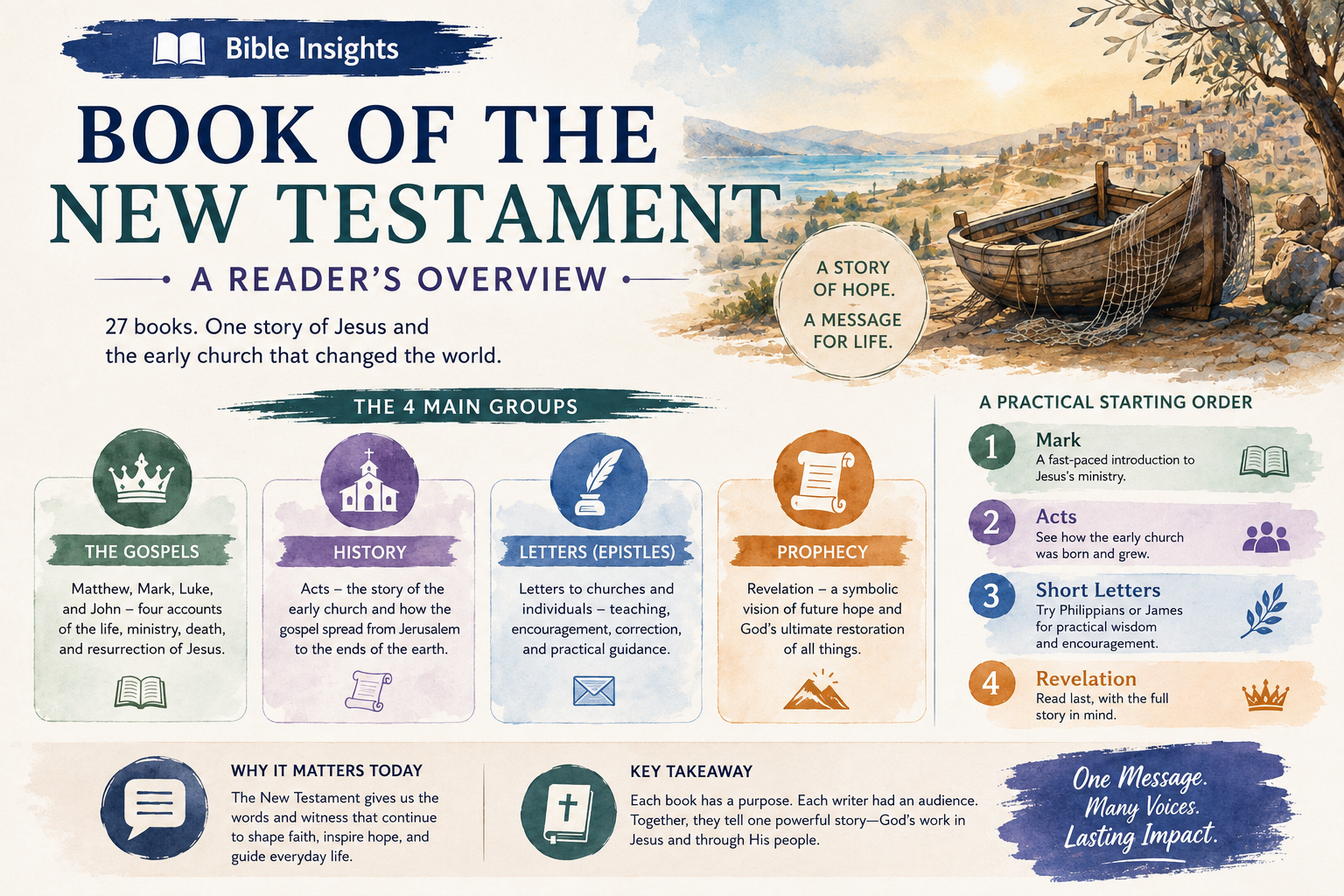
Picking up a Bible for the first time, many readers aren’t sure where to start or how each book of the New Testament connects to the next. It can feel like walking into a conversation halfway through. Understanding what is the New Testament, at its core, helps solve that confusion. It’s a collection of 27 books written within roughly a century, covering the life of Jesus, the early Christian church, and letters written to guide new communities of faith. This guide walks through how these books are grouped, what each section is meant to do, and how to approach the collection without feeling overwhelmed.
What Is the New Testament, in Simple Terms
At its most basic level, the New Testament tells the story of Jesus and the movement that followed him. It was written primarily in Greek, the common language of the eastern Mediterranean at the time, and compiled from documents circulating among early Christian communities.
Unlike the Old Testament, which spans centuries, the New Testament covers a much shorter historical window. That compressed timeframe is part of why the writing feels more immediate and personal compared to older historical narratives.
How Each Book of the New Testament Is Organized
The 27 books generally fall into four recognizable categories:
- The Gospels: Matthew, Mark, Luke, and John, each telling the story of Jesus from a different perspective
- History: Acts, which follows the early church after Jesus’s resurrection
- Letters (Epistles): Writings addressed to specific churches or individuals, offering guidance and correction
- Prophecy: Revelation, using symbolic language to describe future hope and ultimate restoration
Recognizing this structure makes it far easier to know what to expect from any individual book of the New Testament before diving in.
Why the Four Gospels Tell the Same Story Differently
New readers sometimes assume the four Gospels are repetitive, but each one was written with a distinct audience and purpose in mind.
- Matthew emphasizes Jesus’s connection to Jewish prophecy and tradition
- Mark moves quickly, focusing on action and urgency
- Luke includes more detail aimed at a broader, non-Jewish audience
- John takes a more reflective, theological approach
Reading all four side by side reveals details that a single account would miss entirely, and it highlights just how deliberately each book of the New Testament was shaped for its intended readers.
Understanding the Letters and Their Purpose
Letters make up the largest portion of the New Testament, and most were written to address real, specific situations within early churches. Paul, for example, wrote to correct misunderstandings, encourage struggling communities, or answer direct questions from church leaders.
This context matters because pulling a single verse from a letter without understanding its original audience can distort the intended meaning. A book of the New Testament like one of Paul’s letters often makes far more sense once you know what problem it was originally written to solve.
A Practical Starting Order for New Readers
Rather than reading straight through in canonical order, many readers find it easier to start with a sequence like this:
- The Gospel of Mark, for a fast-paced introduction to Jesus’s ministry
- Acts, to understand how the early church formed afterward
- One or two shorter letters, such as Philippians or James
- Revelation last, once the earlier historical and theological context feels familiar
This order builds foundational understanding before tackling the more symbolic or complex sections.
Common Misunderstandings Worth Clearing Up
A few assumptions tend to confuse new readers early on:
- Assuming every letter applies the same instruction to every reader today without context
- Treating Revelation as a straightforward, literal timeline rather than symbolic literature
- Expecting the Gospels to match perfectly in every detail, rather than reflecting different perspectives
- Overlooking Acts, which explains how the early church actually took shape
For readers who want a deeper breakdown of related biblical structure, book of the New Testament topics are explored further alongside other foundational studies that connect Old and New Testament themes.
Bible Insights approaches these connections the same way, treating historical and literary context as essential rather than optional details.
How This Collection Still Shapes Modern Faith
Ideas about grace, community, and personal transformation, still widely discussed today, trace directly back to this collection. Understanding what is the New Testament helps explain why these concepts carry the weight they do, since they were shaped by real historical communities working through real challenges.
Bible Insights offers additional context for readers who want to explore individual books in more depth, though steady personal reading remains the most reliable way to absorb the material.
Putting the Pieces Together
So, what is the New Testament once the structure becomes clear? It’s a focused, purposeful collection built from firsthand accounts, church history, and practical guidance for early believers. Each book of the New Testament serves a specific role, whether that’s telling Jesus’s story, tracing the church’s early growth, or addressing real problems within a community. Start with one Gospel, move into Acts, then explore a letter or two before tackling Revelation. That order builds context gradually, and it turns what once felt like scattered pieces into a collection that actually makes sense.
