

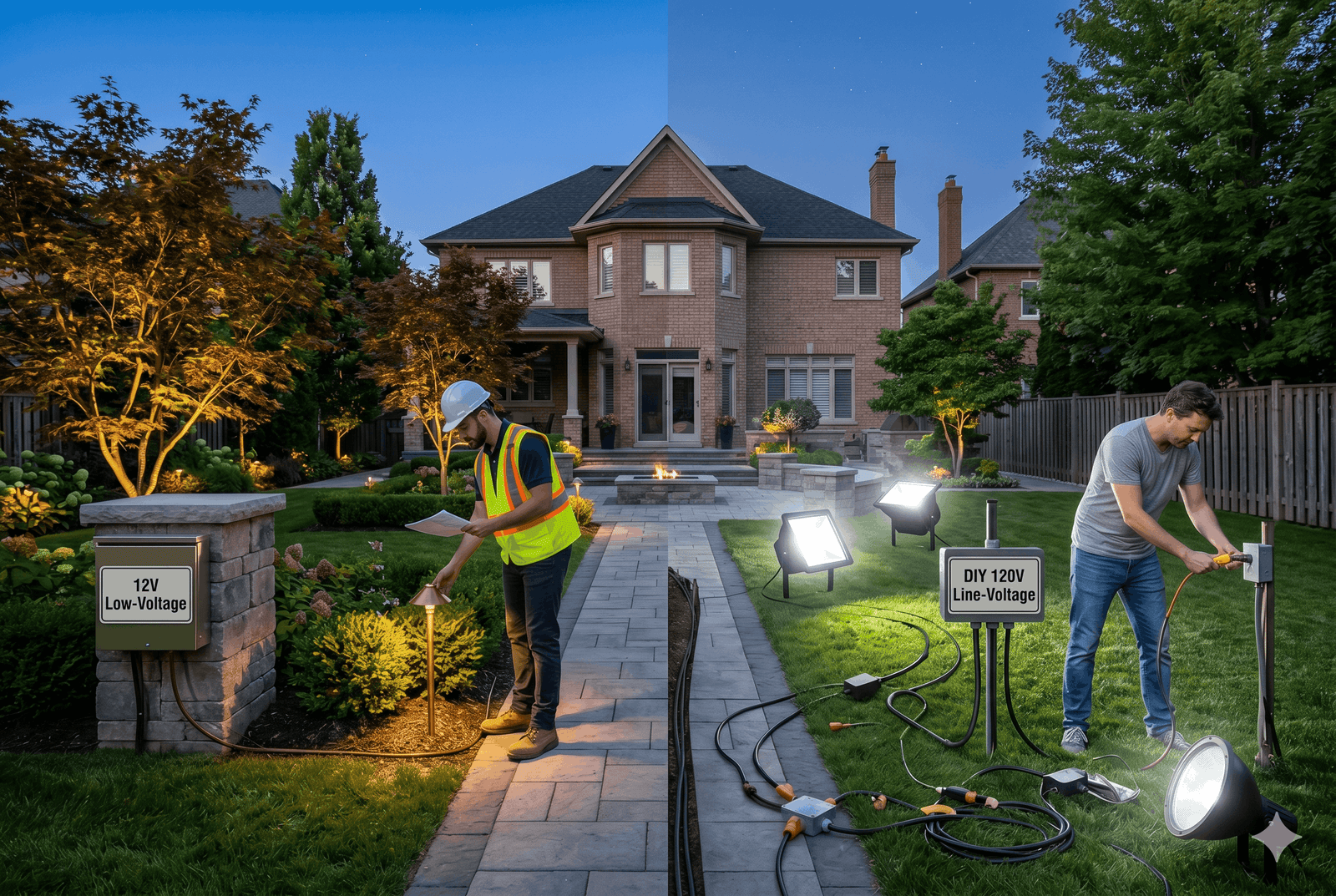
Homeowners across Toronto, Mississauga, Scarborough, and Markham face a genuine procurement decision when planning landscape lighting: engage a licensed electrician for a professional low-voltage system, or self-install a line-voltage kit purchased from a big-box retailer. Both approaches deliver outdoor lighting installation outcomes, but they differ substantially in safety exposure, regulatory standing, long-term cost structure, and design capability. This article provides a neutral, side-by-side evaluation to help property owners and facilities managers choose the approach that fits their specific site conditions, budget posture, and compliance obligations.
Which Outdoor Lighting Installation Method Offers Better Long-Term Safety and Compliance?
Trenching Depth and Wiring Hazards
Low-voltage twelve-volt systems require shallower burial depths than line-voltage circuits, reducing the risk of accidental contact during future landscaping work. Line-voltage installations demand deeper conduit runs, often through areas already occupied by gas, water, and telecommunications infrastructure. For residential pathway illumination in established GTA yards, shallow-buried low-voltage cable is significantly easier to route around existing utility lines. In contrast, line-voltage conduit poses a materially higher excavation risk if utility locates are incomplete.
Permitting and Local Electrical Codes
Line-voltage exterior lighting installation in Ontario requires a permit and inspection under the Electrical Safety Authority framework, and unlicensed work carries municipal fine exposure that a substantial share of unpermitted projects ultimately face. DIY low-voltage kits often fall below the permit threshold, but improper transformer placement or overloaded circuits still create liability. Professional outdoor lighting installation by a licensed contractor, such as Canadian Wire Wizards, ensures code-compliant wiring, documented inspection records, and reduced homeowner liability across all GTA municipalities.
How Does Exterior Lighting Installation Impact Overall Project Costs and Property Value?
Upfront Hardware Versus Long-Term Maintenance
Professional low-voltage systems carry a higher upfront hardware cost than big-box retailer kits, but the maintenance cadence is materially lighter over the asset’s life. DIY line-voltage kits may appear cost-competitive at purchase, yet connector corrosion, socket failures, and non-standard components drive a heavier ongoing replacement burden. For homeowners in North York or Richmond Hill planning a multi-zone landscape project, requesting a professional site assessment from Canadian Wire Wizards clarifies the true lifecycle cost difference before any trench is opened.
Energy Efficiency and Modern Technology
Modern light-emitting diode fixtures consume a fraction of the energy that legacy halogen bulbs draw, and this gap compounds meaningfully over a multi-year operating period, regardless of which voltage system powers them. Professional installations pair LED sources with properly sized transformers and dimming controls, whereas DIY kits frequently bundle lower-efficacy components that limit efficiency gains. Architectural grazing techniques, which wash textured surfaces with angled light to enhance curb appeal, are far easier to execute with a professionally zoned low-voltage system than with fixed line-voltage floodlights.
Which Outdoor Lighting Installation Approach Provides Superior Smart Home Integration?
Automation and App-Based Scheduling
Professional low-voltage systems integrate cleanly with premium ecosystems such as Lutron and Ring, enabling app-based scheduling, motion-triggered zones, and remote dimming. DIY line-voltage kits typically rely on basic timer switches with limited protocol compatibility, creating integration friction for homeowners who already operate smart thermostats or security platforms. Adoption of automated landscape illumination systems has grown across Vaughan and Aurora properties, and professional zoning design is the primary factor separating responsive smart lighting from a collection of independently switched fixtures.
Future Expansion and System Flexibility
Low-voltage transformers allow landscape retrofits with minimal disruption: additional fixture runs connect to spare transformer capacity without new conduit or panel work. Line-voltage systems require a licensed electrician for every circuit extension, adding cost and scheduling friction to future expansions. Before expanding any existing system, evaluate the current transformer capacity by confirming the total wattage of connected fixtures, comparing that figure against the transformer’s rated output, and verifying that the voltage drop across the longest run remains within the acceptable range for consistent fixture performance.
How Do Professional and Do-It-Yourself Systems Compare for Dark Sky Sustainability?
Mitigating Light Pollution
Dark Sky compliance standards call for fully shielded fixtures that direct light downward and eliminate unnecessary skyward glare, a specification that professional designers incorporate from the initial layout stage. DIY line-voltage floodlights are frequently unshielded, and field evidence consistently links unshielded installations to measurable increases in ambient sky brightness in suburban corridors. Professional design approaches such as moonlighting, which positions fixtures high in tree canopies to mimic natural light, and silhouetting, which backlights architectural features, achieve dramatic results with lower aggregate output than broad-coverage DIY arrays.
Weather Resistance and Material Durability
Brass and copper fixtures used in professional low-voltage outdoor lighting installation develop a protective patina that resists corrosion through GTA freeze-thaw cycles. In contrast, plastic housings common in DIY kits become brittle and UV-degraded within a few seasons. The qualitative lifespan gap between cast-metal and injection-moulded plastic fixtures is substantial in harsh winter climates like those experienced in Ajax, East York, and Scarborough. Homeowners searching for outdoor lighting installation near them should prioritize fixture material grade alongside installation method, as hardware longevity directly determines total replacement frequency.
Verdict: Which Outdoor Lighting Installation Is Right for Your Property?
The Decision Matrix for Homeowners
| Scenario | Professional Low-Voltage Is Best When | DIY Line-Voltage Is Best When |
| Safety priority | Licensed work, shallow burial, ESA compliance needed | Temporary accent lighting on a covered porch only |
| Budget posture | Lifecycle cost matters more than the lowest upfront spend | The lowest possible initial outlay is the sole constraint |
| Smart home integration | Lutron, Ring, or multi-zone dimming is required | A basic on/off timer is sufficient |
| Aesthetic complexity | Moonlighting, grazing, or silhouetting techniques planned | Single-zone floodlight coverage is acceptable |
| Property value impact | Architectural illumination tied to resale positioning | Functional security lighting with no design intent |
Professional outdoor lighting installation consistently delivers stronger property value outcomes when architectural illumination is part of a deliberate curb-appeal strategy, a pattern well-documented across residential markets in Mississauga and Toronto.
Next Steps for Your Landscape Project
Canadian Wire Wizards, a licensed electrical contracting company serving the GTA since its founding in 2018, follows a structured process: site consultation, custom zone design, and rapid deployment using weather-resistant brass and copper fixtures rated for Canadian climate conditions. To begin, schedule a comprehensive design consultation so your property’s specific conditions, from soil depth to smart home platform, inform every fixture placement decision.
