

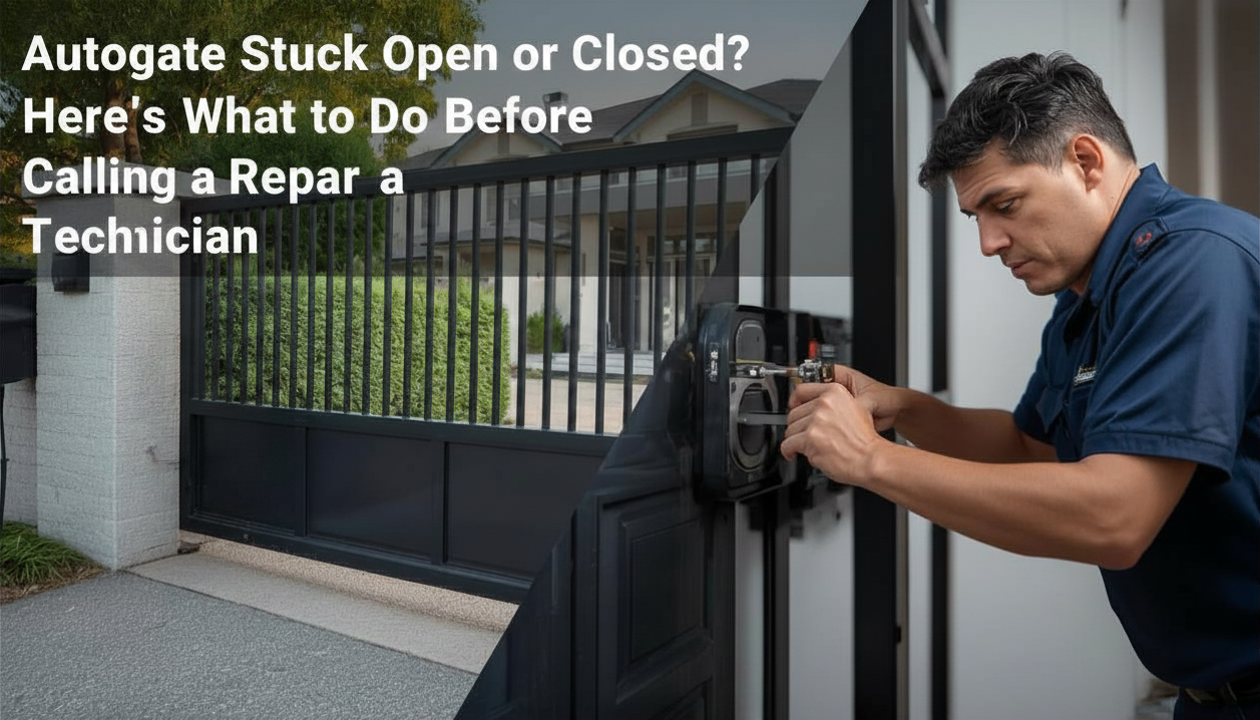
A gate that won’t open leaves you stranded outside your own home. A gate that won’t close leaves your property exposed. Either way, a stuck autogate is stressful — but before you panic or pay for an emergency callout, there are a few safe checks you can do yourself that solve the problem in many cases.
Here’s a step-by-step guide to work through, plus a clear line on when it’s time to stop troubleshooting and call a professional.
First: Check for Your Own Safety
If your gate is stuck and there is a vehicle, person, or pet caught in its path, do not attempt to force it open or closed manually. Use the emergency manual release (covered below) to free the gate safely, and keep people and pets clear of the gate mechanism at all times.
Step 1: Identify Whether It’s Stuck Open or Stuck Closed
The cause — and the urgency — differ depending on which state your gate is stuck in.
- Stuck open: a security concern, but not usually an emergency. Your home is exposed, but you can typically still drive in and out.
- Stuck closed: more urgent if you need to leave for work, an appointment, or an emergency. This is where knowing the manual release matters most.
Step 2: Try the Remote From Different Positions
Before assuming the worst, rule out the simplest explanation — a weak or misaligned signal.
- Stand closer to the gate motor and try the remote again. Most residential autogate remotes have a range of 15–30 metres; obstructions like parked vehicles or thick foliage can block the signal.
- Try a second remote if you have one. If the second remote works, the issue is isolated to one remote (likely a battery or programming issue), not the gate system itself.
- Check whether any indicator light on the motor unit or control box is flashing. A flashing light, even without movement, usually signals the system is receiving power and registering input — pointing to a mechanical or sensor fault rather than a complete system failure.
Step 3: Check the Power Supply
Autogate systems run on mains electricity, often stepped down through a transformer. A power interruption is one of the most common — and easiest to fix — causes of a stuck gate.
- Check your home’s circuit breaker or distribution board for any tripped switches related to the gate or outdoor power circuits.
- Look at the motor control box for a power indicator light. No light usually means no power is reaching the unit.
- If there’s been a recent storm or power outage in your area, this is very likely your cause — autogates are particularly sensitive to power interruptions in Singapore’s monsoon season.
Step 4: Inspect the Photocell Sensors
Photocells are the infrared safety beams mounted on either side of your gate opening. If this beam is broken, dirty, or misaligned, most autogate systems will refuse to close — and some will refuse to open too, as a safety precaution.
- Look for the small sensor units, usually mounted on short posts or brackets at the base of the gate opening, roughly 30–50cm off the ground.
- Check whether anything is blocking the beam — fallen leaves, an object, even a spider web can sometimes interfere with the signal.
- Wipe both sensor lenses with a soft, dry cloth. Moisture, dust, and grime build-up are extremely common in Singapore’s humidity and are a leading cause of false obstruction readings.
- Check that both sensor units are facing each other directly. A sensor knocked out of alignment — even slightly, by wind, a passing vehicle, or general wear — will break the beam permanently until it’s re-aligned.
Step 5: Look for Physical Obstructions in the Gate’s Path
Sliding gates, in particular, are prone to this. Walk the full length of the track and check for:
- Small stones, leaves, or debris that have collected in the track.
- Any object that may have rolled or blown into the gate’s path.
- Visible damage, bending, or warping in the track itself — if the gate is grinding or struggling at one specific point, this is often the cause.
For swing gates, check the ground and hinge area for obstructions, and ensure nothing is blocking the arc of the gate’s swing.
Step 6: Use the Manual Release (For Emergency Access)
Every properly installed autogate system includes a manual release mechanism — this is a safety requirement, not an optional feature. It allows you to disengage the motor and move the gate by hand during a power outage or system fault.
- Locate the release key or lever — usually a small lockable cover on the motor unit itself, or a pull-cord for chain-driven systems.
- Insert the key (provided at installation) and turn or pull according to your system’s specific mechanism to disengage the motor.
- Once disengaged, the gate can be pushed or slid open by hand.
- Important: after manually opening the gate, the motor remains disengaged. Re-engage it once power is restored, or the issue is resolved, or the motor will not respond to the remote.
If you don’t know where your manual release is or don’t have the key, this is something to address immediately — even before anything goes wrong. Ask your installer or service provider to show you, or arrange a replacement key.
Step 7: Note Any Unusual Sounds or Behaviour
Before calling a technician, take note of anything specific you observed — this dramatically speeds up diagnosis and often reduces the need for a second visit.
- Did the gate make a grinding, clicking, or humming noise before stopping?
- Did it stop suddenly, or slow down gradually before stopping?
- Did it move partway and then reverse direction on its own?
- Is there a burning smell near the motor unit? (If yes, disconnect power immediately and do not attempt further operation.)
- Has the gate been used unusually often in the last few hours — for an event, deliveries, or multiple family members coming and going?
When to Stop Troubleshooting and Call a Professional
Some causes are safe to investigate yourself. Others require a trained technician with the right tools and parts. Call for professional autogate repair in Singapore if:
- Power and remotes check out, but the gate still won’t move. — This usually points to a motor, control board, or wiring fault that needs proper diagnostic equipment.
- You smell burning or see scorch marks near the motor unit. — This is a potential electrical hazard — disconnect power and call a technician immediately.
- The gate moves erratically — reversing, stopping randomly, or jerking. — This often indicates a limit switch or encoder fault that requires recalibration by a professional.
- You’ve cleaned the photocells and confirmed alignment, but the gate still won’t close. — The sensor unit itself may be faulty and need replacement.
- The track or hinge shows visible structural damage. — Continuing to operate a gate with a damaged track or hinge can cause further damage to the motor and create a safety risk.
- The manual release won’t disengage, or the key is missing. — This needs to be resolved urgently, as it affects your ability to access your property safely during any future fault.
Why a Quick Self-Check Matters
Working through this checklist before calling for repair does two things. First, it may resolve the issue immediately — many stuck-gate calls turn out to be a flat battery or dirty sensor, fixable in minutes. Second, if you do need a technician, the information you’ve gathered (what you checked, what you observed, when it started) allows them to diagnose the fault faster and often arrive with the right part on the first visit.
PCM Electrical Engineering provides autogate repair services accross Singapore, with technicians trained on the full range of NICE autogate systems. If your self-check doesn’t resolve the issue, contact us — we aim to diagnose and fix most faults on the same visit.
FAQs
1. How do I manually open my autogate during a power outage?
Use the manual release key or lever on the motor unit to disengage the motor. This lets you push or slide the gate open by hand. Re-engage it once power returns.
2. Why does my autogate stop and reverse before fully closing?
Usually the photocell sensors detecting an obstruction — even dust or misalignment can trigger it. Clean the lenses and check they face each other directly. If it persists, the sensor may need replacing.
3. Can I fix a stuck autogate myself, or do I need a technician?
Simple issues like flat batteries, dirty sensors, or debris in the track are safe to check yourself. If you smell burning or the gate moves erratically, stop and call a professional.
4. Why is my autogate not responding to the remote at all?
Most likely a weak or dead remote battery. Try a second remote, or move closer to the motor. If neither works, it’s likely a power or control board issue.
5. Is it safe to force open a stuck autogate?
No — never force it, especially if a vehicle or person is nearby. Use the manual release instead to safely move the gate by hand.
