

TL;DR
Choosing between NITs and BITS depends on your JEE Main rank, BITSAT score, preferred branch, campus preference, fees, placements, and long-term career goals.
- A strong JEE Main rank can open doors to top NITs, IIITs, and GFTIs through JoSAA counselling.
- A good score in the BITSAT exam can help you get admission to BITS Pilani, Goa, or Hyderabad campuses.
- BITSAT marks vs rank is useful for understanding expected branch chances in BITS campuses.
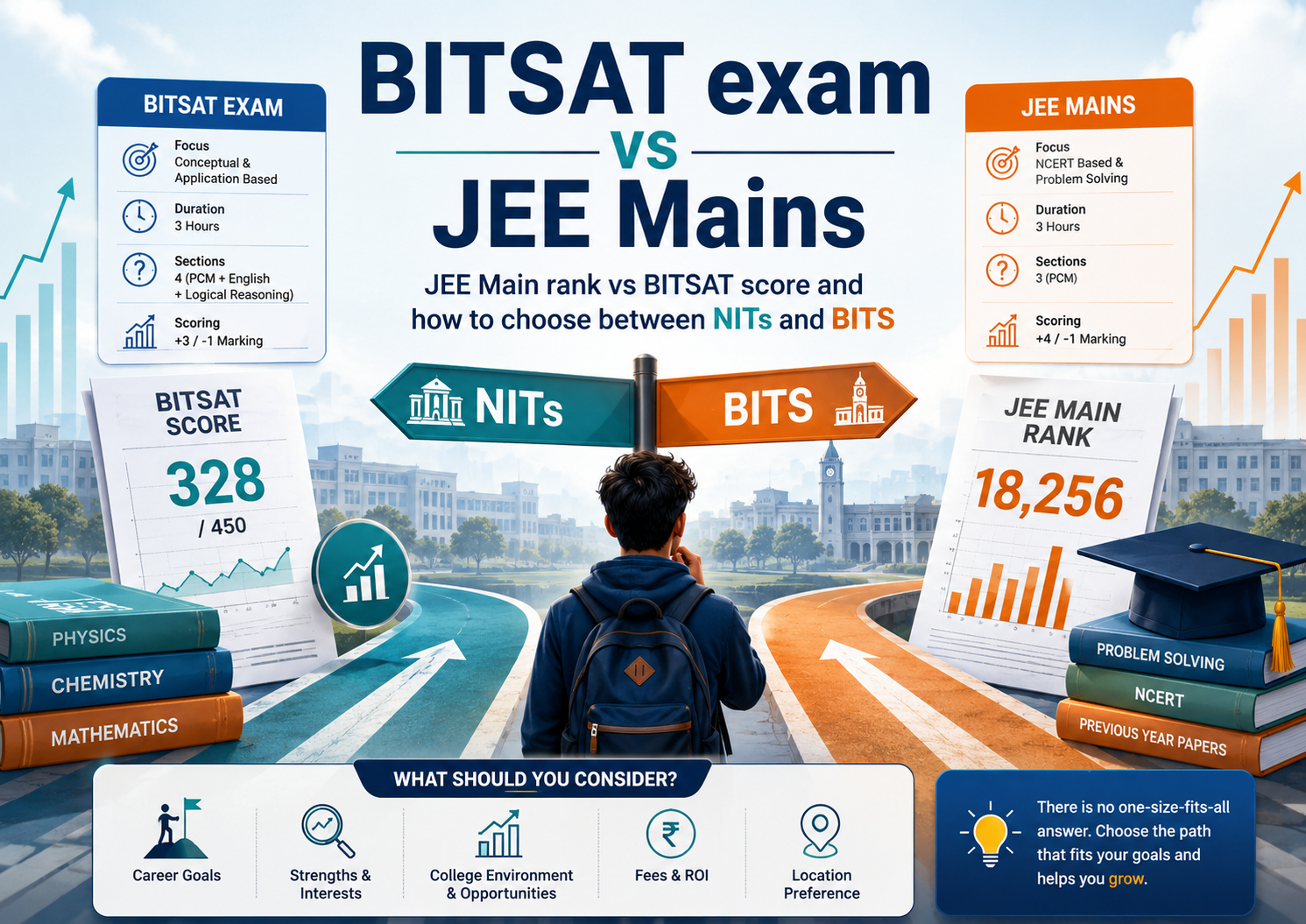
- BITSAT vs JEE Mains is not just about difficulty; it is also about exam pattern, speed, counselling, fees, and college options.
- Students should compare branch quality, placement trends, campus life, cost, location, and future plans before making a final choice.
Introduction
Every year, many engineering aspirants face one common confusion after results: should they choose an NIT through JEE Main rank or go for BITS through their BITSAT score?
This decision is important because both options are highly respected in India.
NITs offer strong government-backed engineering education, good placements, lower fees compared to private institutes, and a wide alumni network.
BITS Pilani and its campuses are also known for academic flexibility, strong industry reputation, impressive placements, startup culture, and a modern campus experience.
So, the real question is not just which college is better.
The better question is: which option is better for your score, your branch preference, your budget, and your career goals?
Understanding JEE Main rank and NIT admission
JEE Main is the entrance exam used for admission to NITs, IIITs, and GFTIs through JoSAA counselling.
Your JEE Main rank matters more than just your raw marks because admission depends on category, home state quota, other state quota, branch demand, and seat availability.
For example, a student with a strong rank may get Computer Science, Electronics, Electrical, or Mechanical in a top NIT.
A student with a moderate rank may still get a good branch in a newer NIT or a core branch in a reputed NIT.
NIT admission depends on many factors:
- JEE Main rank
- Category
- Home state quota
- Preferred branch
- NIT reputation
- Opening and closing ranks
- JoSAA counselling rounds
- CSAB special rounds
This is why students should not compare only college names.
A strong branch in a mid-level NIT may sometimes be better than a less preferred branch in a top NIT, depending on the student’s career plan.
Understanding the BITSAT exam and BITS admission
The BITSAT exam is conducted for admission to BITS Pilani, BITS Goa, and BITS Hyderabad.
Unlike JEE Main, BITSAT focuses more on speed, accuracy, time management, and conceptual clarity.
The exam includes Physics, Chemistry, Mathematics or Biology, English proficiency, and logical reasoning.
This makes BITSAT different from JEE Main because students must solve more questions in limited time.
BITS does not have reservation-based admission for regular seats, and admission is mainly based on the BITSAT score, subject to eligibility criteria.
BITS campuses are popular because of:
- Strong brand value
- Flexible academic structure
- Good placement opportunities
- No strict attendance policy in many cases
- Practice School internship system
- Startup-friendly culture
- Good peer group
If a student scores well in BITSAT, BITS can become one of the best private engineering options in India.
BITSAT marks vs rank: Why it matters before choosing BITS
BITSAT marks vs rank helps students estimate which branch and campus they may get based on their score.
Since BITS admission depends on score-based cutoffs, students should compare their score with previous year trends and expected cutoff ranges.
For example, higher BITSAT scores are usually needed for Computer Science at BITS Pilani.
Slightly lower scores may still help students get Electronics, Electrical, Mechanical, Chemical, Civil, or dual degree courses depending on the campus and counselling iteration.
Students should use BITSAT marks vs rank only as a prediction tool, not as a final guarantee.
Cutoffs may change every year due to:
- Exam difficulty level
- Number of applicants
- Seat availability
- Branch demand
- Campus preference
- Counselling withdrawals
- Iteration-wise movement
If your BITSAT score is close to the expected cutoff for your preferred branch, you should keep backup choices ready.
BITSAT vs JEE Mains: Key differences students should know
Many students compare BITSAT vs JEE Mains only based on difficulty level, but the difference is much deeper.
JEE Main is more concept-driven and requires strong problem-solving ability.
BITSAT is also concept-based, but it demands faster solving, better accuracy, and strong time management.
In JEE Main, your percentile and rank decide your admission options.
In BITSAT, your score directly influences your campus and branch chances.
Some major differences include:
- JEE Main gives access to NITs, IIITs, GFTIs, and eligibility for JEE Advanced.
- BITSAT gives access to BITS Pilani, Goa, and Hyderabad.
- JEE Main has a percentile and rank system.
- BITSAT has a score-based admission process.
- BITSAT includes English and logical reasoning.
- JEE Main is usually more competitive because of the larger number of applicants.
- BITSAT often requires higher speed because of the exam pattern.
So, students should prepare and decide based on their strength.
If you are strong in deep concepts and advanced problem-solving, JEE Main may suit you well.
If you are fast, accurate, and comfortable with mixed-section exams, the BITSAT exam can become a strong opportunity.
When should you choose an NIT?
Choosing an NIT can be a smart decision when your JEE Main rank gives you a strong branch in a reputed NIT.
NITs are especially attractive for students who want quality education with relatively lower fees.
You may choose an NIT if:
- You are getting Computer Science, Electronics, Electrical, or another preferred branch in a top or good NIT.
- You want a government-funded institute.
- You are looking for lower education cost.
- You are comfortable with JoSAA counselling and branch-based selection.
- You want strong alumni support and national recognition.
- You are planning for GATE, UPSC, PSU jobs, research, or higher studies.
Top NITs have strong placement records, especially in branches like CSE, ECE, EEE, IT, and Mechanical.
However, the final decision should depend on both college and branch.
A lower-preference branch in a top NIT may not always be better than a high-demand branch in BITS.
When should you choose BITS?
BITS can be a great option if your BITSAT score gives you a good branch in Pilani, Goa, or Hyderabad.
BITS is especially attractive for students who want academic flexibility, strong placements, industry exposure, and a private campus environment.
You may choose BITS if:
- You are getting your preferred branch in any BITS campus.
- You want flexibility in academics.
- You are interested in startups, research, internships, or product-based companies.
- You are comfortable with higher fees.
- You value campus culture and peer quality.
- You are getting a better branch in BITS than in NIT.
For example, if you are getting Civil or Metallurgy in an NIT but Electronics or Computer Science-related courses in BITS, BITS may be a better choice for technology-focused careers.
Similarly, if you are getting a top NIT with your preferred branch, then NIT may offer better value for money.
Branch vs college: What should matter more?
This is one of the biggest questions in engineering admissions.
Should you choose a better college with a lower branch or a better branch in a slightly lower-ranked college?
There is no single answer.
For students who are very clear about coding, software, AI, data science, or product-based roles, branch can matter a lot.
Computer Science, IT, Electronics, and related branches often offer better opportunities in tech placements.
For students who want a strong brand, diverse exposure, and flexibility, college reputation also matters.
Before choosing, ask yourself:
- Do I have a strong interest in this branch?
- Am I choosing this branch only because of the college name?
- What are the placement trends for this branch?
- Does the college allow branch change?
- What are the internship opportunities?
- Can my family comfortably manage the fees?
- Will this choice support my long-term career goal?
The best option is usually where branch, college reputation, affordability, and career goals align well.
How to make the final decision between NITs and BITS
Before locking your choice, compare your options honestly.
Do not choose only because of social media opinions, relatives, or general rankings.
Make a shortlist of the actual options available to you.
For example:
- NIT name and branch
- BITS campus and branch
- Expected placements
- Fees and scholarships
- Location
- Curriculum flexibility
- Internship exposure
- Higher studies opportunities
- Student reviews
- Long-term career fit
If you are getting a top NIT with a strong branch, it can be a very good decision.
If you are getting a better branch in BITS and can manage the fee structure, BITS can also be a strong choice.
The better decision is the one that gives you confidence, not confusion.
Common mistakes students should avoid
Many students make rushed decisions during counselling.
Avoid these mistakes:
- Choosing only by college name
- Ignoring branch interest
- Not checking previous year cutoffs
- Comparing JEE Main rank and BITSAT score directly without context
- Ignoring total fees
- Not considering campus location
- Following random online opinions
- Missing counselling deadlines
- Not keeping backup options
- Ignoring long-term career plans
Both NITs and BITS can lead to excellent careers.
The outcome depends not only on the institute but also on how well you use the opportunities available there.
Conclusion
Choosing between NITs and BITS is not about finding one universal winner.
It is about finding the right fit based on your JEE Main rank, BITSAT score, branch preference, budget, and career goals.
The BITSAT exam gives students a strong chance to enter one of India’s most respected private engineering institutions, while JEE Main opens the door to NITs, IIITs, and GFTIs.
By understanding BITSAT marks vs rank and comparing BITSAT vs JEE Mains carefully, students can make a smarter and more confident admission decision.
GoFillForm helps students stay updated with exam details, counselling guides, college options, and application support. Students can use GoFillForm to make the admission process easier, more organized, and less stressful.
Frequently Asked Questions
1. Is BITS better than NIT?
BITS can be better than many NITs for certain branches, placements, flexibility, and campus exposure. However, top NITs with strong branches are also excellent, especially because of lower fees and strong national reputation.
2. Can I compare JEE Main rank directly with BITSAT score?
No, JEE Main rank and BITSAT score follow different admission systems. JEE Main uses rank and percentile, while BITS admission depends mainly on BITSAT score and cutoff trends.
3. What is more important, branch or college?
Both are important. If you are career-focused in software, electronics, AI, or data science, branch may matter more. If you want broader exposure, brand value, and flexibility, college reputation also matters.
4. Is BITSAT easier than JEE Main?
BITSAT is not necessarily easier. JEE Main may have more concept-heavy questions, while BITSAT requires speed, accuracy, English, logical reasoning, and better time management.
5. Should I choose BITS if I get a lower branch in an NIT?
You can consider BITS if you are getting a better branch there and can manage the fees. However, compare placements, campus, long-term goals, and personal interest before deciding.
6. Does BITSAT marks vs rank help in counselling?
Yes, BITSAT marks vs rank helps students estimate expected campus and branch chances. However, it should be used only as a guide because cutoffs change every year.
7. Which is better for placements, NIT or BITS?
Both can offer strong placements. Top NITs and BITS campuses usually have good placement opportunities, but the outcome depends on branch, skills, internships, projects, and student performance.