

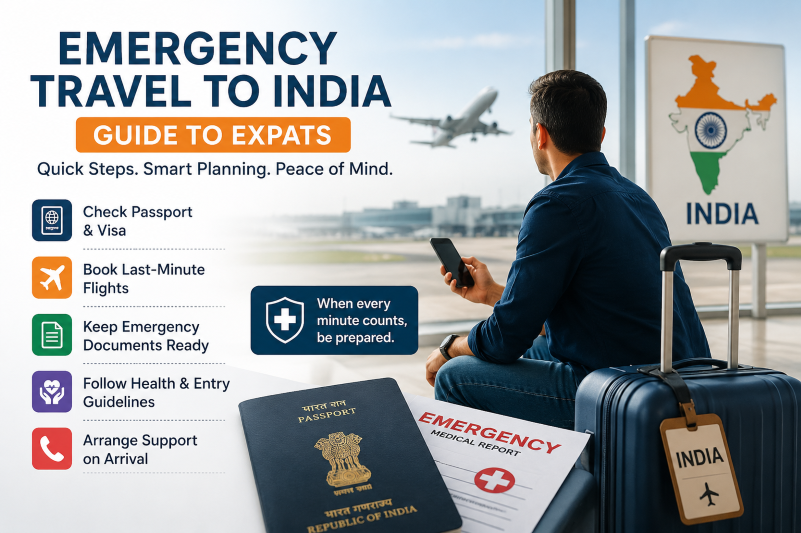
Emergency Travel to India can hit without warning.
A medical crisis back home. A family loss. A legal emergency.
I’ve been there. I booked a ticket overnight, packed in a daze, and learned the hard way what really matters when every hour counts. This guide walks you through the process—calmly, clearly, and honestly—so you can move fast without missing critical steps.
Why Expats Face Emergency Travel to India
Most emergencies fall into a few patterns.
A parent falls seriously ill.
A close family member passes away.
A legal or property issue demands your presence.
According to the Ministry of External Affairs, medical and bereavement cases are the most common reasons NRIs request urgent travel assistance. Timing matters, but preparation matters more.
Step 1: Check Passport and Visa Status Immediately
Start here. Always.
Your passport must remain valid for at least six months.
If it expires soon, contact the nearest Indian consulate right away.
For visas, most expats travel on an OCI, tourist visa, or employment visa. OCI holders rarely face issues. Tourist visas may need quick validation.
I once lost three hours because I assumed my visa still worked. Don’t make that mistake.
Step 2: Look for Last-Minute Flights Without Panic
Flights fill fast during emergencies. Still, options exist.
Focus on major hubs like Delhi, Mumbai, and Hyderabad.
Be flexible with layovers and arrival cities.
This is where Last minute flights to India become critical.
Specialized international travel agencies often access fares not visible on public booking sites.
Step 3: Gather Emergency Documents
Airlines and immigration officers may ask for proof.
Keep these ready:
- Hospital letter or doctor’s note
- Death certificate or hospital summary
- Relationship proof (passport, birth certificate, or family tree affidavit)
The Air India and other international carriers sometimes waive penalties if you provide valid emergency documents. Policies vary, so ask directly.
Step 4: Monitor Health and Entry Guidelines
Health rules change fast.
As of recent advisories, India no longer requires routine COVID testing for most travelers. Still, rules can shift during outbreaks.
The Centers for Disease Control and Prevention recommends expats stay updated on destination health alerts and carry proof of basic vaccinations if available.
I always save screenshots of official guidelines. Airport Wi-Fi fails when you need it most.
Step 5: Arrange Support on Arrival in India
Landing is not the end. It’s the start.
Confirm who will pick you up.
Plan hospital transport if needed.
Inform local relatives of your arrival time.
If emotions run high, logistics fall apart fast. A simple pickup plan reduces stress more than you expect.
Step 6: Manage Work and Legal Responsibilities Abroad
Notify your employer as early as possible.
Most companies allow emergency leave with documentation.
If you manage property, finances, or dependents abroad, assign temporary authority through email or power of attorney. I learned this lesson when a bank froze my transaction mid-trip.
Expert Insight: Why Speed Still Needs Structure
According to immigration attorneys quoted by Indian consular services, “Most emergency travel delays happen due to incomplete documentation—not lack of flights.”
That matches my experience. Speed works only when paired with clarity.
Common Mistakes to Avoid
- Booking flights before checking visa validity
- Ignoring time zone differences when calling consulates
- Forgetting travel insurance coverage details
- Carrying only digital copies of documents
Emergency Travel to India tests your decision-making. Small oversights cost hours.
FAQs on Emergency Travel to India
Can I get a visa on arrival during an emergency?
India does not offer visa-on-arrival for most nationalities. OCI holders face fewer restrictions.
Do airlines offer bereavement fares?
Some airlines review cases individually. You must submit proof quickly.
Can someone else collect documents on my behalf in India?
Yes, with authorization letters and ID proof. Requirements vary by institution.
Is travel insurance useful in emergencies?
Yes. Many plans cover medical evacuation, flight changes, and hospital stays.
Emergency Travel to India feels overwhelming because emotions and urgency collide. I’ve lived it. Acting step by step restores control.
Start with documents.
Secure flights wisely.
Lean on verified information, not assumptions.
If time matters, explore trusted options for Last minute flights to India and move forward with confidence—not panic.
