

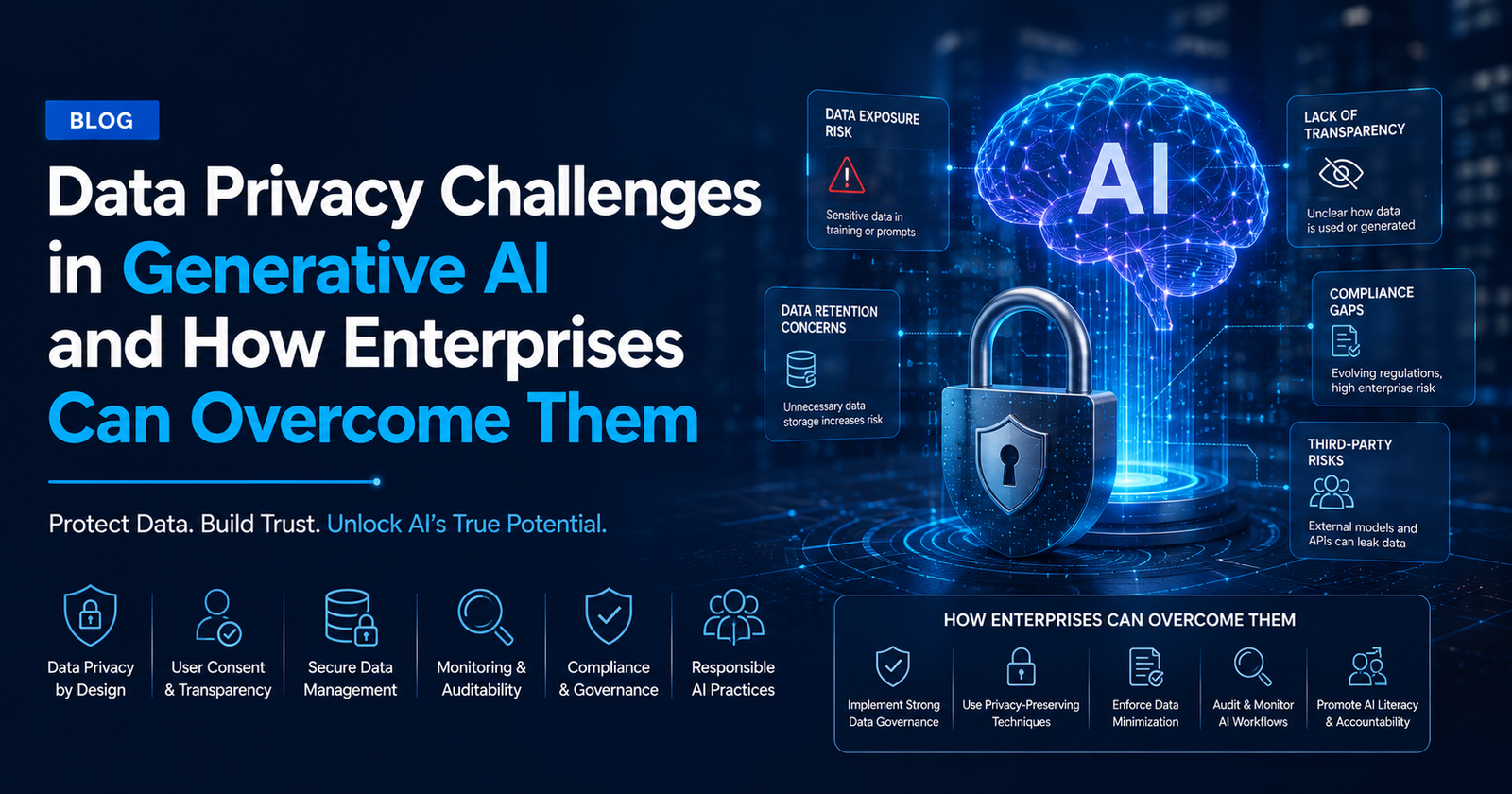
Generative AI has rapidly moved from experimentation to enterprise adoption. Organizations are using AI-powered systems to automate customer interactions, support software development, analyze documents, generate content, and improve decision-making. While the benefits are substantial, the technology has also introduced a new category of privacy and governance concerns.
The numbers tell an important story. According to IBM’s 2025 Cost of a Data Breach Report, 13% of organizations reported security incidents involving AI applications or models, and nearly all affected organizations lacked sufficient AI access controls. IBM also found that organizations with mature AI governance practices experienced significantly lower breach-related costs.
Another IBM CEO study revealed that 71% of business leaders believe trusted AI depends on strong governance. Yet many organizations still lack clear policies governing how employees use generative AI tools.
At the same time, AI adoption continues to accelerate. This creates a pressing challenge for enterprises: how can they benefit from generative AI while protecting sensitive business and customer data?
The answer begins with understanding where privacy risks originate and why traditional security approaches are often insufficient.
Why Generative AI Has Changed the Privacy Landscape
Most enterprise software stores and processes data within clearly defined boundaries. Generative AI changes that model.
A large language model can interact with thousands of documents, knowledge bases, emails, reports, and databases. It can summarize information, answer questions, and generate new content from that context.
That capability creates efficiency. It also increases risk.
The challenge is not that generative AI is inherently unsafe. The challenge is that these systems often require access to information that businesses consider confidential. Customer records, financial projections, source code, legal agreements, and internal communications may all become part of AI workflows.
As the volume of AI-generated interactions grows, organizations must pay closer attention to how information enters, moves through, and exits AI systems.
The Employee Behavior Risk Nobody Predicted
When executives discuss AI security, they often focus on sophisticated cyber threats. In reality, many privacy risks begin with ordinary workplace activities.
Consider a software engineer troubleshooting an application issue. To save time, they paste internal code into a public AI chatbot and ask for suggestions.
A marketing manager uploads customer feedback reports to generate a campaign summary.
A finance analyst asks an AI assistant to simplify quarterly revenue projections.
None of these actions are malicious. In fact, they are often attempts to improve productivity.
The problem is that employees may not know what happens to the information after submission. Depending on the platform, data could be stored, logged, or processed outside the organization’s direct control.
This trend has contributed to the rise of Shadow AI—unauthorized use of AI tools without formal oversight from IT or security teams. For many enterprises, Shadow AI has become one of the fastest-growing privacy concerns because it introduces risk through everyday business operations.
Training Data: The Privacy Challenge That Starts Before Deployment
Many discussions about AI privacy focus on user prompts, but the challenge often begins much earlier.
Every generative AI model learns from data. The quality, source, and governance of that data directly affect privacy outcomes.
Imagine a healthcare organization building an internal AI assistant. If historical datasets contain patient information, the organization must ensure that protected data is properly anonymized before training begins.
The same concern applies to banks, insurers, manufacturers, and government agencies.
Privacy issues frequently arise when organizations cannot clearly answer basic questions:
- Where did the training data originate?
- Was proper consent obtained?
- Does the dataset contain regulated information?
- Can sensitive records be removed if required?
These questions have become increasingly important as regulators place greater emphasis on transparency and accountability in AI systems.
Poor training data governance can create risks long before a model reaches production.
When Convenience Creates Compliance Problems
Generative AI often introduces compliance challenges in unexpected ways.
A multinational organization may use an AI platform hosted in one country, process data in another region, and serve customers across several jurisdictions. This complexity can create uncertainty around data residency and regulatory obligations.
Privacy regulations continue to evolve globally. Organizations must navigate frameworks such as GDPR in Europe, HIPAA in the healthcare sector, and India’s Digital Personal Data Protection Act (DPDP).
For compliance teams, visibility is often the biggest challenge.
If an organization cannot determine where data is processed, who can access it, or how long it is retained, demonstrating compliance becomes significantly more difficult.
As AI adoption expands, privacy discussions are increasingly moving from IT departments to executive boardrooms.
What Enterprises Learned from Early AI Adoption
One of the most widely discussed enterprise AI incidents involved employees sharing proprietary source code with public AI systems.
The intention was simple. Developers wanted assistance with debugging and code optimization.
However, the event highlighted a serious governance issue. Once confidential information was entered into external AI environments, organizations had limited control over how that information was handled.
The response from many enterprises was swift.
Several organizations restricted access to public AI tools, introduced internal AI policies, and accelerated investment in private AI environments.
The lesson was not that AI should be avoided. Rather, organizations recognized that innovation must be accompanied by clear governance and data protection measures.
Why Traditional Security Controls Are Struggling
For years, enterprises relied on firewalls, identity management systems, endpoint protection, and network monitoring to secure digital assets.
Those controls remain essential.
However, generative AI introduces risks that traditional security frameworks were not designed to address.
For example, a firewall can control network traffic, but it cannot determine whether an employee has entered sensitive business information into an AI prompt.
Similarly, access management systems may verify user identity, yet they often lack visibility into how AI-generated outputs are being used.
This gap explains why many organizations are now developing AI-specific governance programs alongside existing cybersecurity initiatives.
Protecting AI systems requires visibility into data, models, prompts, outputs, and user behavior—not just infrastructure.
Why Enterprises Are Moving Toward Custom Generative AI Solutions
A hospital, an investment bank, and a manufacturing company all use data differently.
As a result, many organizations are finding that public AI platforms cannot fully address their privacy requirements.
This shift has increased interest in Custom generative AI solutions.
Instead of relying on shared environments, enterprises can build AI systems around their own governance policies, security controls, and compliance requirements.
For example, a financial institution may deploy an internal AI assistant that operates entirely within approved infrastructure and accesses only authorized datasets. A healthcare provider may require strict controls that prevent patient information from leaving a private environment.
These deployments provide greater visibility and help organizations maintain stronger control over sensitive information.
Building a Privacy-First AI Strategy
Technology alone cannot solve privacy challenges.
Organizations that successfully manage AI risks typically combine governance, security controls, employee education, and continuous monitoring.
Several practices consistently appear in mature AI programs:
Establish Clear Usage Policies
Employees should understand which AI tools are approved, what data can be shared, and which activities require additional review.
Apply Data Minimization Principles
Organizations should limit the amount of sensitive information exposed to AI systems whenever possible. Masking, anonymization, and tokenization can significantly reduce risk.
Implement Role-Based Access Controls
Not every employee requires access to every dataset or AI capability. Limiting permissions helps reduce unnecessary exposure.
Monitor AI Activity Continuously
Regular audits, usage monitoring, and policy enforcement help organizations identify risks before they become serious incidents.
A privacy-first approach requires ongoing attention rather than a one-time implementation effort.
The Role of a Generative AI Development Company
Building secure enterprise AI systems often requires expertise across machine learning, cybersecurity, cloud infrastructure, and regulatory compliance.
For this reason, many organizations work with a specialized Generative AI Development Company when planning large-scale AI initiatives.
Experienced development teams can help design secure architectures, implement governance controls, establish audit mechanisms, and ensure that privacy requirements are integrated into the development lifecycle.
The objective is not simply to deploy AI capabilities. It is to deploy them responsibly.
ROI: Why Privacy Investments Deliver Business Value
Privacy initiatives are often viewed as compliance expenses. In reality, they can produce measurable business benefits.
Organizations with mature AI governance programs often experience:
- Lower breach-related costs
- Faster incident response
- Reduced regulatory exposure
- Stronger customer trust
- Greater confidence in AI adoption
According to IBM research, organizations using AI and automation extensively in security operations reduced breach costs by nearly $2 million on average while shortening breach response timelines.
Beyond direct financial savings, privacy-focused AI strategies reduce uncertainty. That confidence allows organizations to expand AI initiatives without introducing unnecessary risk.
Final Thoughts
Generative AI is reshaping how enterprises manage information, develop products, and support decision-making. Yet the technology’s rapid adoption has exposed significant privacy challenges that many organizations are still learning to address.
The most successful enterprises are not treating privacy as an afterthought. They are integrating governance, security, compliance, and risk management into every stage of the AI lifecycle.
As regulations evolve and AI adoption increases, organizations that invest in strong privacy foundations today will be better positioned to scale AI initiatives tomorrow. Whether through improved governance, stronger oversight, or the adoption of Custom generative AI solutions, the goal remains the same: enabling innovation while protecting the data that businesses and customers trust organizations to safeguard.
