

The global robotic wheelchair market is witnessing rapid growth due to increasing prevalence of mobility impairments, rising geriatric population, and growing advancements in assistive healthcare technologies. Robotic wheelchairs are intelligent mobility devices equipped with advanced automation, sensors, navigation systems, and smart control technologies that enhance mobility, independence, and quality of life for individuals with physical disabilities.
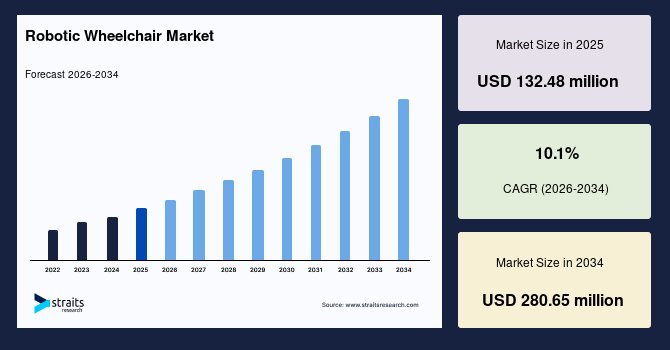
The global robotic wheelchair market size is estimated at USD 132.48 million in 2025 and is projected to reach USD 280.65 million by 2034, growing at a CAGR of 10.1% during the forecast period (2026–2034).
The increasing demand for advanced mobility assistance solutions, rising adoption of smart healthcare devices, and continuous technological advancements in robotics and artificial intelligence are major factors driving market growth. In addition, growing awareness regarding independent living solutions for disabled and elderly individuals is further supporting the expansion of the robotic wheelchair market globally.
Market Drivers
One of the primary drivers of the robotic wheelchair market is the growing aging population worldwide. Elderly individuals are more susceptible to mobility-related disorders, neurological conditions, and physical disabilities, significantly increasing the demand for advanced mobility support systems.
Another major growth factor is the increasing prevalence of spinal cord injuries, muscular disorders, and neurological diseases. Robotic wheelchairs provide enhanced independence, improved navigation capabilities, and better accessibility for patients with limited mobility.
The integration of artificial intelligence, machine learning, and sensor technologies is also fueling market growth. Modern robotic wheelchairs offer features such as obstacle detection, autonomous navigation, voice control, and remote monitoring, improving user safety and convenience.
Additionally, increasing healthcare expenditure and rising government initiatives supporting disability assistance and rehabilitation technologies are contributing significantly to market expansion.
Market Challenges
Despite strong growth prospects, the robotic wheelchair market faces several challenges. One of the major concerns is the high cost associated with advanced robotic wheelchair systems, which may limit adoption among low-income populations and healthcare facilities with budget constraints.
Another challenge is the complexity of maintenance and technical support requirements. Robotic wheelchairs often require specialized servicing, software updates, and trained personnel for efficient operation.
The market also faces limited accessibility and reimbursement coverage in certain regions, particularly in developing economies where healthcare infrastructure remains underdeveloped.
Additionally, concerns regarding battery life, device reliability, and operational safety may affect consumer adoption and market penetration.
Market Segmentation
The robotic wheelchair market is segmented based on product type, control mechanism, application, and end user.
By product type, the market includes fully autonomous robotic wheelchairs and semi-autonomous robotic wheelchairs. The semi-autonomous segment dominates the market due to lower costs, improved user control, and increasing adoption in healthcare and rehabilitation settings.
The fully autonomous segment is also witnessing rapid growth owing to advancements in AI-based navigation and smart mobility technologies.
By control mechanism, the market is categorized into joystick-controlled, voice-controlled, gesture-controlled, and brain-computer interface systems. The joystick-controlled segment accounts for a major market share due to its widespread usage and ease of operation.
The voice-controlled and brain-computer interface segments are experiencing significant growth because of increasing innovation in assistive technologies for individuals with severe physical disabilities.
By application, the market includes personal mobility, rehabilitation centers, hospitals, elderly care facilities, and others. The personal mobility segment dominates the market due to rising demand for independent mobility solutions among disabled and elderly individuals.
Hospitals and rehabilitation centers are also contributing substantially to market growth through increasing adoption of robotic rehabilitation technologies.
By end user, the market is segmented into adults, pediatric users, and geriatric patients. The geriatric patient segment holds a substantial market share due to rising age-related mobility disorders and increasing demand for assisted living technologies.
Regional Insights
Regionally, the robotic wheelchair market is analyzed across North America, Europe, Asia-Pacific, Latin America, and the Middle East & Africa.
North America dominates the global market due to advanced healthcare infrastructure, strong adoption of assistive technologies, and increasing investments in healthcare robotics and rehabilitation systems. The presence of leading medical device manufacturers and favorable reimbursement policies further supports regional market growth.
Europe also holds a significant market share driven by rising geriatric population, growing disability support programs, and increasing healthcare technology adoption.
Asia-Pacific is expected to witness the fastest growth during the forecast period. Rapid healthcare infrastructure development, increasing awareness regarding assistive mobility devices, and growing aging population in countries such as China, Japan, India, and South Korea are driving regional market expansion.
The rising adoption of smart healthcare technologies and supportive government healthcare initiatives are further contributing to market growth across the region.
Latin America and the Middle East & Africa are emerging markets with improving healthcare services, growing awareness regarding disability assistance technologies, and increasing investments in rehabilitation and elderly care infrastructure.
Key Players Analysis
The robotic wheelchair market is highly competitive, with several global and regional manufacturers focusing on smart mobility technologies, AI-powered navigation systems, and advanced rehabilitation solutions to strengthen their market presence.
Companies are increasingly investing in research and development activities aimed at improving wheelchair automation, obstacle detection, battery efficiency, and user comfort. Manufacturers are also emphasizing lightweight designs, ergonomic features, and intelligent control systems to enhance product performance and user experience.
Strategic collaborations, partnerships with healthcare institutions, and expansion into emerging healthcare markets remain key growth strategies among market participants.
Continuous advancements in robotics, artificial intelligence, wearable technologies, and connected healthcare systems are expected to intensify market competition during the forecast period.
For detailed insights, visit: https://straitsresearch.com/report/robotic-wheelchair-market
About Us
Straits Research is a leading research and intelligence organization, specializing in research, analytics, and advisory services, along with providing business insights and research reports.
Contact Us
Email: sales@straitsresearch.com
Tel: +1 646 905 0080 (U.S.), +44 203 695 0070 (U.K.)
