

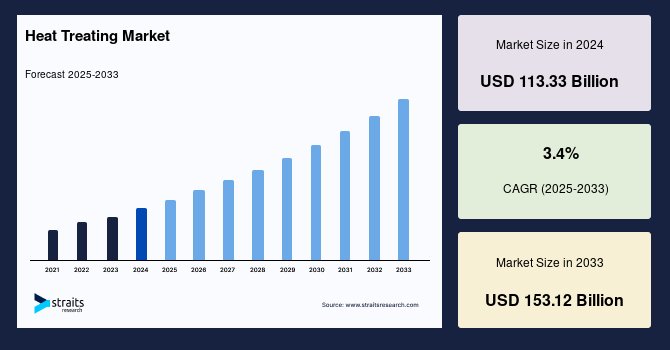
The global heat treating market is experiencing steady growth due to increasing demand for high-performance metal components, expanding industrial manufacturing activities, and rising adoption of advanced material processing technologies. Heat treating is a controlled thermal process used to alter the physical and mechanical properties of metals and alloys, enhancing characteristics such as hardness, strength, toughness, wear resistance, and durability for various industrial applications.
The global heat treating market size was valued at USD 113.33 billion in 2024 and is estimated to grow from USD 117.18 billion in 2025 to reach USD 153.12 billion by 2033, growing at a CAGR of 3.4% during the forecast period (2025–2033).
The increasing demand from automotive, aerospace, construction, and industrial machinery sectors is a major factor driving market growth. Furthermore, advancements in heat treatment technologies and the growing need for high-quality engineered materials are supporting the expansion of the heat treating market globally.
Market Drivers
One of the primary drivers of the heat treating market is the growing demand for durable and high-strength metal components across various industries. Heat treatment processes significantly improve the mechanical performance of metals, making them suitable for demanding industrial applications.
Another major growth factor is the expansion of the automotive industry. Heat-treated components are extensively used in engines, transmissions, gears, axles, suspension systems, and other critical automotive parts to enhance durability and performance.
The aerospace sector is also fueling market growth. Aircraft manufacturers increasingly rely on advanced heat treatment processes to improve the strength-to-weight ratio, fatigue resistance, and reliability of aerospace components.
Additionally, rapid industrialization, infrastructure development, and increasing investments in manufacturing facilities are contributing significantly to market expansion.
Market Challenges
Despite favorable growth prospects, the heat treating market faces several challenges. One of the major concerns is the high energy consumption associated with heat treatment operations. Rising energy costs can significantly impact production expenses and operational profitability.
Another challenge is the increasing pressure to comply with environmental regulations regarding emissions, energy efficiency, and industrial waste management.
The market also faces challenges related to equipment maintenance, process optimization, and the shortage of skilled labor capable of operating advanced heat treatment systems.
Additionally, fluctuations in raw material prices and economic uncertainties may influence manufacturing investments and market demand.
Market Segmentation
The heat treating market is segmented based on process type, material type, equipment, and end-user industry.
By Process Type
The market includes annealing, hardening, tempering, carburizing, nitriding, normalizing, and others. The hardening segment dominates the market due to its widespread use in improving metal strength, wear resistance, and mechanical performance across industrial applications.
The carburizing and nitriding segments are also witnessing significant growth owing to increasing demand for surface hardening solutions in automotive and aerospace components.
By Material Type
The market is categorized into steel, cast iron, aluminum, copper, titanium, and others. The steel segment accounts for the largest market share due to its extensive use in automotive, industrial machinery, construction, and transportation applications.
Aluminum and titanium materials are also experiencing strong demand because of their growing adoption in aerospace and lightweight automotive manufacturing.
By Equipment
The market includes batch furnaces, continuous furnaces, vacuum furnaces, induction heating systems, and others. Continuous furnaces dominate the market due to their high productivity, efficiency, and suitability for large-scale industrial operations.
Vacuum furnaces are witnessing rapid growth as industries increasingly require contamination-free and high-precision heat treatment processes.
By End-User Industry
The market is segmented into automotive, aerospace and defense, construction, industrial machinery, energy, and others. The automotive sector holds the largest market share due to extensive utilization of heat-treated components in vehicle manufacturing.
The aerospace and defense sector is also contributing significantly to market growth through increasing demand for high-performance alloys and precision-engineered components.
Regional Insights
Regionally, the heat treating market is analyzed across North America, Europe, Asia-Pacific, Latin America, and the Middle East & Africa.
Asia-Pacific dominates the global market due to rapid industrialization, strong manufacturing activities, expanding automotive production, and increasing infrastructure investments in countries such as China, India, Japan, and South Korea.
North America holds a significant market share driven by advanced manufacturing capabilities, strong aerospace and defense industries, and growing investments in industrial automation.
Europe also represents a substantial market due to its established automotive sector, advanced engineering capabilities, and increasing focus on energy-efficient manufacturing technologies.
Latin America and the Middle East & Africa are emerging markets with growing industrial development, expanding construction activities, and increasing demand for durable industrial components.
Key Players Analysis
The heat treating market is highly competitive, with numerous global and regional service providers and equipment manufacturers focusing on technological innovation, operational efficiency, and process optimization to strengthen their market positions.
Companies are increasingly investing in advanced furnace technologies, automation systems, vacuum heat treatment solutions, and energy-efficient processing equipment to improve productivity and reduce environmental impact. Strategic partnerships, acquisitions, and facility expansions are also helping market participants enhance their service capabilities and geographic presence.
Manufacturers are emphasizing digital monitoring systems, predictive maintenance technologies, and environmentally sustainable heat treatment processes to meet evolving industry requirements.
Continuous advancements in metallurgy, materials science, industrial automation, and energy-efficient manufacturing technologies are expected to intensify market competition during the forecast period.
For detailed insights, visit: https://straitsresearch.com/report/heat-treating-market
About Us
Straits Research is a leading research and intelligence organization, specializing in research, analytics, and advisory services, along with providing business insights and research reports.
Contact Us
Email: sales@straitsresearch.com
Tel: +1 646 905 0080 (U.S.), +44 203 695 0070 (U.K.)
