

Introduction
In construction sites, factories, energy plants, and other high-risk workplaces, safety is not just a compliance requirement it’s a matter of protecting lives.
Workers in these environments face hazards every day, including heavy machinery, working at height, hazardous materials, electrical risks, and constantly changing work conditions. A single safety failure can lead to serious injuries, fatalities, project delays, and significant financial losses.
Today, clients, contractors, and regulators expect organizations to demonstrate a proactive approach to occupational health and safety. This is where ISO 45001 certification becomes essential.
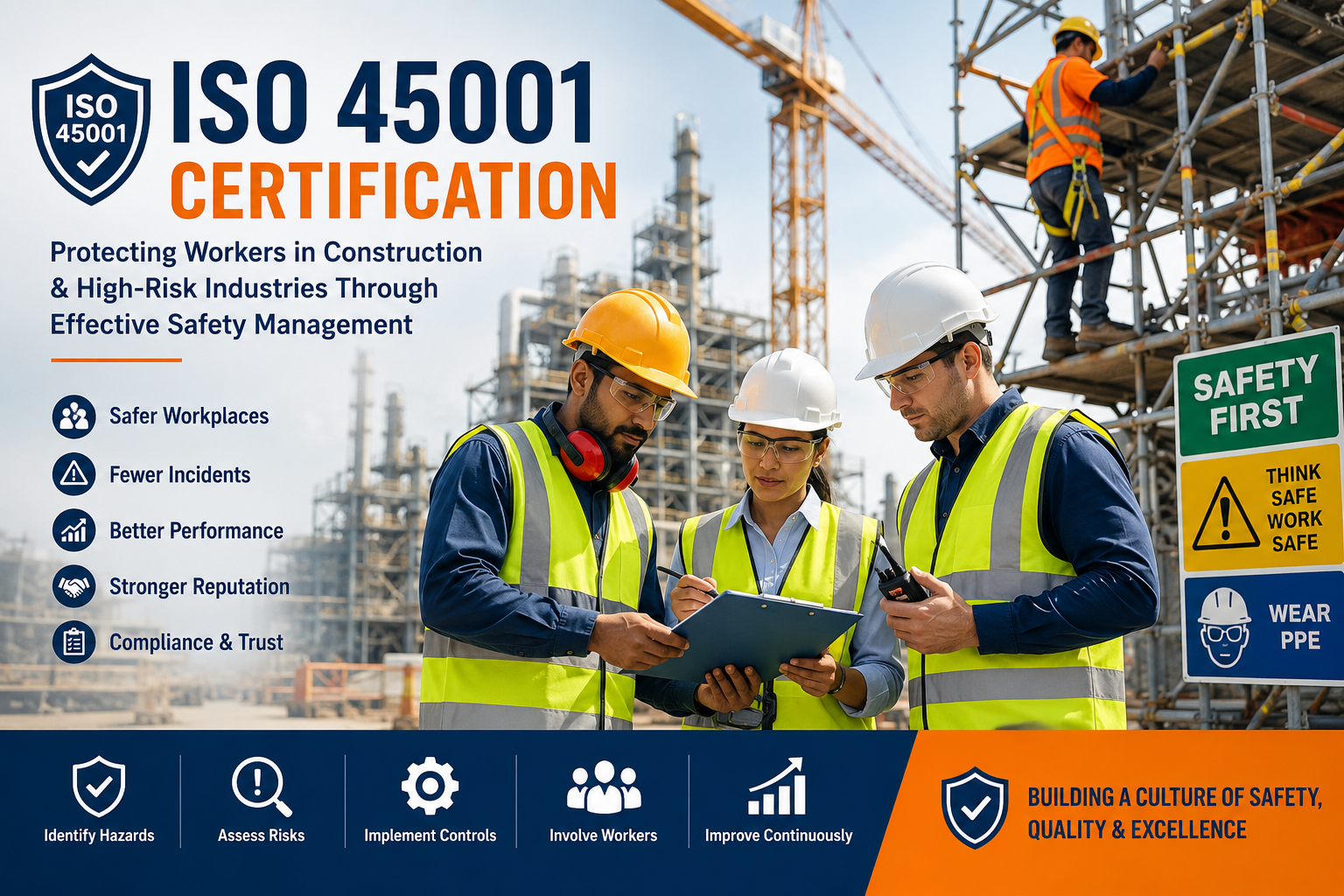
ISO 45001 certification is the internationally recognized standard for Occupational Health and Safety Management Systems (OHSMS). It helps organizations identify workplace hazards, reduce risks, improve safety performance, and create a safer working environment for employees and contractors.
This guide explains what ISO 45001 certification is, why it matters for high-risk industries, and how organizations can achieve certification successfully.
What Is ISO 45001 Certification?
ISO 45001 certification is independent confirmation that an organization has implemented an effective Occupational Health and Safety Management System (OHSMS).
The standard provides a structured framework for:
- Identifying workplace hazards
- Assessing health and safety risks
- Implementing preventive controls
- Managing incidents and emergencies
- Improving safety performance continuously
- Involving workers in safety decisions
Rather than reacting to accidents after they occur, ISO 45001 promotes a proactive approach to preventing injuries and illnesses before they happen.
Understanding the Hierarchy of Controls
A key principle of ISO 45001 is the Hierarchy of Controls, which prioritizes the most effective ways to eliminate or reduce workplace risks.
The hierarchy follows this order:
- Elimination – Remove the hazard completely.
- Substitution – Replace the hazard with a safer alternative.
- Engineering Controls – Isolate workers from the hazard.
- Administrative Controls – Change work procedures to reduce risk.
- Personal Protective Equipment (PPE) – Provide protective gear as the final layer of defence.
For example, eliminating a fall hazard through safer design is more effective than relying solely on safety harnesses.
What Do ISO 45001 Auditors Assess?
Certification auditors evaluate whether safety practices are genuinely implemented across the organization.
They typically review:
- Hazard identification processes
- Risk assessments
- Safe work procedures
- Contractor management systems
- Incident investigation records
- Employee training programs
- Emergency preparedness plans
- Internal audit reports
Auditors also speak directly with workers to verify that safety procedures are understood and followed in daily operations.
Why High-Risk Industries Pursue ISO 45001 Certification
Protecting Workers and Preventing Incidents
The primary objective of ISO 45001 certification is to reduce workplace injuries, illnesses, and fatalities.
A strong safety management system helps organizations identify risks early and implement controls before incidents occur.
Winning More Contracts
Many construction, energy, and industrial clients require contractors and suppliers to hold ISO 45001 certification before they can bid for projects.
Certification demonstrates a commitment to workplace safety and increases credibility during procurement evaluations.
Improving Operational Performance
Fewer incidents mean:
- Reduced downtime
- Lower compensation costs
- Improved productivity
- Better employee morale
- Stronger business reputation
Common Workplace Hazards Covered by ISO 45001
Organizations in high-risk sectors must manage a variety of hazards, including:
- Working at height
- Heavy equipment and machinery
- Excavations and confined spaces
- Electrical hazards
- Hazardous chemicals and substances
- Noise and dust exposure
- Lifting and material handling operations
- Contractor and subcontractor activities
- Emergency response situations
Effective hazard management is essential for achieving and maintaining ISO 45001 certification.
Step-by-Step Process to Achieve ISO 45001 Certification
Step 1: Leadership Commitment
Senior management establishes safety objectives and allocates resources.
Step 2: Hazard Identification
Workplace hazards are identified with active employee participation.
Step 3: Risk Assessment
Risks are evaluated based on severity and likelihood.
Step 4: Control Implementation
Appropriate controls are introduced following the hierarchy of controls.
Step 5: System Operation
The organization operates the management system and maintains records.
Step 6: Internal Audit and Management Review
Internal assessments verify compliance and readiness for certification.
Step 7: Certification Audit
An accredited certification body conducts an independent audit and issues the certificate upon successful completion.
Essential Documents for Certification
Organizations typically require:
- Occupational Health and Safety Policy
- Hazard Identification Register
- Risk Assessments
- Safe Work Procedures
- Training Records
- Contractor Management Records
- Incident Investigation Reports
- Emergency Response Plans
- Internal Audit Reports
- Management Review Minutes
Who Should Obtain ISO 45001 Certification?
ISO 45001 certification is particularly valuable for:
- Construction companies
- Manufacturing facilities
- Energy and utility providers
- Infrastructure projects
- Engineering contractors
- Warehousing operations
- Logistics providers
- Mining and heavy industry organizations
Any business with significant workplace safety risks can benefit from implementing the standard.
Common Mistakes to Avoid
Many organizations struggle because they:
- Focus on documentation rather than actual safety practices
- Delegate safety solely to one department
- Ignore contractor management risks
- Discourage reporting of near-misses
- Depend too heavily on PPE instead of eliminating hazards
- Treat certification as a one-time project
Successful organizations view ISO 45001 as a continuous improvement journey.
Conclusion
ISO 45001 certification provides a proven framework for managing workplace health and safety in construction and other high-risk industries.
By identifying hazards, controlling risks, involving workers, and continually improving safety performance, organizations can protect their workforce while strengthening business performance.
The most successful companies use ISO 45001 certification not only to achieve compliance but also to build a lasting culture of safety, responsibility, and operational excellence.
