

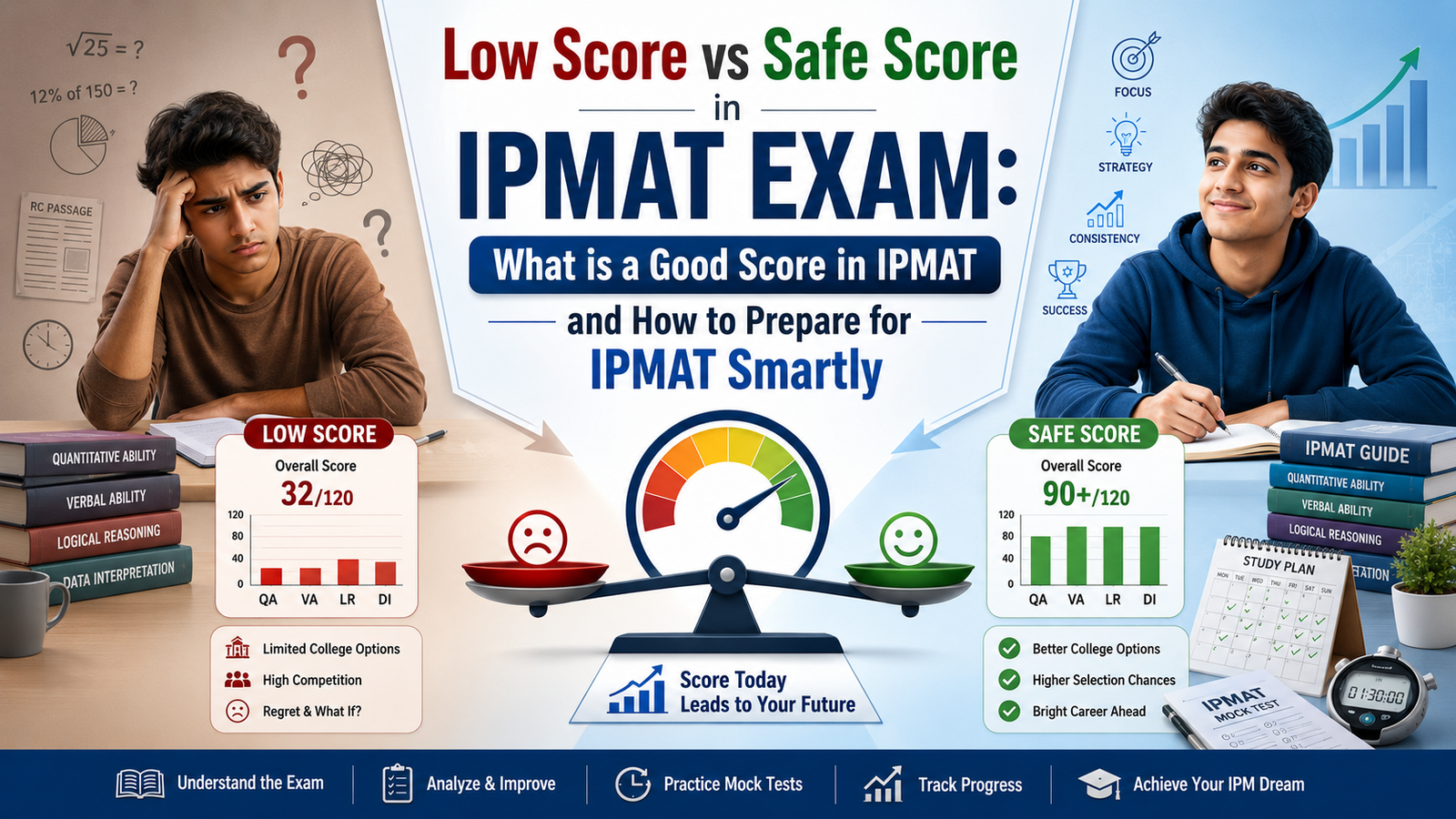
TL;DR
- A low score in the IPMAT exam does not always mean failure, but it may reduce your chances of getting shortlisted for top IIM IPM programmes.
- A safe score is not fixed every year because it depends on exam difficulty, category, sectional cutoffs, number of candidates, and available seats.
- What is a Good Score in IPMAT depends on the institute you are targeting and how well you perform across all required sections.
- Candidates should focus on accuracy, sectional balance, speed, and mock test analysis instead of only chasing a random score target.
- How to prepare for IPMAT becomes easier when students divide preparation into concept building, practice, revision, and exam strategy.
The IPMAT exam is one of the most competitive entrance tests for students who want to join integrated management programmes after Class 12.
Every year, many candidates ask the same question after giving mocks or the actual exam: is my score low, average, good, or safe?
This confusion is natural because IPMAT selection does not depend only on the total score.
A candidate must also clear sectional requirements, perform better than the competition, and meet the shortlisting criteria of the institute.
That is why understanding the difference between a low score and a safe score is important before making admission decisions or planning the next attempt.
What does a low score mean in the IPMAT exam?
A low score in the IPMAT exam usually means that the candidate is below the expected cutoff range for shortlisting.
However, a low score is not the same for every student.
For one candidate, a low score may come from poor performance in Quantitative Ability.
For another candidate, the issue may be Verbal Ability, Logical Reasoning, or poor time management.
A score can also feel low if the paper is easy and many students score high.
But if the paper is difficult, even a moderate raw score may still be competitive.
So, candidates should not judge their performance only by raw marks.
They should look at:
- Overall score
- Section-wise score
- Accuracy level
- Number of attempts
- Difficulty level of the paper
- Category-wise competition
- Previous year trends
- Institute-specific selection process
A low score becomes a serious concern when the candidate misses one or more sectional cutoffs or has very low accuracy.
What is a safe score in IPMAT?
A safe score is a score that gives a candidate a stronger chance of getting shortlisted for the next selection stage.
It is not a guaranteed admission score.
It simply means the candidate is in a comfortable range compared to the expected cutoff.
In IPMAT, safe score expectations change every year because the exam difficulty, number of applicants, and competition level are not always the same.
A safe score should ideally have three qualities.
First, it should be above the expected overall cutoff.
Second, it should be balanced across sections.
Third, it should leave some margin even if the cutoff goes higher than expected.
Many students make the mistake of focusing only on total marks.
But in the IPMAT exam, a candidate with a strong total score may still face problems if one section is weak.
That is why a safe score is not just about scoring high.
It is about scoring smartly across all important sections.
What is a Good Score in IPMAT?
What is a Good Score in IPMAT is one of the most searched questions among aspirants.
A good score is generally a score that keeps a candidate above the expected cutoff and improves the chance of getting shortlisted for further rounds.
But candidates should understand that a good score is different from a safe score.
A good score may help you stay in the competition.
A safe score gives you a stronger cushion.
A very high score may place you among the top candidates.
For IIM Indore, candidates must be strong in Quantitative Ability and Verbal Ability.
For IIM Rohtak, candidates also need to prepare well for Logical Reasoning.
So, a good score depends on the exam pattern of the institute.
Students should also remember that the final selection may include more than the entrance test score.
Some institutes consider interviews, academics, and other admission parameters.
Therefore, a good written test score is important, but it should be supported by good communication skills and a clear understanding of basic academic concepts.
Low score vs safe score: Key differences candidates should know
The main difference between a low score and a safe score is admission possibility.
A low score puts the candidate at risk.
A safe score keeps the candidate in a better position for shortlisting.
A low score usually shows gaps in preparation, poor accuracy, weak concepts, or wrong exam strategy.
A safe score shows that the candidate has managed time well and performed consistently across sections.
Here is how candidates can understand the difference clearly:
- Low score means the candidate may struggle to clear cutoff.
- Safe score means the candidate has a better chance of clearing cutoff.
- Low score often comes from random guessing or weak accuracy.
- Safe score comes from planned attempts and careful question selection.
- Low score may happen when one section is ignored.
- Safe score requires balanced preparation in all sections.
- Low score creates uncertainty after results.
- Safe score gives more confidence during counselling and interview preparation.
The goal should not be to attempt every question.
The goal should be to maximize correct answers.
Why students get a low score in IPMAT
Many candidates get a low score not because they lack potential, but because their preparation is not structured.
Some students start too late.
Some only solve easy questions and avoid difficult areas.
Some focus too much on Quant and ignore Verbal Ability.
Some spend hours studying but do not analyze mocks properly.
A low score can happen due to:
- Weak basics in maths
- Poor reading habit
- Slow calculation speed
- Lack of mock test practice
- Guesswork in negative marking sections
- Poor revision
- Exam pressure
- Not understanding the actual pattern
- No sectional strategy
The IPMAT exam checks aptitude, speed, logic, and decision-making.
So, preparation should not be limited to learning formulas.
Candidates must also learn when to attempt, when to skip, and how to stay calm during the exam.
How to prepare for IPMAT to reach a safe score
How to prepare for IPMAT becomes easier when students follow a practical plan.
The first step is to understand the exam pattern of the target institute.
The second step is to identify strong and weak areas.
The third step is to create a preparation schedule that covers concepts, practice, mocks, and revision.
For Quantitative Ability, students should focus on arithmetic, algebra, number system, geometry, and basic higher maths topics depending on the exam requirement.
For Verbal Ability, students should read regularly and practice grammar, vocabulary, reading comprehension, para jumbles, and sentence correction.
For Logical Reasoning, students targeting exams like IIM Rohtak should practice puzzles, arrangements, coding-decoding, series, blood relations, and statement-based questions.
A good preparation plan should include:
- Daily concept revision
- Topic-wise practice
- Weekly mock tests
- Error analysis after every mock
- Short notes for formulas and grammar rules
- Timed practice sessions
- Previous year paper analysis
- Regular reading practice
Mock tests are extremely important.
But just giving mocks is not enough.
Students should check why they lost marks.
Was it because of a concept gap?
Was it because of silly mistakes?
Was it because of poor time management?
This analysis helps candidates move from low score to safe score.
Smart strategy to improve from low score to safe score
If your mock score is low, do not panic.
A low mock score is a signal, not a final result.
The best way to improve is to divide mistakes into categories.
For example, mark mistakes as concept errors, calculation errors, time pressure errors, and guessing errors.
Then work on each category separately.
Students should first improve accuracy before increasing attempts.
A candidate with fewer correct attempts and high accuracy can often perform better than a candidate who attempts too many questions with poor accuracy.
Also, avoid comparing your score with every topper score online.
Your target should be steady improvement.
Even a small increase in every mock can make a big difference by exam day.
Final thoughts
The difference between a low score and a safe score in the IPMAT exam is not just about marks.
It is about preparation quality, accuracy, sectional balance, and exam temperament.
Candidates should understand that What is a Good Score in IPMAT depends on the exam difficulty, institute, category, and selection process.
Instead of worrying about one fixed number, students should focus on building strong concepts, improving mocks, and learning smart question selection.
GoFillForm helps students stay updated with exam details, application form guidance, important dates, preparation resources, and admission-related updates. Candidates preparing for IPMAT can use GoFillForm to make their exam journey more organized and avoid missing important steps.
FAQs
1. What is considered a low score in IPMAT?
A low score is usually one that falls below the expected cutoff or shows weak performance in one or more sections. It may reduce the chances of getting shortlisted, especially if sectional cutoffs are not cleared.
2. What is a safe score in IPMAT?
A safe score is a score that keeps the candidate comfortably above the expected cutoff range. It should be balanced across sections and not depend only on one strong area.
3. What is a Good Score in IPMAT for top IIMs?
What is a Good Score in IPMAT depends on the institute, paper difficulty, category, and competition level. A good score should be strong enough to clear sectional and overall shortlisting requirements.
4. Can I get shortlisted with an average IPMAT score?
Yes, it may be possible if the paper is difficult, your sectional scores are balanced, and the cutoff remains within range. However, candidates should aim for a safe score instead of depending on borderline chances.
5. How to prepare for IPMAT if my mock scores are low?
How to prepare for IPMAT with low mock scores starts with analyzing mistakes. Focus on weak topics, improve accuracy, revise basics, take timed tests, and avoid random guessing.
6. Is accuracy more important than attempts in IPMAT?
Yes, accuracy is very important because wrong answers can reduce your score in sections with negative marking. Candidates should attempt questions carefully and avoid risky guesses.
7. Should I focus more on Quant or Verbal for IPMAT?
Both sections are important. For some institutes, Logical Reasoning is also required, so candidates should prepare according to the exam pattern of their target institute.
8. Can one weak section affect my IPMAT result?
Yes, one weak section can affect shortlisting if sectional cutoffs are considered. That is why balanced preparation is important for reaching a safe score.
9. How many mocks should I take before IPMAT?
Candidates should take enough mocks to understand the pattern, improve speed, and build exam confidence. The focus should be on mock analysis, not just the number of tests.
10. Is IPMAT difficult to crack?
IPMAT is competitive, but it can be cracked with consistent preparation, strong basics, regular practice, and a clear exam strategy.