

Manufacturing in the UAE is under pressure. The sector contributes over 14% of GDP and the government targets 25% by 2031 through Operation 300bn. Yet most mid-sized factories still run on disconnected systems spreadsheets, legacy ERPs, and manual production tracking that cannot keep pace with growth.
A NetSuite ERP partner for manufacturing gives factories a single, integrated platform to manage production, inventory, procurement, and finance. The right partner accelerates go-live, reduces implementation risk, and configures the system to match how your plant actually operates.
This post explains what a NetSuite manufacturing partner does, what features matter most for UAE factories, how to evaluate partners, and what implementation really costs.
What Does a NetSuite ERP Partner Do for Manufacturers?
A NetSuite ERP partner for manufacturing handles the full implementation cycle: scoping, configuration, data migration, testing, training, and post-go-live support. They map your production workflows BOM structures, work orders, routing, WIP tracking into NetSuite’s manufacturing module so the system reflects your operations from day one.
Manufacturers cannot afford a generic ERP setup. A qualified partner brings industry-specific templates, pre-built configurations for discrete and process manufacturing, and experience with UAE compliance requirements including VAT, excise regulations, and Free Zone reporting.
Configuration vs Customisation
Good partners work within NetSuite’s native functionality as far as possible. Over-customisation creates long-term maintenance costs and complicates upgrades. An experienced partner knows when to configure and when a SuiteApp or third-party integration is the better answer.
Industry Verticals Within Manufacturing
Not all manufacturing is the same. Discrete manufacturers (electronics, automotive parts, furniture) need strong BOM and work order management. Process manufacturers (chemicals, food & beverage, pharmaceuticals) need batch processing, lot traceability, and compliance workflows. The right partner has delivery experience in your specific vertical, not just manufacturing in general.
Ongoing Support and Optimisation
Implementation is the start, not the finish. Production volumes change, product lines expand, and compliance rules update. A good partner stays engaged post-go-live to tune the system, train new staff, and keep your instance current with each NetSuite release.
How Does NetSuite Help Manufacturing Companies in the UAE?
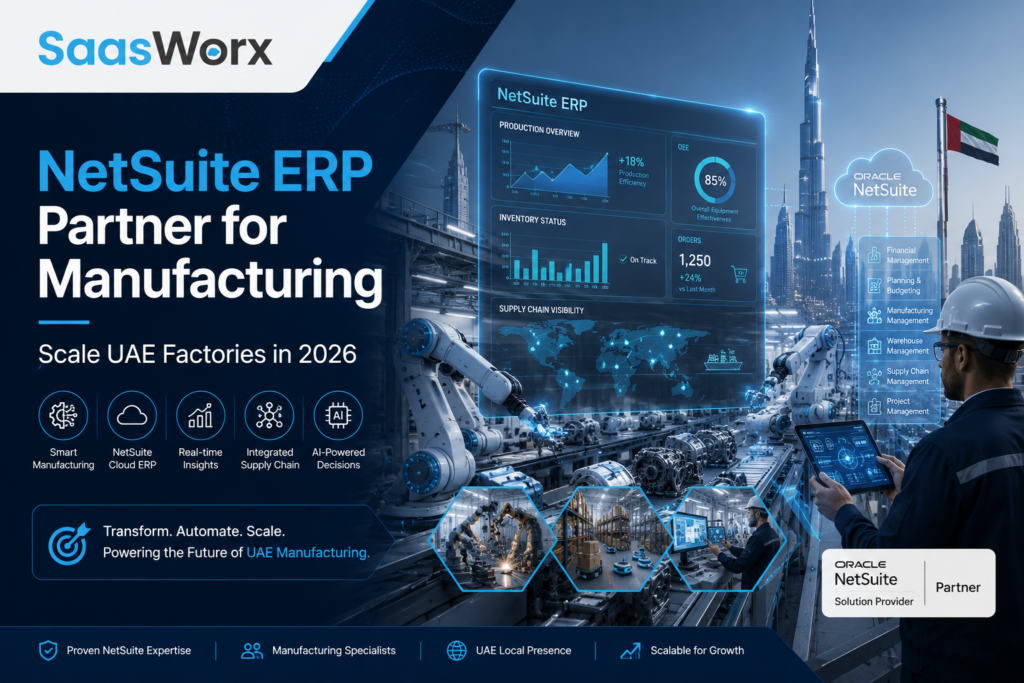
netsuite erp partner for manufacturing
NetSuite helps UAE manufacturers by replacing disconnected tools with one real-time system across production, inventory, procurement, sales, and finance. Factory managers see accurate stock levels, actual production costs, and order status without chasing updates across departments.
The UAE’s manufacturing growth trajectory makes this urgent. Companies scaling from a few SKUs to hundreds, or from local to export markets, quickly outgrow basic accounting software. NetSuite grows with the business rather than requiring a platform change at each growth stage.
Real-Time Production Visibility
NetSuite’s Work Order Management tracks every production job from release to completion. Supervisors see WIP status, labour hours logged, and material consumption in real time. This eliminates the end-of-month reconciliation that delays financial close for most mid-market manufacturers.
Demand Planning and Inventory Control
Excess inventory ties up working capital. Stock-outs stop production lines. NetSuite’s demand planning and MRP engine calculates replenishment needs based on actual sales orders, production schedules, and lead times not manual estimates. UAE manufacturers operating across Free Zones with separate inventory locations benefit from multi-warehouse visibility in a single view.
Multi-Currency and VAT Compliance
UAE manufacturers exporting to GCC, African, or South Asian markets deal with multi-currency transactions, letter-of-credit requirements, and cross-border VAT rules. NetSuite handles multi-currency natively and supports UAE VAT compliance. Manufacturers with Free Zone status can configure specific tax treatment for designated zone transactions without additional customisation.
What Are the Key Features of NetSuite for Manufacturing?
NetSuite covers the full manufacturing operation within a single cloud platform. The core features relevant to UAE factories include work order and routing management, BOM version control, shop floor control, demand planning, quality management, and landed cost tracking.
Bill of Materials and Work Orders
NetSuite supports multi-level BOMs with revision control. Engineers can update component lists without breaking live production orders. Work orders tie directly to sales orders so production is always aligned to actual demand, not forecasts built in separate spreadsheets.
Shop Floor Control and Labour Tracking
Operators log time and materials against work orders directly from the shop floor. This gives management accurate actual-versus-standard cost data by job, product, or period. For factories operating under ISO quality standards, this data trail supports audit requirements without additional documentation.
Demand Planning and MRP
NetSuite’s MRP engine runs material and capacity planning against confirmed and projected demand. It generates purchase orders and work orders automatically when stock falls below reorder points or production plans require specific components. Manufacturers can run planning across multiple facilities and inventory locations in a single run critical for UAE manufacturers with split operations across Free Zones and mainland sites.
According to Gartner, cloud ERP adoption in manufacturing has grown at over 18% annually in the MENA region since 2021, driven by companies moving off legacy on-premise systems.
How Do I Choose the Right NetSuite Partner in the UAE?
Choose a NetSuite partner for manufacturing based on three criteria: certified expertise, manufacturing-specific delivery experience, and UAE market knowledge. A partner who has only implemented NetSuite for services companies will struggle with production routing, WIP accounting, and shop floor integrations.
Certifications and Tier Status
NetSuite partners hold different tier statuses Solution Provider, Star, Five Star based on certifications, customer satisfaction scores, and annual revenue from NetSuite sales. Higher tier partners receive more direct support from Oracle NetSuite’s technical teams, which reduces escalation times during your implementation.
Reference Checks for UAE Manufacturing Clients
Ask every shortlisted partner for three references from UAE or GCC manufacturing clients with similar production complexity to your own. Ask specifically about go-live timelines, budget adherence, and post-implementation support quality. A partner willing to connect you with references is more trustworthy than one who avoids the question.
Fixed-Price vs Time-and-Materials Contracts
Fixed-price implementations protect your budget but require a detailed scope document. Time-and-materials contracts offer flexibility but put cost risk with you. For a first NetSuite implementation, fixed-price is generally lower risk provided the partner has done the scoping work thoroughly before signing. Ask to see the scope document before committing. Thin scopes lead to change orders.
A 2022 Forrester study found that companies selecting ERP partners with deep industry experience reported 31% shorter implementation timelines and 24% lower total cost of ownership versus those choosing general-purpose implementation partners.
Final Thoughts
A qualified NetSuite ERP partner for manufacturing is the difference between a system that fits your operation and one that requires constant workarounds. UAE factories scaling toward Vision 2031 targets need production systems that handle multi-site inventory, real-time WIP, and VAT compliance without bolted-on solutions.
The partner selection decision matters as much as the software decision itself. Industry experience, proven references, and a structured implementation methodology reduce risk more than any software feature list.
As manufacturing in the UAE moves toward higher value-added production aerospace components, pharmaceuticals, advanced electronics the question is not whether to implement an integrated ERP, but how quickly you can get one running without disrupting current production.
